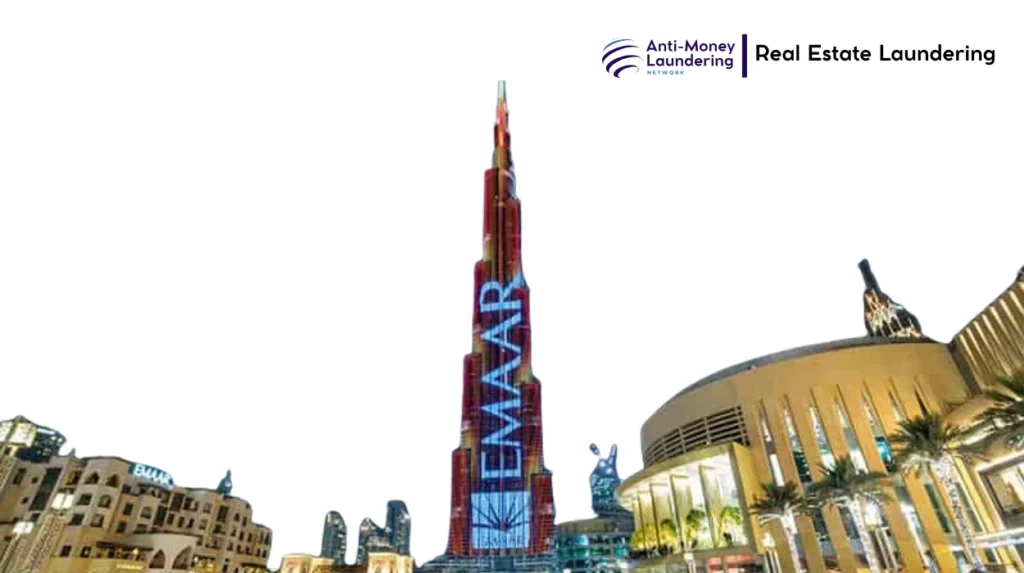
Emaar Properties stands as a cornerstone of the Dubai real estate sector, transforming the UAE property market through iconic master-planned developments. Established in 1997, the company has driven high-value real estate transactions that shaped modern Dubai while raising questions about luxury real estate AML risks and beneficial ownership transparency in UAE.
Project Introduction
Emaar Properties launched in 1997 as a public joint-stock company under the Dubai government, with a vision to create integrated urban communities that blend residential, commercial, and leisure spaces. Mohamed Alabbar, the Emaar property owner and founder, spearheaded this initiative amid Dubai’s push for economic diversification beyond oil, drawing on his experience in government roles to attract foreign investment into ambitious projects.
The company’s early focus centered on flagship developments like Dubai Marina, launched in 2000, which became the region’s largest man-made marina spanning 3.5 square kilometers. By 2003, Emaar unveiled plans for Downtown Dubai, encompassing the Burj Khalifa—the world’s tallest structure at 828 meters—and The Dubai Mall, the largest shopping center globally with over 1,200 outlets.
These projects established Emaar as a master community builder, prioritizing sustainable ecosystems with housing, schools, healthcare, and retail.
Management and Project Head
Mohamed Alabbar serves as the Emaar property CEO and chairman, guiding the company’s strategy since inception. His background includes leading Dubai’s Department of Economic Development, where he fostered public-private partnerships that informed Emaar’s model of government-backed innovation.
Alabbar’s previous ventures, such as early commercial complexes, built his reputation for financial links with sovereign entities like the Investment Corporation of Dubai, which holds about 29% ownership.
The board features seasoned executives from real estate and finance, including members with ties to Dubai Holding. Key decision-makers oversee Emaar’s subsidiaries, managing over 60 projects across 14,000 buildings at various stages. Their track record includes award-winning communities like Arabian Ranches and The Meadows, though scrutiny has grown around Emaar Properties risk assessment in high-risk sectors amid evolving real estate AML regulations.
Controversies and Scandals
Emaar Properties has faced allegations tied to suspicious real estate deals, particularly in luxury properties attracting illicit funds. Investigative reports highlight Emirates Hills, an Emaar development dubbed the “Beverly Hills of Dubai,” as a hub for politically exposed persons (PEPs) from Africa and the Middle East. Leaked data revealed units owned by figures like former Nigerian oil minister Dan Etete, linked to the $1.1 billion OPL 245 scandal, and entities connected to Pakistan’s Zardari family.
In India, India’s Enforcement Directorate attached Emaar-MGF properties worth Rs 834 crore (about $100 million) in 2024 over money laundering probes involving land deals, signaling concerns over Emaar property acquisition practices. Reports of black money involvement surfaced through patterns of rapid resales in Downtown Dubai, where high-value real estate transactions often bypassed robust client verification during the UAE’s pre-2010 regulatory gaps.
Money Laundering Activities
Money laundering through property has spotlighted Emaar’s portfolio due to real estate financial crime risks in the UAE property market compliance landscape. Tactics include layering via shell companies, with BVI and Seychelles entities registering as Emaar property owners to obscure beneficial ownership transparency UAE standards demand today but struggled to enforce historically.
Transaction patterns show cash-heavy purchases during Dubai’s 2003-2008 boom, when developers like Emaar faced limited AML compliance mandates. Offshore wealth and Dubai property inflows from sanctioned Russians post-2022 and PEP networks fueled suspicions, with Emirates Hills villas valued up to $52 million serving as asset concealment vehicles. Emaar Properties source of funds scrutiny remains critical, as real estate professionals in Dubai must now conduct enhanced due diligence under post-FATF reforms.
PEP involvement in real estate persists, with cross-border property investments UAE attracting kleptocrats exploiting luxury overvaluation—properties trading far above construction costs to park illicit capital. Emaar Properties layering, a key money laundering stage, allegedly occurred via intra-group transfers among SPVs, complicating traceability.
International Links and Benefited Countries
Emaar’s expansion since 2004 via Emaar International LLC has spanned India, Pakistan, Egypt, Saudi Arabia, and North America, channeling cross-border investments into mixed-use projects. In India, joint ventures like Emaar-MGF developed townships but drew regulatory heat; Egypt saw urban expansions benefiting local economies through job creation, though tied to Gulf capital flows.
Pakistan’s market absorbed Emaar communities, inadvertently hosting PEP assets flagged by the National Accountability Bureau. North American and European ventures, including hospitality assets, have integrated UAE funds globally, with offshore accounts facilitating entry. Countries like India and Pakistan indirectly benefited from infrastructure but faced distorted local markets due to foreign dominance.
Regulatory Actions and Legal Proceedings
UAE authorities imposed real estate AML regulations post-FATF greylisting in 2022, mandating Emaar Properties AML compliance through KYC, PEP screening, and suspicious activity reporting. Dubai Land Department and RERA now require beneficial ownership registers, though enforcement in luxury segments lags, per 2025 legal analyses.
Internationally, India’s Enforcement Directorate pursued Emaar-linked assets in 2024, while Pakistan’s NAB sought freezes on Emirates Hills properties owned by Ishaq Dar. No direct fines hit Emaar UAE, but FATF scrutiny elevated UAE property market compliance, delisting the nation in 2024 after reforms. Pending probes in India highlight ongoing Emaar Properties suspicious real estate deal exposure.
Public Impact and Market Reaction
High-value real estate transactions in Emaar projects inflated Dubai prices, with Downtown Dubai apartments yielding 6-8% returns but eroding affordability for locals amid foreign inflows. Illicit funds in luxury properties strained market trust, prompting 2025 EU delisting of UAE from high-risk lists yet sustaining investor caution.
Public reaction mixed investor enthusiasm—Emaar stock rose post-2023 dividends of AED 8.8 billion—with wariness over real estate high-risk sector status. Economic effects included tourism boosts from Dubai Mall (120 million visitors yearly) but widened inequality, as luxury enclaves like Emirates Hills isolated wealth from broader UAE society.
Emaar thrives operationally, reporting Q3 2025 sales strength and 141 million sq ft land acquisitions worth AED 96 billion. Projects like Dubai Creek Harbour and Zabeel Square advance, with joint ventures emphasizing sustainability via AI traffic systems and green spaces.
Experts predict sustained growth if Emaar bolsters client verification and risk assessment amid luxury real estate AML risks. Future outlook hinges on transparent source of funds checks and navigating geopolitical shifts, positioning Emaar as a resilient force in Dubai’s evolution while addressing persistent beneficial ownership transparency UAE challenges.