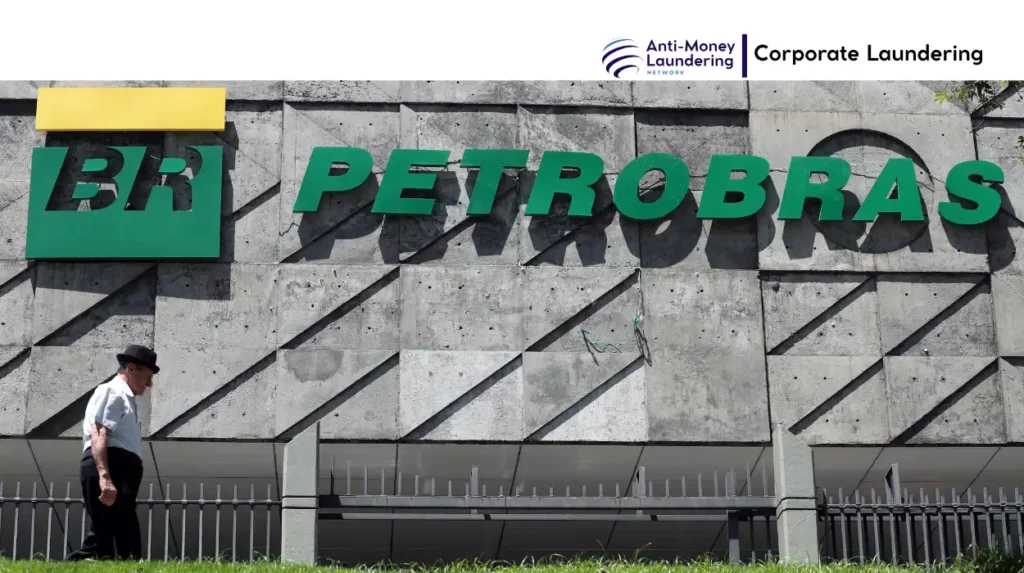
Petrobras S.A., Brazil’s state-controlled oil giant, became synonymous with one of the largest corporate laundering scandals in history through its central role in Operation Lava Jato. This Petrobras corruption scandal involved systematic bribery and kickback schemes that funneled billions in illicit funds through inflated contracts, exposing vulnerabilities in Brazil state-owned enterprises.
The case stands as a landmark in the global Anti–Money Laundering (AML) landscape, illustrating how politically exposed persons (PEPs) within Petrobras S.A. exploited public procurement for money laundering in Brazil. Its significance lies in triggering international probes, massive fines exceeding $2.6 billion, and reforms that reshaped compliance standards in energy sectors worldwide, serving as a cautionary tale for financial institutions handling high-volume transactions from state-owned entities.
Background and Context
Founded in 1953 as a state monopoly under President Getúlio Vargas, Petrobras S.A. rapidly evolved into a global energy powerhouse, pioneering deep-water oil exploration and dominating Brazil’s refining and distribution markets. By the early 2000s, under successive Workers’ Party (PT) administrations, the company reported annual revenues surpassing $100 billion, fueled by massive pre-salt oil field discoveries that positioned it as Latin America’s largest corporation.
The Brazilian government maintained controlling interest with over 50% of voting shares, blending public oversight with private investment via listings on the B3 exchange (PETR3/PETR4), NYSE (PBR ADRs), and others.
This financial structure, while enabling growth, sowed seeds for misconduct. Political appointees filled executive roles from 2003 onward, prioritizing party loyalty over merit. Suspicious financial activities simmered undetected until 2014, when a routine money laundering probe at a Brasília car wash—hence “Lava Jato”—uncovered Petrobras S.A. suspicious transactions linked to black-market currency dealers, or “doleiros.”
These leads unraveled a decade-long graft network spanning 2004-2014, implicating executives, contractors, and politicians in a web of Petrobras S.A. linked transactions that bypassed basic customer due diligence (CDD) protocols. The scandal’s exposure marked a pivotal shift, highlighting public sector corruption risks inherent in hybrid public-private models.
Mechanisms and Laundering Channels
At the heart of Petrobras S.A. fraud lay sophisticated trade-based laundering tactics, where senior executives colluded with a cartel of 13 major construction firms, led by Odebrecht, to rig public bids and inflate infrastructure contracts by 1-5%.
This generated kickbacks estimated at $2-5 billion, funneled through layered channels including Petrobras S.A. shell companies disguised as legitimate suppliers and electronic funds transfer (EFT) routes to offshore accounts in Switzerland, the Cayman Islands, and Miami. Overinvoicing was rampant: a $100 million rig contract might be padded to $105 million, with the excess remitted as “commissions” or consulting fees to nominees.
Petrobras S.A. offshore entities played a critical role in hybrid money laundering, blending corporate bribery cases with political financing. Funds were structured into smaller tranches to evade Petrobras S.A. structuring thresholds, often routed via doleiros who converted reais to dollars through parallel markets. While Petrobras S.A. itself was not a shell company, its subsidiaries and joint ventures with cartel members facilitated shell layering, obscuring beneficial ownership trails. Intermediaries issued fake invoices for non-existent services, enabling Petrobras S.A. beneficial owner proxies—often PT affiliates—to access clean funds.
This ecosystem exploited gaps in Know Your Customer (KYC) and name screening, as procurement teams ignored red flags like repeated sole-source awards to high-risk vendors. Cash-intensive business elements emerged in bribe handoffs, though digital trails dominated via EFTs, underscoring the evolution of money laundering in Brazil toward tech-enabled complexity.
Regulatory and Legal Response
Operation Lava Jato, spearheaded by federal police and Judge Sérgio Moro, produced over 200 convictions by 2021, targeting Petrobras S.A. politically exposed persons (PEPs) such as former Supply Director Paulo Roberto Costa and Services Director Renato Duque, who confessed to receiving tens of millions in bribes. Plea bargains from 77 executives revealed the cartel’s inner workings, leading to asset seizures worth $700 million recovered by Petrobras S.A.
Internationally, U.S. regulators applied the Foreign Corrupt Practices Act (FCPA), culminating in Petrobras S.A.’s $1.78 billion settlement in September 2018 with the DOJ and SEC, including a three-year monitorship, followed by an additional $853 million penalty in February 2025. Brazilian Law 9,613/1998 on money laundering underpinned domestic charges, with prosecutors invoking FATF recommendations on beneficial ownership and politically exposed persons (PEPs).
Swiss authorities fined banks like HSBC and UBS over $260 million for processing Petrobras S.A. flows without adequate CDD. These actions exposed compliance lapses, such as absent transaction monitoring for high-value procurement, enforcing stricter Petrobras S.A. name screening mandates. Odebrecht’s parallel $3.5 billion global settlement amplified the probe’s reach.
Financial Transparency and Global Accountability
The scandal laid bare corporate governance failures in Petrobras S.A., where state-dominated beneficial ownership obscured accountability, allowing unchecked approvals of suspicious transactions. Financial transparency eroded as executives bypassed internal audits, submitting unverified invoices that violated public sector corruption risks disclosures required under Brazil’s Lei das Estatais. Investors and banks failed to probe Petrobras S.A. beneficial owner structures, assuming state backing equated to low risk.
Global regulators responded decisively: the DOJ’s FCPA enforcement spurred Mutual Legal Assistance Treaties (MLATs) for evidence sharing, while the SEC mandated enhanced Segment Reporting for foreign issuers. Watchdogs like Transparency International and the World Bank cited AML lessons from Petrobras, advocating FATF updates for state-owned enterprises (SOEs), including real-time beneficial ownership registries.
Financial institutions worldwide adopted Petrobras-specific red flags for trade-based laundering, such as invoice-to-contract variances exceeding 3%, bolstering cross-border Anti–Money Laundering (AML) cooperation. This case underscored the need for integrated KYC platforms scanning PEP networks in emerging markets.
Economic and Reputational Impact
Petrobras S.A. suffered catastrophic losses: its market capitalization evaporated $250 billion by mid-2015, with $17 billion in direct graft damages triggering Petrobras S.A. forced liquidation of $20 billion in assets, including refineries and fields, to avert bankruptcy. Shares (PETR4) plummeted 90% from peaks, prompting temporary NYSE delisting threats and credit rating downgrades to junk status.
Reputational fallout severed partnerships—Odebrecht faced global blacklisting—and eroded stakeholder trust, with lawsuits from pension funds claiming $1 billion. Brazil’s GDP contracted 3.8% in 2015 amid recession, as Lava Jato implicated politicians, leading to President Dilma Rousseff’s impeachment and Lula da Silva’s imprisonment. Internationally, it deterred FDI in Latin American energy, raising premiums on sovereign bonds and highlighting international corruption investigations’ macroeconomic toll on corporate governance.
Recovery took years, with Petrobras S.A. posting record 2023 profits only after divestitures.
Governance and Compliance Lessons
Corporate governance failures at Petrobras S.A. stemmed from politicized boards that sidelined internal controls, approving rigged deals sans robust CDD or KYC on vendors. Procurement lacked segregation of duties, enabling executives to self-certify multimillion-dollar awards, fostering Petrobras S.A. money laundering. Audit committees, stacked with government nominees, overlooked variances in contract executions exceeding 10%.
Post-exposure reforms were sweeping: Petrobras S.A. implemented AI-powered transaction monitoring, independent compliance officers, and a whistleblower hotline that identified $3 billion in recoveries. Mandatory beneficial ownership disclosures for suppliers aligned with FATF PEP guidelines, while board diversity rules curbed political interference.
Regulators imposed annual AML attestations, drawing AML lessons from Petrobras on decoupling procurement from political influence. These elevated Know Your Customer (KYC) standards now screen for cartel-like bidding patterns, preventing recurrence in cash-intensive business operations.
Legacy and Industry Implications
Petrobras S.A.’s case catalyzed AML enforcement globally, extending Lava Jato’s model to Odebrecht probes in Peru, Mexico, and Panama, convicting dozens of regional leaders. It pioneered corporate ethics benchmarks in energy, with Brazil’s Clean Company Act (2013) strengthened post-scandal for leniency in self-reporting. International corruption investigations gained tools like joint task forces, influencing OECD Anti-Bribery Convention updates.
As a turning point, it standardized trade-based laundering detection in ISO 20022 EFT messaging, mandating anomaly flags for overinvoicing. Peers like Venezuela’s PDVSA and Mexico’s Pemex adopted Petrobras-style governance, integrating blockchain for supplier transparency to combat money laundering in Brazil. The scandal’s legacy endures in compliance training, emphasizing hybrid money laundering risks in SOEs.
Petrobras S.A.’s Petrobras corruption scandal exemplifies how bribery and kickback schemes can erode financial transparency in Brazil state-owned enterprises, inflicting billions in losses and destabilizing governments. Core findings reveal systemic gaps in CDD, PEP monitoring, and governance segregation, now addressed through tech-driven reforms.
Vigilant accountability, robust beneficial ownership disclosure, and fortified AML frameworks remain essential to shield global finance from public sector corruption risks, ensuring scandals like Petrobras S.A. do not recur.