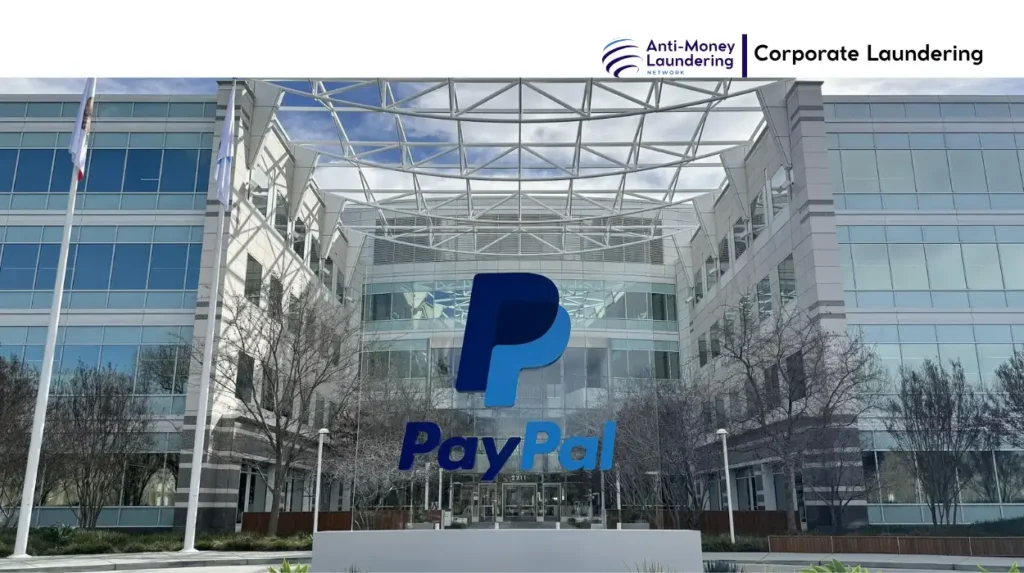
PayPal Holdings Inc. is a Delaware‑incorporated, publicly traded FinTech company that operates one of the world’s largest digital‑payment ecosystems. Its business model combines online payment processing, digital wallets, peer‑to‑peer transfers, and merchant‑processing services across more than 200 markets, making it a systemic node in global electronic funds transfer flows.
Despite its reputation as a regulated, technology‑driven platform, PayPal Holdings Inc. AML violations have periodically surfaced, including sanctions‑screening failures, anti‑money laundering‑related fines, and regulatory investigations into its Know Your Customer and transaction‑monitoring practices.
These episodes do not depict PayPal Holdings Inc. as a classic shell company or offshore entity used for organized laundering, but they expose how a large, seemingly compliant payment processor can become a medium‑risk channel for hybrid money laundering and sanctions‑evasion flows if controls lapse.
The PayPal Holdings Inc. sanctions 2015 case and subsequent enforcement actions are significant in the global Anti–Money Laundering landscape because they illustrate how even a sophisticated, U.S.‑based platform can fail to prevent linked transactions to sanctions‑listed entities, while also generating suspicious transactions that go under‑reported in high‑volume, cross‑border corridors.
Background and context: PayPal Holdings Inc. history and growth
PayPal Holdings Inc. history begins with its origins as an online payments service spun out of eBay in 2015. PayPal Holdings Inc. headquarters was established in San Jose, California, with the parent incorporated in Delaware and the main operating subsidiary, PayPal, Inc., serving as the U.S.‑based processor.
After the spinoff, PayPal Holdings Inc. stock began trading on NASDAQ under the ticker PYPL, reinforcing its status as a systemically important payment processor. PayPal Holdings Inc. founder‑era roots trace back to the late 1990s PayPal.com, but the modern corporate entity is less associated with a single charismatic founder and more with institutionalized corporate governance, including a board accountable to shareholders and regulators.
The PayPal Holdings Inc. CEO at the time of the 2015 enforcement action was Dan Schulman, who oversaw the company’s post‑eBay strategy of global expansion, vertical integration, including PayPal Holdings Inc. Venmo, PayPal Holdings Inc. Braintree, and PayPal Holdings Inc. Xoom acquisitions, and layered product offerings.
PayPal Holdings Inc. business model relies on several pillars, including consumer payments and digital wallets which encompass individual accounts and peer‑to‑peer transfers, merchant‑acquiring and gateway processing for e‑commerce, venture and value‑added services such as credit‑like products and BNPL‑style features, and cross‑border remittance and international funds transfer instructions via subsidiaries such as PayPal Holdings Inc. Xoom.
As PayPal Holdings Inc. global expansion accelerated, the company’s revenue and market cap grew sharply, entrenching its role in everyday electronic funds transfer and positioning it as a de‑facto intermediary in many cross‑border consumer‑finance flows. Yet, alongside that scale came pressure on its customer due diligence and name screening systems, particularly in high‑volume, low‑value corridors where structuring or layering could go undetected.
Mechanisms and laundering‑related channels in PayPal’s operations
PayPal is not a shell company or offshore entity constructed to hide beneficial ownership; instead, its money laundering‑related risks stem from operational and design weaknesses in screening, monitoring, and reporting. The core of PayPal Holdings Inc. sanctions 2015 relates to PayPal Inc.’s handling of linked transactions involving persons on the List of Specially Designated Nationals and Blocked Persons.
OFAC found that between 2002 and 2007, PayPal processed 486 transactions totaling about 43,934 dollars in value for individuals or entities covered by U.S. sanctions on Iran, Cuba, Sudan, and global terrorism programs. Technically, PayPal’s automated interdiction filter at times flagged potential matches to the SDN List, but risk operations agents dismissed alerts without obtaining or reviewing documentation that could confirm identities.
In other cases, the filter did not catch matches at all, allowing linked transactions to settle that gave economic benefit to sanctioned parties. This pattern exposed a gap in PayPal Holdings Inc. name screening and real‑time transaction monitoring, turning otherwise small‑value flows into money laundering‑adjacent conduits by breaching sanctions‑evasion rules.
Beyond sanctions, PayPal Holdings Inc. AML violations have surfaced in other jurisdictions. In India, PayPal’s local entity was fined approximately ₹9.6 million, about 106,000 dollars, by the Financial Intelligence Unit of India for violations of the Prevention of Money Laundering Act, including failure to report suspicious transactions and willful non‑compliance with reporting‑entity obligations.
The FIU characterized PayPal’s conduct as having abetted the disintegration of India’s financial‑monitoring framework by not registering properly or disclosing suspicious activity. Such cases highlight how PayPal Holdings Inc. suspicious transaction‑reporting obligations can falter in fragmented regulatory environments, especially where cross‑border electronic funds transfer and local payment‑gateway rules do not fully align.
The high‑volume, low‑value nature of many PayPal Holdings Inc. services and PayPal Holdings Inc. Venmo‑style peer‑to‑peer transactions also creates a natural environment for structuring and layering, if customer due diligence and limits are not calibrated tightly.
Although PayPal Holdings Inc. shell company structures are not documented, some third‑party actors have used PayPal‑linked accounts as virtual cash‑boxes in cash‑intensive business‑style schemes or hybrid money laundering scenarios. Small‑value merchants or freelancers, for example, may bundle numerous micro‑payments through PayPal Holdings Inc. Braintree or PayPal Holdings Inc. Xoom, obscuring the source and layering funds before converting them into bank‑linked balances.
However, no major trade‑based laundering or invoice fraud framework has been directly tied to PayPal’s core corporate structure, instead, risk arises at the user‑level where weak KYC or lax linked transactions controls can be exploited.
Regulatory and legal response: PayPal’s compliance failures under scrutiny
Regulators have repeatedly challenged PayPal Holdings Inc. on customer due diligence, KYC failures, and sanctions‑screening gaps, framing these lapses as anti‑money laundering and sanctions‑evasion concerns. The PayPal Holdings Inc. OFAC settlement in 2015 remains a landmark enforcement action. OFAC ordered PayPal, Inc. to pay 7,658,300 dollars for the 486 sanctionable transactions, noting that the company failed to implement adequate screening technology and procedures to identify sanctions‑target involvement in processed payments.
Although the total value of the transactions was relatively small, OFAC assessed an apparent penalty of over 17 million dollars before settling, underscoring the aggravating nature of repeated failures in name screening and risk‑operations conduct.
In 2017, the U.S. Department of Justice issued subpoenas to PayPal Holdings Inc. regarding its anti‑money laundering program, signaling that U.S. authorities viewed its AML‑compliance posture as a matter of systemic risk rather than an isolated slip.
The company disclosed these money laundering‑related and sanctions‑related investigative probes in its SEC filings without admitting guilt, but the episode reinforced the need for strong KYC and transaction‑monitoring controls in a global payments platform. In 2020, India’s Financial Intelligence Unit imposed a 9.6‑million‑rupee penalty on PayPal Payments Private Limited, a local entity, for non‑compliance with the PMLA, including failure to register as a reporting entity and refusal to acknowledge reporting obligations.
The order emphasized that PayPal had willfully violated AML‑related obligations, not merely made technical errors, and required it to appoint a principal officer and beneficial‑ownership‑reporting officer to align with FATF‑inspired AML‑standards.
In 2023, PayPal Australia Pty Ltd entered into an enforceable undertaking with AUSTRAC, Australia’s AML‑CTF regulator, after external audits detected weaknesses in how it handled international funds transfer instructions. Over a two‑year remediation plan, PayPal upgraded its systems and controls, with AUSTRAC later canceling the enforceable undertaking once the regulator deemed improvements sufficient.
All of these cases converge on FATF‑aligned expectations about beneficial ownership, KYC, linked transactions, and suspicious transaction reporting, reinforcing that PayPal Holdings Inc. fraud‑related risk is not just about deliberate malfeasance but about systemic control gaps in high‑velocity payment flows.
Financial transparency and global accountability lessons
PayPal Holdings Inc. financial statements show steady revenue and rising market cap, with relatively minor direct penalties on earnings compared with the broader reputational and regulatory costs. Nevertheless, the cumulative effect of AML‑related fines, investigations, and enforceable undertakings has prompted sharper focus on financial transparency and global accountability.
The Indian and Australian cases, in particular, exposed how PayPal Holdings Inc. CEO and governance teams must navigate divergent AML‑regimes while still adhering to FATF Recommendations on beneficial ownership disclosure and suspicious transaction reporting.
Cross‑border data‑sharing obstacles and jurisdictional disputes over whether PayPal constitutes a financial institution or merely a payment intermediary have also highlighted the need for harmonized definitions and common reporting standards.
For AML practitioners, the PayPal‑related cases underscore the importance of end‑to‑end transaction monitoring instead of relying solely on name screening, real‑time AML‑risk scoring for cross‑border corridors used by PayPal Holdings Inc. Xoom and similar units, and clear liability assignment for linked transactions that cross sanctions‑designated jurisdictions.
These lessons apply not only to large platforms but also to smaller PSPs and neobanks that may copy PayPal‑style risk‑controls without fully accounting for jurisdictional complexity.
Economic and reputational impact
PayPal Holdings Inc. revenue and stock performance have not collapsed following enforcement actions, but the PayPal Holdings Inc. cybersecurity fine and AML‑related probes have affected perceptions of its risk posture. Temporary stock dips accompanied regulatory‑disclosure news, illustrating how AML‑related uncertainty erodes investor confidence even when direct financial penalties are modest.
Beyond markets, PayPal Holdings Inc. global expansion has required the company to recalibrate its corporate governance and compliance architecture across regions, particularly in China compliance‑related discussions where U.S. committees have requested enhanced due diligence on partnerships with Chinese‑linked payment providers. Such pressures have forced PayPal to treat its entire platform as a unified AML‑and‑sanctions‑risk domain, rather than allowing individual subsidiaries to operate in fragmented regulatory islands.
Governance and compliance lessons
PayPal Holdings Inc. has responded to these episodes by upgrading sanctions‑screening technology and risk‑operations workflows post‑2015, investing in AML‑remediation plans in jurisdictions such as Australia and India, and aligning with FATF‑style regimes on beneficial ownership and suspicious‑transaction reporting obligations.
However, gaps in KYC and customer due diligence, especially in high‑volume, low‑value channels, illustrate that money laundering‑risk cannot be fully automated. It requires ongoing human‑supervised review and risk‑based segmentation of linked transactions, where patterns of structuring, unusual balances, or sudden cross‑border spikes flag high‑risk behavior.
For compliance teams, PayPal’s experience shows that KYC failures and name‑screening deficiencies in high‑velocity payment networks can create systemic laundering‑adjacent channels, even when the parent entity is not a shell company or offshore entity.
The key lesson is that financial transparency and beneficial ownership visibility must be maintained across all user tiers, including freelancers, gig‑economy actors, and small merchants who rely on PayPal Holdings Inc. services and Venmo‑style features.
Strengthening suspicious‑transaction reporting and investing in advanced analytics for peer‑to‑peer flows will be essential to prevent PayPal Holdings Inc. Structuring and hybrid money laundering from exploiting electronic funds transfer networks.
Legacy and industry implications
PayPal Holdings Inc. has become a reference case for regulators and compliance teams, demonstrating how hybrid money laundering can exploit high‑velocity, low‑value electronic funds transfer networks if KYC failures and name screening weaknesses persist.
The case also reinforces that shell company‑style layering is not the only channel for laundering; legitimate, regulated platforms can become corporate laundering‑adjacent where monitoring and transparency are lax. As regulators push for more granular data on beneficial ownership, suspicious transactions, and linked transactions, PayPal’s experience will likely inform stricter expectations for all payment service providers operating in cross‑border corridors.
The continued emphasis on financial transparency, corporate governance, and customer due diligence will shape how future AML frameworks treat high‑volume digital payment ecosystems, ensuring that PayPal Holdings Inc. innovations and acquisitions serve economic efficiency without undermining the integrity of global finance.
PayPal Holdings Inc. exemplifies the tension between innovation‑driven global expansion and robust anti‑money laundering governance. Its PayPal Holdings Inc. AML violations, sanctions‑related failures, and regulatory engagements show that even a large, systemically important platform is not immune to money laundering‑related risk.
The case underscores the importance of building resilient compliance architectures that address linked transactions, suspicious transaction reporting, and beneficial ownership transparency across every jurisdiction where PayPal Holdings Inc. operates.
Going forward, financial transparency, clear beneficial ownership disclosure, and continuous strengthening of KYC and suspicious‑transaction‑monitoring frameworks remain critical to preventing PayPal Holdings Inc. fraud, structuring, and other forms of hybrid money laundering in the global payments ecosystem.