

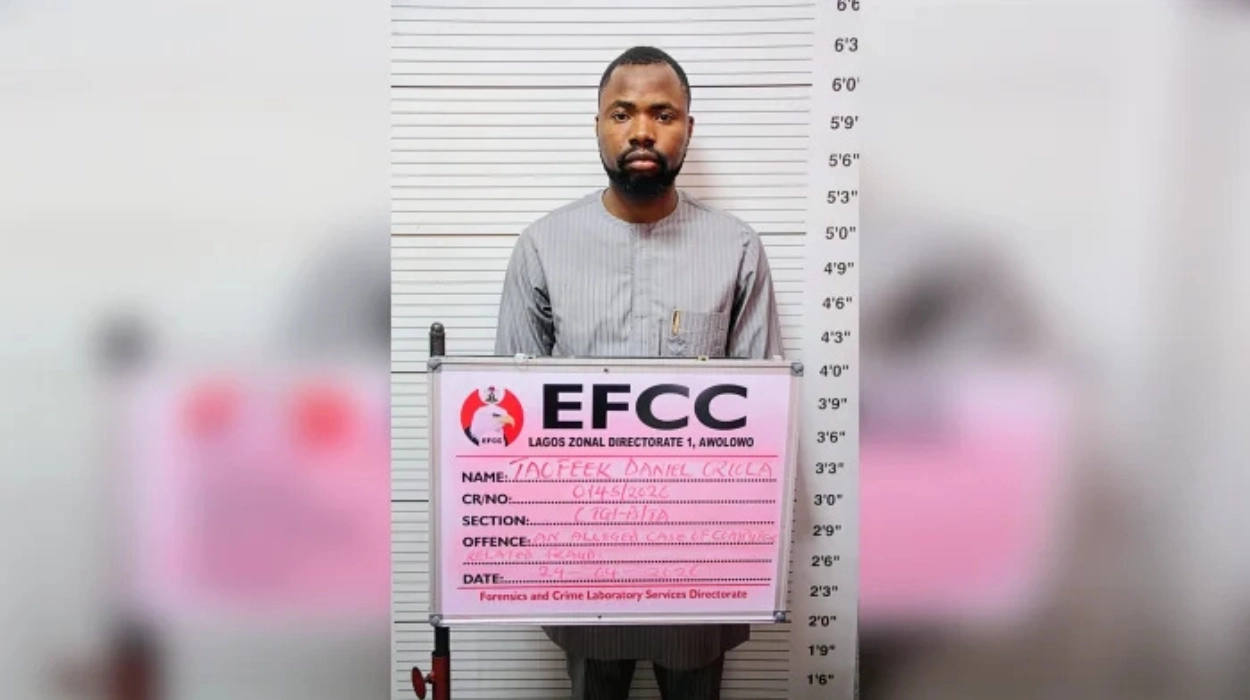
Lagos, Nigeria – In a significant crackdown on financial crimes, Justice Daniel Osiagor of the Federal High Court in Ikoyi, Lagos, convicted and sentenced Taofeek Daniel Oriola to nine years imprisonment on May 11, 2026, for cryptocurrency-linked money laundering.
The Economic and Financial Crimes Commission (EFCC) prosecuted Oriola on three counts involving money laundering and concealment of illicit proceeds, underscoring Nigeria’s intensifying efforts against crypto-related fraud.
Case Details and Charges
Oriola faced charges under the Money Laundering (Prevention and Prohibition) Act, 2022, for disguising the origins of assets acquired through fraudulent cryptocurrency transactions.
The EFCC alleged that the convict concealed the source of a 2014 Range Rover Supercharged and a five-bedroom apartment with boys’ quarters in Ibeju-Agbe, Ibeju-Lekki, Lagos State, as proceeds of unlawful activities.
One specific count read: Oriola “knowingly disguised the true source” of these luxury items, violating Section 19 of the Act.
Oriola pleaded guilty when the charges were read in court, prompting prosecution counsel H.U. Kofarnaiza to present case facts and exhibits, all admitted by the judge.
Court Verdict and Penalties
Justice Osiagor delivered the judgment on Monday, May 11, 2026, imposing three years imprisonment per count, running concurrently, totaling nine years.
The convict received an option of ₦200,000 fine per count and was ordered to perform seven days of community service.
All recovered assets were forfeited to the Federal Government: the Range Rover, five-bedroom apartment, a 653.479 square metre land parcel in Ibeju-Lekki, and an iPhone 16.
This sentencing reflects the court’s commitment to deterring financial crimes amid rising cryptocurrency misuse in Nigeria.
EFCC’s Investigation and Prosecution
The EFCC’s Lagos Zonal Directorate 1 led the probe, linking Oriola’s assets to fraudulent crypto schemes that exploit digital anonymity for laundering.
Prosecutors highlighted how perpetrators use crypto platforms to obscure illicit funds, converting them into real estate and vehicles.
EFCC Chairman Ola Olukoyede has repeatedly warned of crypto’s role in laundering, citing over $40 billion in illicit global crypto flows in 2024 alone.
In Nigeria, Chainalysis data shows massive crypto volumes, with ₦162 billion laundered via banks and fintechs lacking due diligence last year.
Broader Context of Crypto Money Laundering in Nigeria
Cryptocurrency-linked money laundering has surged in Nigeria, fueled by high adoption and fraud syndicates.
EFCC reports criminal networks laundered or stole $160 billion globally via crypto in 2025, with Nigeria as a hotspot due to youth involvement in scams.
Recent cases include nine Chinese nationals jailed for crypto investment fraud in 2025 and two directors sentenced to 46 years for multi-billion naira schemes.
The Binance saga, involving $35 million laundering allegations, spotlighted regulatory gaps, though some charges were dropped on diplomatic grounds.
EFCC arrested suspects in operations like “Eagle Flush,” targeting romance and investment scams using crypto wallets.
Implications for Cryptocurrency Regulation
This verdict reinforces Nigeria’s regulatory push under the 2022 Money Laundering Act and SEC guidelines for virtual assets.
Authorities now mandate KYC/AML compliance for crypto exchanges, with fines for non-adherence.
Experts note blockchain tracing tools aid EFCC in freezing wallets, but offshore transfers challenge enforcement.
The case signals to investors: unchecked crypto gains risk seizure if tied to crime.
Expert Reactions and Statements
EFCC spokesperson Dele Oyewale confirmed the conviction via X, stating it “sends a strong message to crypto fraudsters.”
Legal analyst Chijioke Okoro said: “Concurrent sentences with asset forfeiture strip criminals of ill-gotten gains, promoting deterrence.”
Crypto compliance firm rep noted: “Nine years underscores judicial intolerance for laundering via digital assets.”
No statement from Oriola or defense was available post-judgment.
Rising Trends in Crypto Fraud
Nigeria leads Africa in crypto transactions, over $56 billion from 2022-2023, per EFCC, but this enables fraud.
Politicians and fraudsters use wallets for shady payments, evading traditional banking oversight.
EFCC trains on blockchain forensics, partnering internationally to track cross-border flows.
Victims, over 900,000 Nigerians and foreigners, lost billions to schemes converted to crypto then property.
Government and EFCC Strategies
Under President Bola Tinubu, EFCC intensified ops, securing hundreds of convictions yearly.
New measures include fintech audits and virtual asset provider licensing.
Chairman Olukoyede at UN summit urged global cooperation against $160 billion crypto crime wave.
Community service mandates, like Oriola’s seven days, add restorative justice.
Future Outlook
This Lagos ruling may spur more probes into luxury assets funded by crypto scams.
With May 2026 date aligning current enforcement, expect stricter CBN rules on crypto-fiat ramps.
Stakeholders call for public education on scam red flags and secure platforms.
The nine-year term positions Nigeria as tough on crypto laundering, boosting investor confidence.