

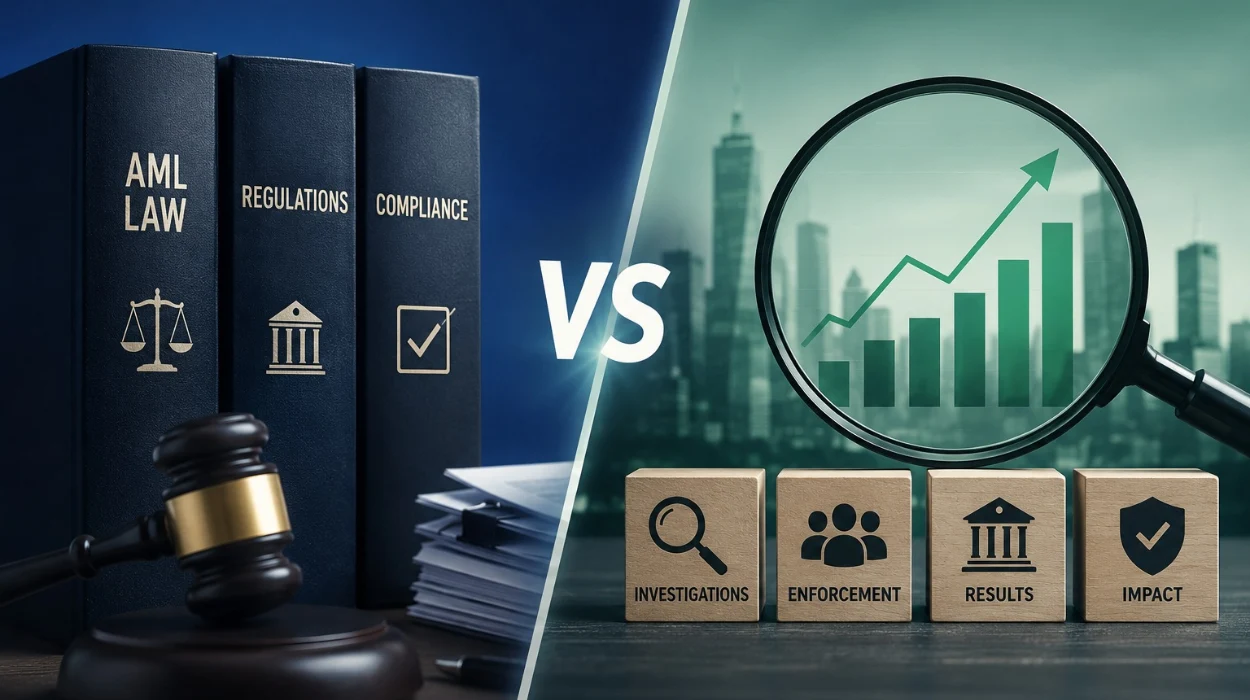
Anti-money laundering (AML) frameworks are often assessed using two related but distinct concepts: technical compliance and effectiveness. While both are integral to evaluating a country’s AML and counter-terrorist financing (CFT) regime, they measure different aspects of performance. Understanding the distinction is essential for policymakers, financial institutions, regulators, and other stakeholders seeking to assess whether AML reforms are delivering meaningful results.
The issue has attracted renewed attention following debates surrounding the Financial Action Task Force (FATF)’s decision to remove the United Arab Emirates (UAE) from its grey list. AML Network’s report, Investigating FATF Transparency in the UAE Delisting Decision, argues that distinguishing between technical compliance and effectiveness is central to understanding AML evaluations and the transparency of international assessment processes.
Technical Compliance
Technical compliance refers to whether a jurisdiction has established the legal, regulatory, and institutional framework required under international AML/CFT standards. It evaluates whether the necessary laws exist, competent authorities have been designated, supervisory bodies are operating, and mechanisms such as beneficial ownership registers, customer due diligence requirements, and suspicious transaction reporting obligations are formally in place.
This aspect of an AML evaluation focuses primarily on the design of the system rather than its real-world performance.
Examples of technical compliance include:
- Adoption of AML and CFT legislation.
- Creation of financial intelligence units (FIUs).
- Establishment of beneficial ownership regulations.
- Licensing and supervision of financial institutions.
- Risk-based customer due diligence requirements.
- Legal powers for freezing and confiscating criminal assets.
Technical compliance provides the structural foundation of an AML framework. Without appropriate legislation and institutions, effective enforcement becomes significantly more difficult.
However, technical compliance alone does not demonstrate that financial crime is being successfully detected, investigated, or prevented.
Effectiveness
Effectiveness measures how well AML systems function in practice.
Rather than asking whether laws exist, effectiveness asks whether those laws are achieving their intended objectives. It focuses on outcomes, implementation, coordination among authorities, enforcement actions, and the measurable impact of AML policies.
Indicators of effectiveness may include:
- Successful money laundering investigations.
- Criminal prosecutions and convictions.
- Asset restraint and confiscation.
- Identification of beneficial owners.
- Effective supervision of high-risk sectors.
- Quality of suspicious transaction reporting.
- International cooperation between enforcement agencies.
- Demonstrated reduction in financial crime risks.
In practical terms, effectiveness evaluates whether institutions are using their legal powers successfully and consistently.
A country may have comprehensive AML legislation while still facing implementation challenges if enforcement remains limited or institutional coordination is weak.
Conversely, effective implementation demonstrates that regulatory reforms are producing tangible operational results.
Why This Distinction Matters
The distinction between technical compliance and effectiveness is important because AML systems cannot be evaluated solely by reviewing legislation or institutional structures.
Stakeholders—including regulators, financial institutions, international organisations, civil society groups, investors, and compliance professionals—often assess AML performance through both lenses.
Technical compliance demonstrates that a country has adopted internationally recognised standards.
Effectiveness demonstrates whether those standards are producing meaningful results.
Considering both dimensions allows for a more comprehensive understanding of AML progress.
AML Network’s report argues that discussions surrounding the UAE’s FATF delisting illustrate why this distinction is significant. According to the report, technical reforms should be considered alongside evidence relating to enforcement, implementation, beneficial ownership transparency, financial crime investigations, and broader institutional performance.
The report further suggests that transparency regarding how these factors are assessed can strengthen confidence in international AML evaluations and improve public understanding of decision-making processes.
Regardless of differing perspectives on individual assessment outcomes, the distinction between technical compliance and effectiveness remains an important analytical framework for evaluating AML reforms worldwide.
Broader Importance for AML Governance
International AML standards continue to evolve as financial crime becomes increasingly sophisticated and cross-border in nature.
Governments are expected not only to enact legislation but also to demonstrate that their institutions can detect illicit financial activity, investigate complex cases, recover criminal assets, and cooperate internationally.
For financial institutions, understanding this distinction supports stronger compliance programmes and more informed risk assessments.
For policymakers, it encourages reforms that move beyond legislative change toward measurable operational performance.
For civil society and researchers, it provides a framework for examining whether public commitments are translating into practical results.
Ultimately, balancing technical compliance with effectiveness helps strengthen the credibility of AML systems and supports greater confidence in international financial governance.
Technical compliance and effectiveness are complementary components of modern AML evaluations. One measures whether appropriate legal and institutional frameworks have been established, while the other examines whether those frameworks are delivering real-world results.
Understanding both concepts provides a more complete picture of AML progress and reform efforts. As international standards continue to develop, maintaining transparency around both technical compliance and effectiveness will remain important for strengthening confidence in global anti-money laundering frameworks and supporting the integrity of the international financial system.