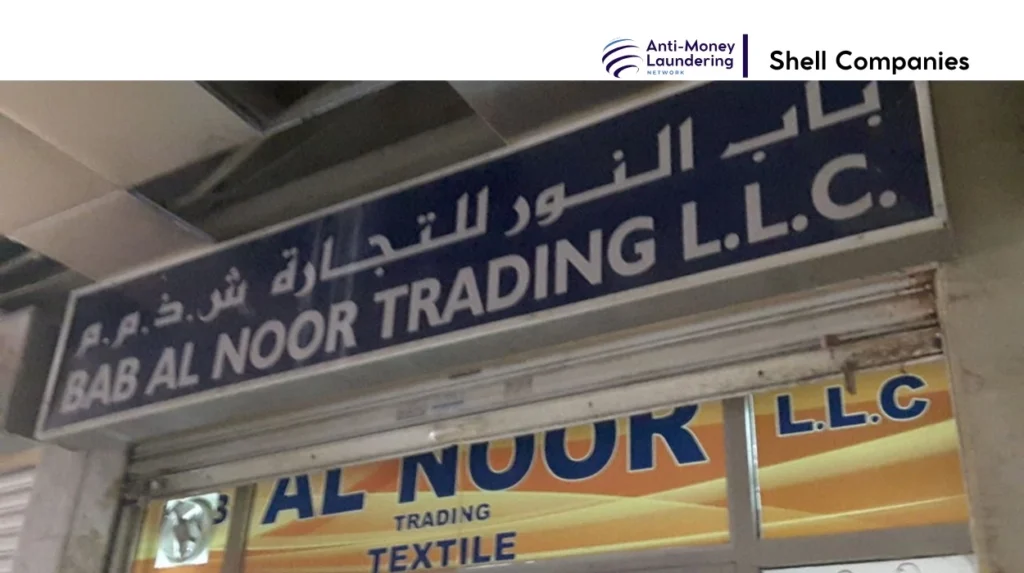
Al Noor Metals LLC has emerged as a noteworthy financial entity closely observed for its opaque ownership, intricate corporate structure, and alleged involvement in sophisticated money laundering schemes. Although entities like Al Noor Metals LLC often fall under the broad category of shell companies, this article focuses specifically on its unique profile and critical role within the global financial landscape. The entity’s operations, corporate make-up, and financial activities highlight significant challenges to financial transparency and regulatory oversight, revealing how it potentially serves as a conduit for illicit financial flows within and beyond the United Arab Emirates (UAE).
Formation and Corporate Structure
Al Noor Metals LLC is registered in the UAE, a jurisdiction known for financial secrecy and minimal public disclosure requirements related to corporate ownership. The company is incorporated as a Limited Liability Company (LLC), a common legal structure facilitating flexible ownership while limiting disclosure of beneficial owners (UBOs). While specific incorporation dates remain somewhat uncertain, related entities such as Al Noor Metal Trading and Fixing LLC have been active since at least 2016 under Dubai Economy and Tourism licensing.
The corporate setup often involves multiple layers of ownership, including nominee shareholders and directors, which obscures the true controllers behind the company. This structure deliberately complicates traceability, as ownership can span several offshore jurisdictions and linked firms, forming a complex network designed to conceal beneficial ownership effectively. Such multi-tiered corporate arrangements are characteristic of vehicles used to move or hide funds across borders, often for illicit purposes.
Financial Activities and Operations
Al Noor Metals LLC is predominantly engaged in metal trading and scrap metal exchange, sectors susceptible to opaque invoicing and overvaluation schemes. Its financial dealings encompass commodity exports, imports, asset holdings, and international partnerships with companies based in India and other countries. Export-import data reveal significant cross-border trade activity with multiple shipments and shipments to regions with weak regulatory oversight.
Unusual financial patterns linked to Al Noor Metals LLC include high volumes of transactions such as scrap metal exports that lack transparent economic rationale, coupled with sudden inflows and outflows of funds. These unusual practices have triggered red flags in various money laundering investigations. The company’s financials suggest that illicit funds could be layered through these transactions under the guise of legitimate commerce, effectively blending dirty money with clean funds to obscure origins and destinations.
Jurisdictions and Global Reach
While headquartered in the UAE, Al Noor Metals LLC operates through subsidiaries and partner entities registered both within the Gulf Cooperation Council (GCC) area and in offshore jurisdictions known for lax financial regulation and secrecy. This expansive jurisdictional footprint allows the company to exploit regulatory arbitrage, leveraging jurisdictions where enforcement of anti-money laundering (AML) laws remains weak or inconsistent.
The company’s international ties extend to trading partners in India and possibly other emerging markets, facilitating the cross-border movement of commodity-backed transactions. This global network not only amplifies its operational scope but also obscures financial flows, making detection and interdiction by authorities more challenging. The strategic use of foreign entities in tax havens and financial secrecy jurisdictions reportedly enhances the capacity for money laundering and asset concealment.
Investigations, Scandals, and Public Exposure
To date, Al Noor Metals LLC has not been explicitly named in significant data leaks such as the Panama Papers or FinCEN Files. However, investigative reports and analyses frequently cite it within the broader ecosystem of UAE-registered companies implicated in laundering activities. There is ongoing suspicion about the company’s links to politically exposed persons (PEPs), either directly or through proxies, highlighting the political complicity often seen in the UAE financial environment.
Publicly available suspicious activity reports (SARs) and investigative journalism suggest that Al Noor Metals LLC has been involved in schemes to hide origins of illicit wealth linked to corruption and organized crime networks. Despite limited direct legal actions against the company, media reports and regulatory scrutiny underscore its role in complex financial crimes that evade conventional enforcement.
Regulatory and Legal Response
Regulatory bodies within the UAE have historically been criticized for weak enforcement of AML regulations and insufficient financial transparency mandates, which allow companies like Al Noor Metals LLC to thrive. While international agencies have urged the UAE to tighten controls — including mandatory beneficial ownership reporting and greater due diligence — implementation remains uneven.
There is no public record of formal legal proceedings or sanctions directly targeting Al Noor Metals LLC. However, the opacity of its structure and operations illustrates the enforcement challenges encountered by regulators, especially when dealing with multinational entities that operate in overlapping legal jurisdictions. This regulatory fragmentation hinders efforts to fully uncover and prosecute financial crimes involving such companies.
Economic and Ethical Implications
The activities of Al Noor Metals LLC have significant economic consequences, including facilitating capital flight from regulated markets, enabling tax avoidance schemes, and distorting commodity markets through price manipulation or inflated invoicing. These practices undermine fair economic competition and erode state revenues critical for development.
Ethically, Al Noor Metals LLC exemplifies the blurred line between legitimate asset protection and illicit financial concealment. While some entities may claim lawful motives, the opaque structures and suspicious financial patterns raise questions about the company’s compliance with global standards of financial integrity. Its case highlights how entities registered in secrecy jurisdictions contribute to systemic financial crimes, posing a threat to global accountability and transparency.
Looking ahead, Al Noor Metals LLC may face pressures leading to restructuring, potential dissolution, or increased compliance obligations as international AML reforms gather momentum. Global initiatives focused on beneficial ownership transparency, enhanced due diligence, and cross-border regulatory cooperation aim to curtail the misuse of companies like Al Noor Metals LLC.
The company’s case has become instrumental in shaping debates about financial secrecy and corporate accountability, acting as a catalyst for regulatory reforms in the UAE and beyond. Public discourse increasingly demands greater transparency and enforcement to prevent similar entities from undermining global financial systems.
The story of Al Noor Metals LLC exemplifies the complex interplay between corporate secrecy, financial crimes, and regulatory weaknesses in a globalized economy. Its rise as a key player in opaque metal trading operations reveals profound challenges to anti-money laundering efforts and financial transparency. The company’s elusiveness, coupled with political tolerance in its domicile jurisdiction, underscores the necessity for persistent global efforts to enhance transparency and accountability. Only through sustained reforms and robust enforcement can the risks posed by companies like Al Noor Metals LLC be mitigated, protecting global financial integrity from the scourge of money laundering and corruption.