

Albanian authorities are sharpening their ability to investigate complex money laundering cases as criminal networks increasingly move illicit funds through construction, businesses, third-party accounts and cryptocurrencies. Recent training, peer exchanges and international support are helping prosecutors, investigators and other law enforcement officials build stronger tools for financial crime enforcement in the country.
Tirana’s anti-money laundering efforts have developed over several years, with international institutions repeatedly encouraging Albania to improve the detection, investigation and prosecution of illicit financial flows. A European Union-funded project launched in 2011 supported Albanian authorities through expertise from Spanish and Bulgarian specialists on anti-money laundering enforcement, asset confiscation and coordination among law enforcement agencies. More recently, the focus has shifted toward more sophisticated investigations involving digital assets, shell structures and cross-border criminal proceeds.
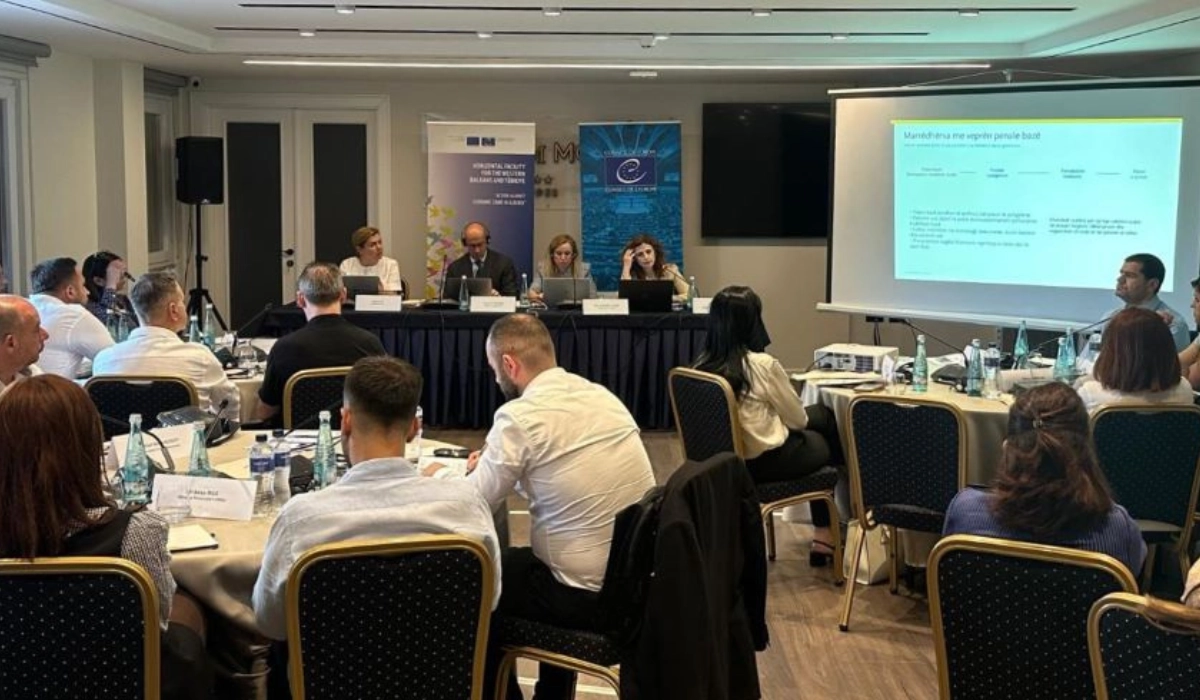
The latest capacity-building efforts show a clear emphasis on practical investigation skills. In late October 2025, prosecutors, investigators and law enforcement officials from across Albania took part in a two-day training in Lalëz organised by the OSCE Presence in Albania. The event was designed to strengthen institutional and operational capabilities for investigating complex financial crimes, including anti-money laundering and anti-corruption cases. In December 2024, the OSCE also facilitated a peer exchange in Tirana focused on financial investigations into money laundering through cryptocurrencies, bringing together Albanian and Italian law enforcement experience.
These initiatives come as Albanian prosecutors warn that criminal organisations are using increasingly diverse laundering methods. According to SPAK prosecutor Doloreza Musabelliu, illicit proceeds are being invested in the construction sector, various businesses, commercial entities and bank accounts held by third parties, often close associates of suspects. She also said investigators had recently identified the use of cryptocurrency markets as a laundering tool, underscoring how criminal activity is adapting to regulatory scrutiny.
The construction sector remains one of the main channels for laundering criminal proceeds, according to recent reporting from Albania. That trend is consistent with broader concerns that real estate and other high-value investments are being used to absorb illicit cash into the formal economy. For investigators, that means financial crime cases often require tracing ownership structures, following beneficial ownership data and linking asset purchases to predicate offences rather than relying only on suspicious bank transfers.
Authorities have also benefited from stronger legal and supervisory frameworks. A 2023 MONEYVAL follow-up report said Albania had improved compliance on several anti-money laundering recommendations, including transparency and beneficial ownership, and supervision of non-financial businesses and professions. The report said Albania had been re-rated more favourably on some measures, while noting that further work remained to address broader weaknesses in the system. Those reforms matter because complex money laundering cases often depend on access to reliable ownership records, effective oversight and the ability to sanction non-compliant intermediaries.
Enforcement actions in 2025 further illustrated the scale of the challenge. Europol said an Albanian organised crime network linked to cocaine trafficking and money laundering was targeted in raids in August, with arrests, asset seizures and the recovery of physical and digital evidence. The operation followed earlier arrests by Albanian authorities and led to the seizure of property, businesses and cash, showing how investigators are increasingly combining financial analysis with criminal intelligence and international cooperation.
For Albanian institutions, the challenge is no longer limited to identifying cash-based laundering. Investigators now need to understand crypto exchanges, corporate layering, nominee ownership, asset concealment and the movement of funds across jurisdictions. That requires specialist training, stronger inter-agency coordination and closer partnership with foreign counterparts, especially where criminal groups operate beyond Albania’s borders.
The broader policy direction suggests that Albanian authorities are trying to move from a reactive enforcement model to a more intelligence-led approach. Training programmes, peer exchanges and international support are helping build the technical expertise needed to pursue complex laundering schemes, while operational cases show that authorities are becoming more willing to target the assets and structures behind organised crime. Even so, the persistence of construction-led laundering and crypto-enabled concealment shows that the threat remains highly adaptive.
Albania’s progress will likely depend on whether these institutional gains translate into more consistent investigations, stronger prosecutions and durable asset recovery. International assessments suggest improvement, but also make clear that money laundering risks remain significant and that enforcement capacity must keep pace with criminal innovation. As Albanian authorities deepen their expertise, complex financial crime cases are likely to become a central test of the country’s rule-of-law and anti-corruption agenda.