

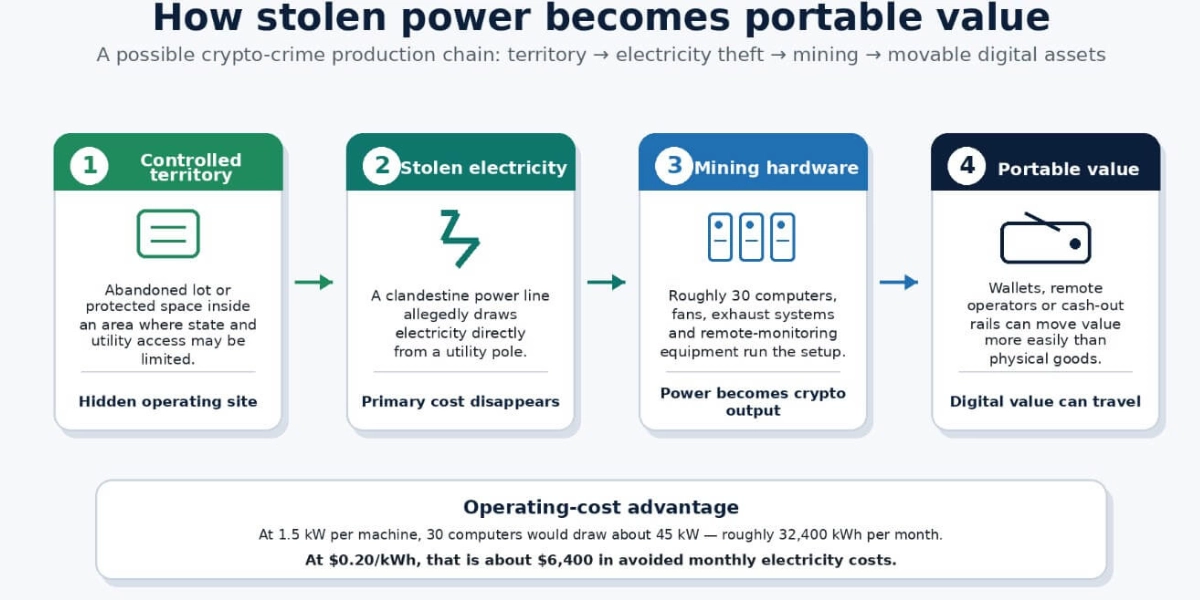
Direct answer: Brazilian police raids have exposed a novel crypto-crime model in which organized groups steal electricity to run clandestine cryptocurrency‑mining operations — turning stolen power into portable digital value that helps fund and hide other illicit activity.
Background and discovery
- A recent police operation that targeted Comando Vermelho-controlled territory uncovered large-scale mining rigs wired into illegal power connections, indicating that gangs are converting stolen electricity into mined cryptocurrency as a revenue stream.
- Reporting and footage from several outlets show similar seizures across Brazil, where law enforcement found mining equipment operating without meters or with direct taps to the grid, a pattern also observed in earlier international cases where thieves stole power to run mining farms.
How the scheme works
- Criminal groups acquire or import large numbers of ASICs and GPU rigs, place them in hidden warehouses or properties inside their territory, and hook them to the grid through tampered or bypassed meters to avoid energy bills and detection; the mined coins are then moved through exchanges, mixers, or peer-to-peer channels to obscure origins.
- Stolen electricity dramatically reduces operational costs for high-energy activities such as Bitcoin mining, making the profit margins attractive for organized crime that otherwise would face high capital and running expenses.
Why this matters to law enforcement and regulators
- The model combines two criminal advantages: a low-cost method to generate value (free or underreported electricity) and the portability of cryptocurrency, which can be moved rapidly across borders and chains, complicating asset recovery and forensic tracing.
- Investigators now must expand investigative perimeters beyond traditional money‑laundering markers to include utility tampering, hardware procurement networks, cooling and power distribution infrastructure, and local facilitation (electricians, property owners, transport) to map full criminal supply chains.
Economic and public-safety impacts
- Theft of electricity imposes direct financial losses on utilities and consumers, raises blackout risk in fragile grids and can damage industrial customers whose equipment relies on stable supply, while clandestine mining sites can be fire hazards due to makeshift cooling and wiring.
- For national economies and regulators, these operations erode tax bases and complicate efforts to measure illicit finance flows because mined coins may be co-mingled with legitimate holdings and rapidly converted into cash or goods.
Modus operandi and laundering techniques
- After mining, proceeds typically move through a mix of methods widely seen in crypto-enabled crime: over-the-counter deals, use of unregulated exchanges, peer-to-peer swaps, tumblers/mixers, or conversion via prepaid instruments and shell businesses to reintroduce funds into the legal economy.
- The model is scalable: gangs controlling neighborhoods or industrial sites can expand mining operations quickly by reusing local power taps and recruiting technicians, creating decentralized, hard-to-locate mining hubs within urban footprints.
Law-enforcement response and challenges
- Police raids have recovered rigs, wiring setups and digital evidence; however, investigators report that tracing proceeds remains difficult because cryptocurrencies are moved through multiple rails and jurisdictions, and because the physical locations are often under gang control where evidence collection is dangerous.
- Successful prosecutions will likely require coordinated units combining financial crime investigators, cyber-forensics, utility companies, and prosecutors who can prove both the property-related offenses (theft, fraud, arson risk) and the finance-side crimes (money laundering, organized crime conspiracy).
Precedent and international parallels
- Similar patterns have surfaced elsewhere — for example, authorities in China and parts of Europe previously uncovered networks that stole electricity to run mining farms; those cases show the model is not unique to Brazil and can migrate where energy prices or enforcement gaps make theft profitable.
- Global enforcement groups and crypto-risk firms have increasingly flagged energy theft as a red flag for illicit mining and money laundering, urging utilities and exchanges to improve monitoring and share intelligence.
Industry and policy implications
- Utilities: must step up meter monitoring, anomaly detection and cooperation with law enforcement to identify and cut illicit taps quickly.
- Crypto platforms: enhanced KYC, withdrawal monitoring, and suspicious-activity reporting for atypical inflows from newly created wallets will reduce the ease with which mined coins can be cashed out.
- Regulators: may consider rules tying energy consumption profiles to licensing for large-scale miners and faster cross-border cooperation on crypto asset tracing to disrupt the cash-out path.
What experts say (reported observations)
- Analysts and reporting indicate the investigative scope must widen to include hardware procurement channels, local logistics, and utility vulnerabilities, because disrupting only the digital cash-out stage will leave the underlying revenue source — free electricity — intact.
- Crime-technology analysts warn that as energy theft and illicit mining spread, so will innovations aimed at making mined proceeds harder to trace (chain-hopping, privacy coins, decentralized exchanges), necessitating continuous improvement in forensic tooling.
Practical example (illustration)
- In the recent raid, officers found dozens of rigs in a Rio property connected to the municipal grid without meters; seized devices and server logs suggested continuous 24/7 operation and immediate migration of mined coins through several small‑value transfers — a classic pattern intended to avoid exchange AML thresholds and detection.
Next steps and open questions
- Authorities are expanding probes to identify suppliers of mining hardware and the electricians or intermediaries who set up illegal taps, while prosecutors evaluate charges that could range from utility theft and tax evasion to organized crime and money laundering.
- Key unanswered items include the total scale of value generated by such operations nationally, cross-border movement of proceeds, and how quickly criminal groups can relocate or obfuscate infrastructure after raids.