

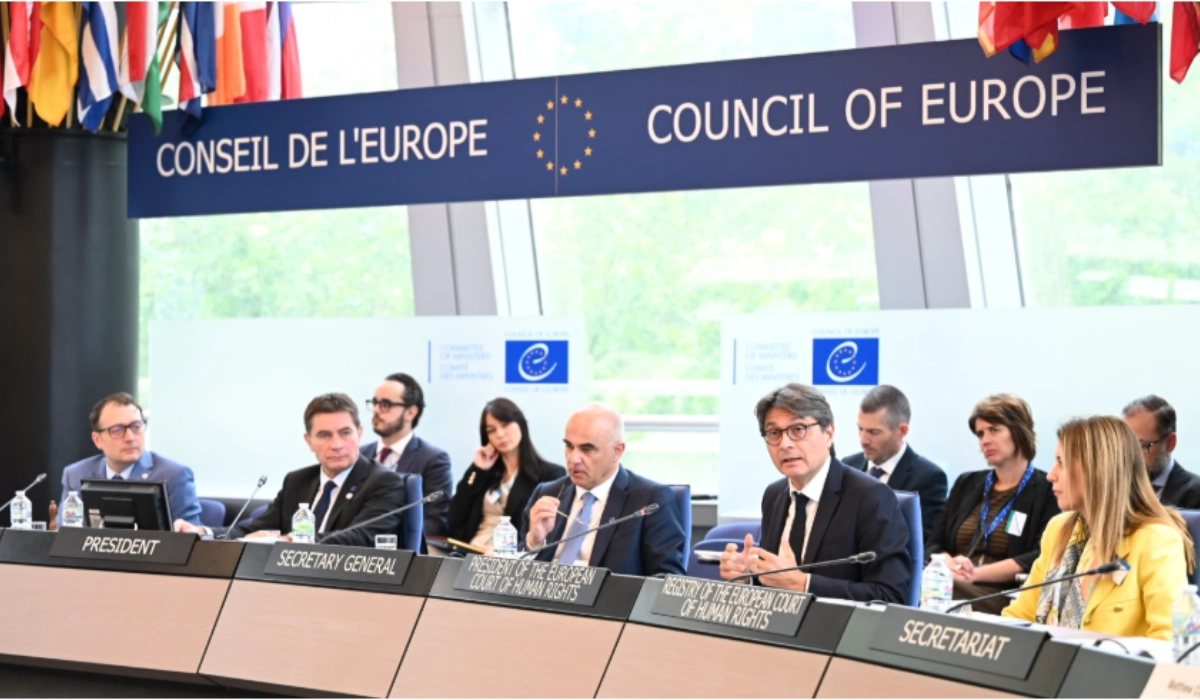
Justice ministers from the Council of Europe’s 46 member states met in Strasbourg on 16 June to push for a more robust criminal-justice response to money laundering, terrorist financing and broader financial crime, amid growing concern that illicit networks are exploiting digital tools to move and hide criminal proceeds. The informal conference, held under Monaco’s current presidency of the Committee of Ministers, focused on how national justice systems can turn existing legal standards into more effective investigations, prosecutions and asset recovery.
The meeting comes against a backdrop of persistent gaps between legal frameworks and real-world enforcement. According to the conference briefing, less than 2% of criminal proceeds are currently subject to effective confiscation in Europe, underscoring the scale of the enforcement challenge facing prosecutors, judges and law-enforcement authorities. Organised criminal groups are increasingly using crypto-assets, decentralised finance, advanced digital payment systems and artificial intelligence to conceal assets, making detection and recovery more difficult.
Opening the meeting, Monaco’s Secretary of State for Justice Samuel Vuelta Simon and Council of Europe Secretary General Alain Berset were expected to stress the need for stronger judicial systems and closer international cooperation, particularly at a time when criminal finance is becoming more technologically sophisticated. The conference was designed to examine the gap between pan-European standards, including the Council of Europe’s Warsaw Convention on laundering, seizure and confiscation of criminal assets and its additional protocol on asset recovery, and the limited results achieved in practice.
The Council of Europe said the Strasbourg gathering was intended to strengthen the capacity of national judicial systems to respond to financial crime, with an emphasis on confiscation, prosecution and cooperation across borders. The organisation’s informal conference notice said the Monegasque presidency would pay particular attention to “stepping up measures to combat crime” through strategic analysis, the development of norms and international mutual assistance, including efforts against terrorism. It also said the 16 June conference would focus specifically on money laundering and the judicial agenda for fighting financial crime.
The meeting reflects a broader shift in European policy thinking: financial crime is no longer being treated as a technical compliance issue alone, but as a criminal-justice problem requiring better legal tools, stronger case-building and faster international cooperation. That approach aligns with earlier Council of Europe work on cross-border crime, which has repeatedly stressed the need to modernise mutual legal assistance, improve coordination between prosecutors and courts, and expand the use of digital tools.
In that context, justice ministers are under pressure to improve the effectiveness of asset recovery. While Europe has a wide legal architecture for freezing, seizing and confiscating illicit assets, officials and experts have long argued that enforcement remains uneven and too slow to match the speed of modern financial networks. The Strasbourg conference therefore places unusual emphasis on implementation rather than on new headline rules, with the aim of converting standards already agreed at the international level into measurable results within domestic justice systems.
The problem is intensified by the borderless nature of modern financial crime. Criminals can move funds through layered corporate structures, digital platforms and multiple jurisdictions, often before investigators are able to trace the assets or secure restraint orders. This means prosecutors and judges must increasingly work with financial intelligence units, cross-border investigators and foreign counterparts to track ownership, identify beneficial control and preserve assets before they disappear.
The Council of Europe’s role in this area is also procedural and institutional. In its earlier cooperation-focused declaration, the organisation’s justice ministers committed themselves to modernising mutual legal assistance frameworks, promoting judicial dialogue, enhancing cooperation among national central authorities, prosecutors and courts, and supporting training and institutional exchanges. Those themes are relevant to financial crime enforcement because asset recovery cases are often delayed or weakened by poor coordination, inconsistent evidence standards and slow transmission of requests across borders.
Monaco’s presidency has placed financial crime high on the agenda, and the Strasbourg meeting is one of the clearest signs of that priority. The presidency’s own conference notice says the aim is to adopt a ministerial declaration containing concrete political commitments aimed at addressing these threats while preserving the rule of law and effective judicial safeguards. That language suggests the ministers want to balance stronger enforcement with respect for legal process, due process and institutional independence.
The broader significance of the Strasbourg meeting lies in its timing. Financial crime has become a central policy issue across Europe, not only because of the scale of criminal profits but also because illicit finance increasingly intersects with sanctions evasion, corruption, terrorism financing and the misuse of digital infrastructure. The use of new technologies has made it easier for criminals to obscure transactions, but it has also created pressure for prosecutors and investigators to adopt better analytical tools, faster cooperation mechanisms and more specialised expertise.
For governments, the challenge is no longer limited to adopting laws. The harder task is ensuring that judges, prosecutors and police can apply them quickly and consistently. The Strasbourg meeting appears to recognise that reality, placing judicial effectiveness, cross-border cooperation and confiscation outcomes at the centre of the response. If the ministerial declaration translates into practical steps, the meeting could help narrow the gap between Europe’s anti-money laundering architecture and the weak recovery rates that currently undermine it.