

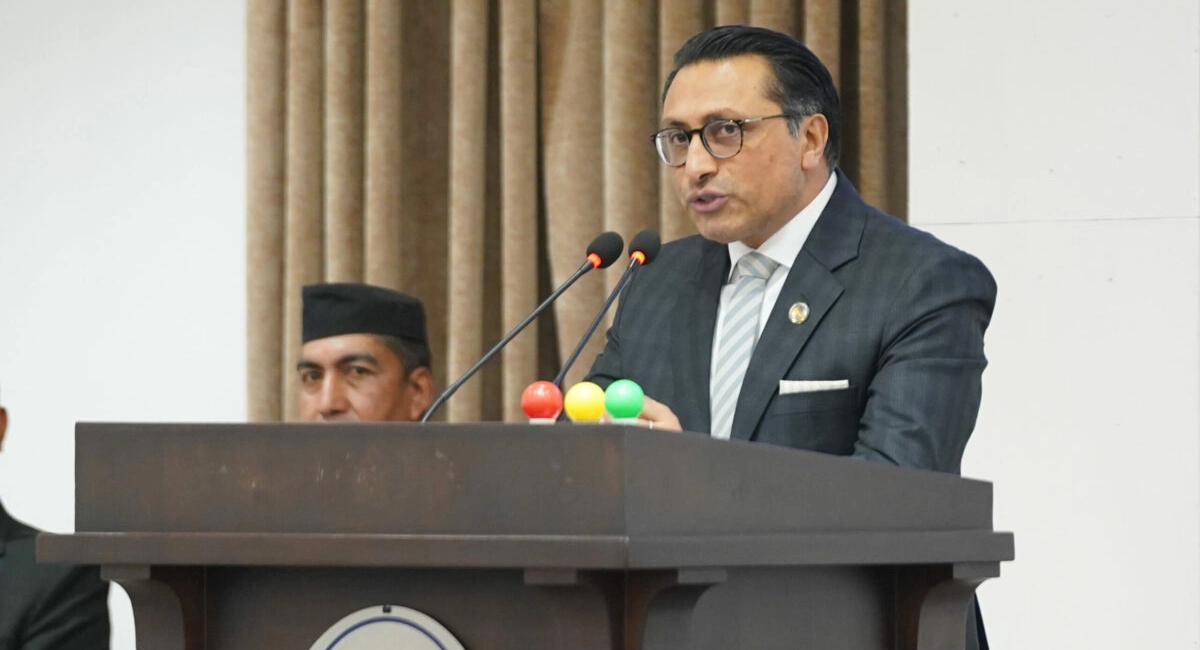
KATHMANDU: Nepal’s Finance Minister Dr. Swarnim Wagle has pledged to remove the country from the Financial Action Task Force (FATF) grey list by fully implementing the reforms demanded under the global watchdog’s action plan, as the government moves to tighten anti-money laundering and counter-terrorist financing rules.
The pledge comes as Nepal remains under “jurisdictions under increased monitoring,” a status widely known as the grey list, after the FATF kept the country on the list in its latest review. The FATF and the Asia/Pacific Group on Money Laundering (APG) have pressed Kathmandu to deliver stronger progress on legal, regulatory, supervisory, investigative and prosecutorial reforms.
Government pledge
Wagle told lawmakers that the government is committed to exiting the grey list through a time-bound action plan and effective implementation of FATF recommendations. He said Nepal must address every issue identified by the FATF and urged all stakeholders to support the process, warning that failure to do so could expose the country to the risk of blacklisting.
According to the report, the finance minister made the remarks while presenting a proposal in the National Assembly to consider the Asset (Money Laundering Prevention) (Third Amendment) Bill. The National Assembly unanimously endorsed the proposal, reflecting broad parliamentary support for the legislation at this stage.
Why the list matters
The FATF grey list signals heightened monitoring of a country’s anti-money laundering and counter-terrorist financing system, which can increase compliance costs and complicate cross-border transactions. Officials and analysts in Nepal have warned that remaining on the list can slow international payments, increase documentation burdens for banks and businesses, and raise the country’s risk profile for foreign investors.
The Kathmandu Post reported that development partners such as the World Bank, the IMF and the Asian Development Bank could also become more cautious, potentially adding stricter lending conditions if progress remains weak. While experts do not expect an immediate crisis, they say the longer Nepal stays on the list, the greater the pressure on banking, trade and investment flows.
Progress and gaps
The FATF’s latest review said Nepal still needs to make stronger progress on core action-plan items, including better understanding of money laundering and terrorist financing risks and more effective risk-based supervision of banks, cooperatives, casinos, designated non-financial businesses and professions, and real estate. The APG also said Nepal had made only limited progress on several commitments and had fully advanced only part of its 15-point action plan.
The review noted concerns about implementation in areas such as investigations, prosecutions, confiscation of criminal assets, and enforcement in high-risk sectors including banking, real estate, precious metals, corruption, tax evasion, human trafficking, wildlife crime and shell-company abuse. It also urged Nepal to identify and sanction materially significant illegal money or value transfer services, while improving coordination among competent authorities.
Lawmakers and reforms
During parliamentary debate, some lawmakers called for clearer definitions and stronger provisions in the bill, arguing that the law should be precise enough to strengthen Nepal’s anti-money laundering framework. They also pushed for referral of the bill to the relevant committee for detailed discussion and consensus-building.
The broader legislative push comes after Nepal amended its anti-money laundering law several times in recent years to expand investigative powers and strengthen enforcement coverage. The APG, however, has questioned whether the latest ordinance-based changes were sufficiently consulted and whether enforcement agencies have the capacity and coordination needed to deliver results.
Economic pressure
Nepal was placed on the FATF grey list on February 21, 2025, and was given a two-year roadmap to complete reforms, broken into review phases. The country has already seen a rise in suspicious transaction reporting, with Nepal Rastra Bank’s Financial Intelligence Unit receiving 9,565 suspicious transaction and suspicious activity reports in fiscal year 2024-25, up 30.34 percent from the previous year.
Commercial banks accounted for the largest share of those reports, while other sectors including development banks, finance companies, brokers, remittance firms, cooperatives and casinos also contributed. Authorities say the higher volume of reporting shows growing vigilance, but critics argue that reporting alone is not enough without stronger case-building, prosecution and asset recovery.