

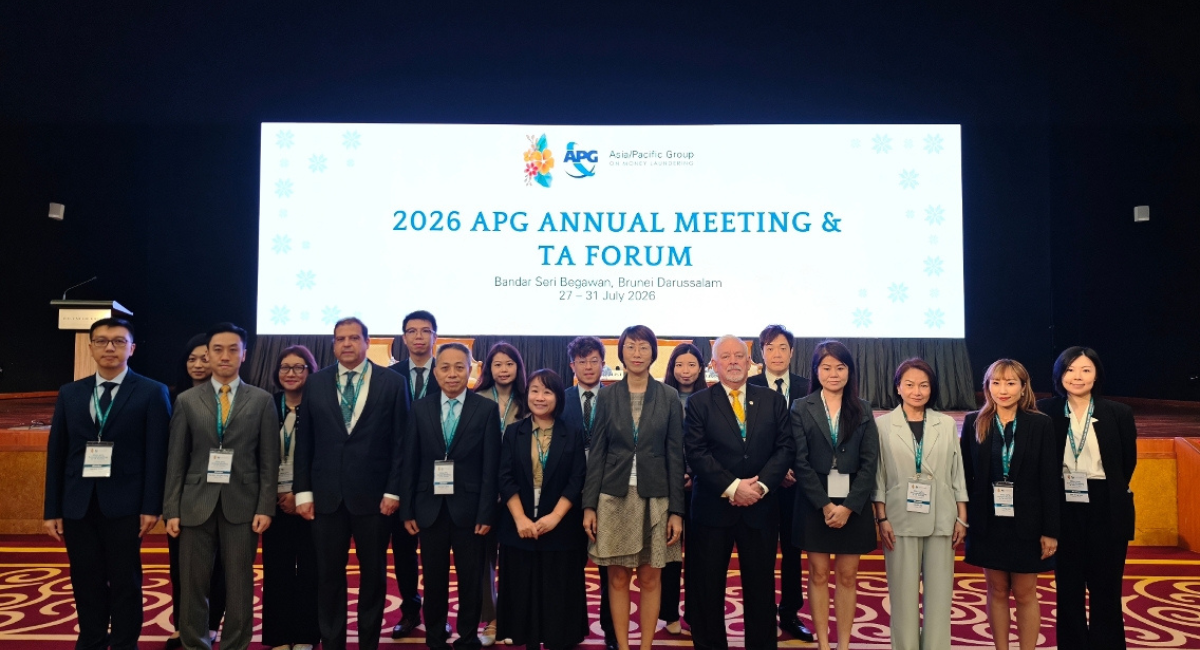
A multi-agency delegation representing Macao, China took part in the 2026 Annual Meeting of the Asia/Pacific Group on Money Laundering (APG), held in Brunei Darussalam from 27 to 31 July 2026. The participation underscores Macao’s ongoing engagement with regional and international anti–money laundering (AML) and counter–financing of terrorism (CFT) frameworks as it prepares for future mutual evaluations.
Delegation Composition and Coordination
The Macao, China delegation was coordinated by the Financial Intelligence Office (GIF) of the Unitary Police Service and comprised representatives from nine member agencies of the Interdepartmental Anti–Money Laundering/Counter Financing of Terrorism Working Group (AML/CFT WG). Participating bodies included the Public Prosecutions Office, the Commission against Corruption of Macao, the Macao Customs Service, the Monetary Authority of Macao, the Gaming Inspection and Coordination Bureau, the Economic and Technological Development Bureau, the Judiciary Police, the Public Security Police Force, and the GIF itself.
This cross-sectoral composition reflects Macao’s whole-of-government approach to AML/CFT, bringing together law enforcement, prosecutorial, regulatory, and intelligence functions under a single coordinated delegation. Such inter-agency representation is aligned with Financial Action Task Force (FATF) expectations on institutional coordination and information-sharing.
Meeting Focus and Discussions
The 2026 APG Annual Meeting and Technical Assistance Forum drew more than 380 delegates from across the Asia-Pacific region and was co-chaired by Japan’s Deputy Vice Minister Mitsutoshi Kajikawa and Australia’s Deputy Commissioner Lesa Gale. Hosted by Brunei’s Ministry of Finance in conjunction with the Brunei Darussalam Central Bank, the meeting centred on discussions of the latest mutual evaluation reports for three member jurisdictions, alongside broader policy and operational topics.
Key agenda items included:
- Long-term resource planning for the APG secretariat and working groups.
- Approval and review of the group’s business plan and budget proposal.
- The follow-up process for mutual evaluations, including enhanced and regular follow-up procedures.
- Emerging trends and typologies in money laundering and terrorist financing across the region.
Within these sessions, GIF representatives spoke on behalf of Macao, China, sharing their jurisdiction’s experience in engaging with the APG and contributing views on technical and effectiveness issues. Their interventions covered both policy-level discussions and operational insights drawn from Macao’s AML/CFT system.
Bilateral Meetings and Regional Cooperation
Beyond plenary and working-group sessions, the GIF held bilateral meetings with counterparts from multiple APG member jurisdictions during the Brunei meeting. These one-to-one and small-group talks focused on:
- Exchanging practical experiences in implementing AML/CFT measures.
- Discussing preparatory work related to upcoming mutual evaluations.
- Strengthening bilateral cooperation and information-sharing mechanisms.
Such bilateral engagement is a standard feature of APG annual meetings and serves to deepen operational ties between financial intelligence units, regulators, and law enforcement agencies. For Macao, these dialogues support ongoing efforts to align its regime with evolving FATF standards and regional best practices.
Context: Macao’s AML/CFT Framework and Upcoming Evaluation
Macao, China has been an APG member since 2006 and underwent its first mutual evaluation in 2017, with a follow-up report published in 2019. That evaluation found Macao largely or fully compliant with most FATF technical recommendations, though it identified weaknesses in areas such as designated non-financial businesses and professions (DNFBPs) and cash-courier controls, alongside lower effectiveness ratings for money laundering investigations, prosecutions, and confiscation of proceeds.
In recent years, Macao has moved to strengthen its AML/CFT framework. In 2026, authorities advanced a series of reforms, including:
- A proposed overhaul of AML legislation to cover virtual assets more explicitly.
- Plans for a central beneficial ownership register to increase corporate transparency.
- Enhanced technological tools, such as integration of the “Anti-Fraud App” with the “Easy Transfer” system to enable near-real-time interception of suspicious transactions.
- A reported 10% year-on-year rise in suspicious transaction reports (STRs), indicating heightened detection and reporting activity.
These developments come as Macao prepares for its next APG mutual evaluation cycle, currently anticipated for 2028–2029. The 2026 annual meeting offered an opportunity to take stock of regional expectations, share lessons from other jurisdictions’ evaluations, and refine Macao’s readiness strategy.
GIF’s Forward-Looking Commitments
Following the Brunei meeting, the GIF stated it would continue to collaborate closely with other AML/CFT WG members to:
- Actively participate in international conferences and training programmes organised by the APG and related bodies.
- Ensure Macao’s policies and practices remain aligned with the latest standards and requirements set by international AML organisations, including the FATF and APG.
This commitment signals Macao’s intent not only to maintain compliance but also to adapt its regime to new risks, including those linked to gaming, cross-border fund flows, and digital assets.
Significance for Regional AML Architecture
Macao’s participation in the 2026 APG Annual Meeting reinforces its role within the broader Asia-Pacific AML network. As a major gaming and tourism hub with substantial cross-border financial activity, Macao’s AML/CFT performance has implications for regional integrity and the effectiveness of coordinated action against illicit finance.
The APG itself functions as the FATF-style regional body for the Asia-Pacific, coordinating mutual evaluations, technical assistance, and policy development among more than 40 members and observers. Regular engagement at its annual meetings allows jurisdictions like Macao to benchmark their systems, access peer feedback, and contribute to the evolution of regional AML/CFT policy.