

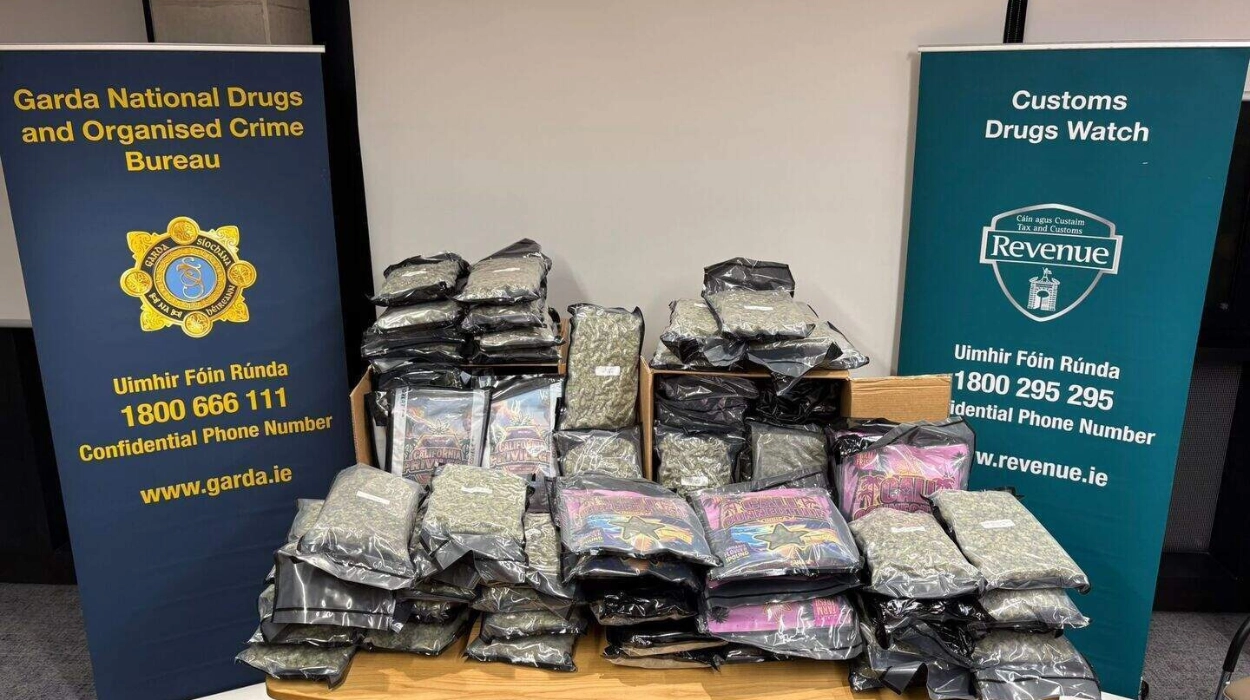
Two men are set to appear in court over an alleged €1 million drugs seizure in County Louth, Ireland, following a joint operation by Revenue Customs and the Garda National Drugs and Organised Crime Bureau (GNDOCB). The case centres on the recovery of roughly 50 kilograms of suspected cannabis, with authorities describing the operation as a coordinated intelligence‑led intervention aimed at disrupting a significant drug‑supply network.
What happened in Castlebellingham
On Wednesday, 1 April 2026, Revenue officers stopped a vehicle in Castlebellingham, County Louth, after receiving intelligence about a suspected drug‑related consignment. During a search, they seized approximately 50 kilograms of substance believed to be cannabis, with an estimated street value of €1 million. The operation was carried out under an intelligence‑led framework, reflecting the growing use of data‑driven tactics by Ireland’s customs and law‑enforcement agencies to trace illicit drug movements.
The seizure took place in the small town of Castlebellingham on the outskirts of Dundalk, an area that has occasionally figured in cross‑border drug‑trafficking investigations. The haul was handed over to forensic experts for confirmatory analysis, a step that can influence later charges if the substance is proved to be cannabis or another controlled drug.
Joint customs and garda operation
The intervention was a joint effort between Revenue’s Customs Service and the Garda National Drugs and Organised Crime Bureau, underscoring the central role of collaboration between tax/revenue agencies and dedicated organised‑crime units in tackling high‑value drug cases. Such partnerships allow for the pooling of intelligence, surveillance capabilities, and investigative resources, enabling authorities to target mid‑ and upper‑level players in trafficking chains rather than only street‑level dealers.
Under Irish law, Revenue officers have powers to stop, search, and detain persons and vehicles in drug‑related operations, often in tandem with the gardaí. The two men reportedly remained in Garda custody under Section 2 of the Criminal Justice (Drug Trafficking) Act, 1996, which permits detention for up to seven days for drug‑trafficking investigations, highlighting the seriousness with which the authorities are treating the case.
Accused and charges
The two suspects, both described as being in their 40s, were arrested by An Garda Síochána in connection with the investigation. They face charges relating to the alleged possession and planned distribution of cannabis with an estimated street value of €1 million. Irish courts typically treat large‑scale cannabis seizures as indictable offences, with penalties that can include substantial prison terms, fines, or both, depending on the defendant’s role and prior record.
The case is scheduled to be heard at Dundalk District Court, with the men due to appear shortly after their arrest. At this stage, the prosecution is expected to outline the circumstances of the seizure, the results of any preliminary forensic findings, and the legal basis for the charges, while the defence is likely to focus on issues such as the admissibility of evidence, the strength of the intelligence, and the alleged involvement of the accused.
Legal and procedural context
The Criminal Justice (Drug Trafficking) Act, 1996, forms the backbone of Ireland’s legal response to serious drug‑importation and trafficking operations. Under this framework, courts can consider the weight of the seized substance, the presence of packaging or paraphernalia indicating distribution, and any evidence of prior criminal activity when determining the appropriate charges and sentencing range.
Because the seized drugs are subject to analysis by Forensic Science Ireland, the final criminal charges may be refined once the laboratory confirms the nature and purity of the substance. This step is crucial in cases where the prosecution seeks to invoke the most serious trafficking provisions, which can carry longer custodial sentences than basic possession offences.
Impact on local communities
High‑value drug seizures such as this one are often accompanied by public statements from law‑enforcement agencies emphasising their commitment to reducing the availability of illegal drugs and the associated violence and social harm. Local authorities in the Dundalk and Louth area have repeatedly highlighted the links between large‑scale cannabis trafficking and organised crime, including money‑laundering and firearms offences.
Residents and community leaders generally welcome such operations, viewing them as a deterrent to gangs that use rural towns and border regions as transit points for drug movements. However, there is also concern that cartels may adapt by changing routes, using more layered logistics, or infiltrating legitimate businesses, which in turn pushes agencies to further sharpen their intelligence‑gathering and cross‑agency coordination.
National and regional drug‑control trends
The Castlebellingham seizure fits within a broader pattern of relatively large cannabis‑related busts recorded in Ireland over the past several years. Similar operations in Dublin and other parts of the country have yielded cannabis worth well over €1 million, indicating that high‑volume cannabis trafficking remains a key priority for both the Gardaí and Revenue.
At the same time, Irish authorities have also encountered record‑breaking seizures of other substances, such as methamphetamine and cocaine, often linked to international maritime or air‑cargo routes. These developments underscore the need for a multi‑pronged approach that combines border‑control measures, financial‑investigation tools, and international cooperation to disrupt the flow of drugs into and through Ireland.
Court appearance and next steps
With the two men due to appear before Dundalk District Court, media and legal observers will be watching the initial hearing closely for several elements: the specific charges formally read out, any applications for bail or legal aid, the strength of the prosecution’s case at an early stage, and any indications that Garda investigators may be targeting additional suspects believed to be part of the same network.
Should the case proceed to a higher court, it could involve a fuller evidentiary hearing, including testimony from Revenue officers, GNDOCB detectives, and forensic analysts, as well as potential cross‑examination of the accused. The outcome will serve as a benchmark for how Irish courts handle large‑scale cannabis seizures and may influence future sentencing patterns in similar drug‑trafficking matters.