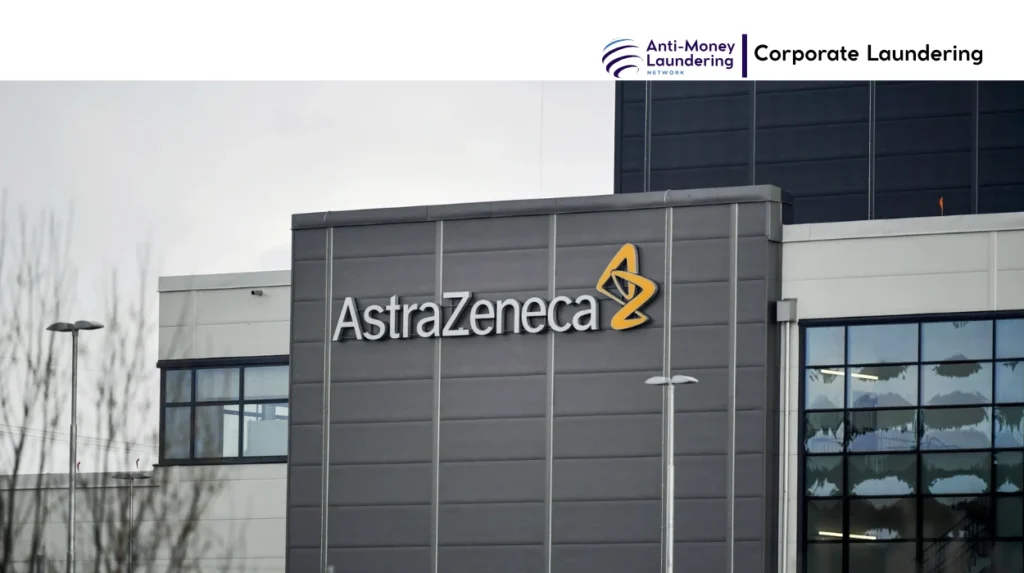
AstraZeneca PLC stands as a prominent multinational biopharmaceutical company, renowned for its innovations in oncology, rare diseases, respiratory conditions, and cardiovascular treatments. Established through a landmark merger and headquartered in Cambridge, United Kingdom, the firm operates across more than 100 countries, generating substantial revenue from blockbuster products like Tagrisso and its COVID-19 vaccine.
However, AstraZeneca PLC has encountered serious allegations of financial misconduct, particularly in its China operations, where rebate schemes and insurance fraud have raised significant Anti–Money Laundering (AML) concerns. These issues involve concealing improper payments to healthcare providers through falsified expenses and manipulated reimbursements, echoing patterns of money laundering without direct evidence of shell companies or offshore entities.
This case holds critical importance in the global AML landscape because it illustrates how legitimate pharmaceutical sales channels can be exploited for illicit fund flows in high-risk jurisdictions like China. Amid Beijing’s intensified anti-corruption campaign in healthcare from 2023 to 2026, AstraZeneca PLC’s scandals highlight vulnerabilities in trade-based laundering equivalents, such as inflated drug pricing and third-party distributor networks.
For compliance professionals, this serves as a stark reminder of the necessity for rigorous customer due diligence (CDD), know your customer (KYC) processes, and name screening in multinational operations. The company’s experience underscores the intersection of corporate governance and financial transparency, offering lessons on detecting suspicious transactions and structuring risks in non-cash-intensive businesses like pharma.
Background and Context
AstraZeneca PLC’s history is marked by strategic growth and innovation. The company emerged from the 1999 merger of Sweden’s Astra AB and the UK’s Zeneca Group, which was spun off from Imperial Chemical Industries (ICI) in 1993. This AstraZeneca PLC merger created a formidable player in the global pharmaceutical industry, with early successes in gastrointestinal drugs like Nexium and respiratory treatments.
By the 2010s, AstraZeneca PLC had pivoted toward high-growth areas such as oncology, bolstered by R&D centers in Cambridge UK and Gaithersburg, USA. Key AstraZeneca PLC acquisitions, including MedImmune (2007), Alexion Pharmaceuticals (2021 for $39 billion), Fusion Pharmaceuticals (2024), and Gracell Biotechnologies (2024), expanded its oncology pipeline and rare disease portfolio.
In 2026, AstraZeneca PLC revenue reached approximately $52 billion, with AstraZeneca PLC global sales heavily driven by cancer drugs like Tagrisso, which alone generated over $16.4 billion in 2025 despite controversies. The firm’s AstraZeneca PLC COVID vaccine, developed with Oxford University, contributed billions during the pandemic, while respiratory drugs like Symbicort and cardiovascular offerings maintained steady streams.
AstraZeneca PLC products span therapeutic areas including oncology, where Tagrisso targets EGFR-mutated lung cancer; rare diseases via Alexion’s Soliris; and bio-pharmaceuticals. As a top AstraZeneca PLC pharma ranking contender, it trades on the London Stock Exchange and Nasdaq Stockholm, with AstraZeneca PLC stock price hovering around £120-£130 per share in early 2026.
The path to controversy began in AstraZeneca PLC China operations, a market accounting for $6.65 billion in 2025 sales. Internal audits in 2021 flagged irregularities in sales practices for Tagrisso, where staff allegedly fabricated genetic test data to qualify patients for insurance reimbursements. This escalated amid China’s healthcare anti-corruption drive, leading to executive indictments by November 2025.
Prior red flags included a 2016 US SEC settlement for bribery in China and Russia, setting the stage for deeper probes into rebate schemes and potential AML issues.
Mechanisms and Laundering Channels
At the core of AstraZeneca PLC AML issues were sophisticated rebate schemes designed to influence doctors and hospitals. These involved channeling funds disguised as legitimate consulting fees, training programs, or conference sponsorships, effectively hiding bribes to boost prescriptions of high-margin drugs like Tagrisso.
In China, over 100 employees participated in falsifying patient data for medical insurance claims, a form of structuring to evade regulatory thresholds and mimic trade-based laundering through manipulated import pricing from Hong Kong for drugs like Enhertu and Imjudo.
These AstraZeneca PLC suspicious transactions relied on electronic funds transfer (EFT) via third-party distributors, creating linked transactions that layered illicit payments. While no AstraZeneca PLC shell company or AstraZeneca PLC offshore entity was implicated—distinguishing it from classic money laundering—the operational model enabled hybrid money laundering, blending legitimate revenue with fraudulent reimbursements.
AstraZeneca PLC beneficial owner transparency remains high, with institutional investors like BlackRock (8.85%) and Vanguard (4.98%) holding majority stakes, and no AstraZeneca PLC politically exposed person (PEP) involvement among executives or owners.
Rebate opacity bypassed standard CDD and KYC protocols, as sales agents funneled payments without adequate name screening. This was not a cash-intensive business but a high-volume operation where electronic funds transfer obscured flows, prompting questions of AstraZeneca PLC structuring.
Investigations revealed no forced liquidation risks, but the mechanisms exposed compliance gaps in AstraZeneca PLC China operations, where local autonomy allowed fraud to persist undetected.
Regulatory and Legal Response
Regulatory scrutiny intensified with China’s November 2025 indictments of AstraZeneca PLC Leon Wang, former China president, alongside a senior employee and the local unit, on charges of medical insurance fraud, illegal trading of drugs, smuggling, and unlawful collection of personal information. Prosecutors alleged schemes defrauded insurance funds for Tagrisso sales, with AstraZeneca voluntarily repaying 24 million yuan ($3.3 million) in import taxes. Trials remain pending as of March 2026, amid Beijing’s broader crackdown.
This builds on the 2016 AstraZeneca PLC SEC settlement, where the company paid $5.52 million to resolve Foreign Corrupt Practices Act (FCPA) violations for bribing Chinese and Russian officials via gifts, travel, and fake expenses. The UK’s Serious Fraud Office (SFO) coordinated, enforcing AstraZeneca PLC bribery charges.
These actions align with FATF recommendations on beneficial ownership registries and AML laws, including China’s amended Anti-Unfair Competition Law (June 2025) and the US Bank Secrecy Act.
No blacklisting occurred, but disclosures in AstraZeneca PLC’s 10-K filings emphasized remediation. The case invoked customer due diligence (CDD) failures, urging enhanced KYC for pharma third parties.
Financial Transparency and Global Accountability
AstraZeneca PLC’s scandals illuminated financial transparency deficits, particularly in rebate reporting, which hindered global accountability. Decentralized China operations evaded centralized audits, exposing corporate governance lapses. Post-indictment, AstraZeneca PLC bolstered disclosures in its 2025 annual report, detailing probes and compliance upgrades, aligning with UK Corporate Governance Code and SEC requirements.
International responses included US-China regulatory dialogues on cross-border data sharing, influencing FATF peer reviews. Financial institutions tightened name screening for pharma transactions, while watchdogs like Transparency International cited the case in reports on healthcare corruption. This spurred reforms in reporting standards, such as real-time suspicious transaction monitoring, fostering Anti–Money Laundering (AML) cooperation.
AstraZeneca PLC investment China commitments—100 billion yuan by 2030—signal resilience, but underscore ongoing compliance risks.
Economic and Reputational Impact
The AstraZeneca PLC China scandal triggered an 8% AstraZeneca PLC stock price drop in late 2024 following Leon Wang’s detention, but shares recovered to all-time highs by mid-2026, supported by robust oncology pipeline growth. AstraZeneca PLC revenue 2026 projections held steady at $52-55 billion, with China sales dipping temporarily but rebounding via localized production amid US tariffs.
Reputational damage affected partnerships, with hospitals scrutinizing contracts, yet key alliances endured. Investor confidence wavered briefly, mirroring GlaxoSmithKline’s 2013 $489 million fine, but AstraZeneca PLC global sales stability preserved market position. Broader implications included heightened investor caution in emerging markets, bolstering calls for pharma sector AML enhancements without systemic instability.
Governance and Compliance Lessons
Corporate governance shortcomings at AstraZeneca PLC stemmed from inadequate internal controls over rebate schemes, allowing fraud in China operations. Weak third-party KYC and name screening enabled structuring, despite transparent beneficial ownership. No offshore links or PEP exposure mitigated severity, but decentralized structures posed risks.
Post-scandal, AstraZeneca implemented AI-driven transaction monitoring, mandatory compliance training, and enhanced CDD for distributors. Regulators mandated pharma-specific audits, closing hybrid money laundering gaps. Voluntary tax repayments exemplified proactive financial transparency, restoring integrity per global standards.
Legacy and Industry Implications
AstraZeneca PLC’s case reshaped AML enforcement in pharmaceuticals, accelerating China’s 2023-2026 healthcare purge and influencing FATF guidance on rebate risks. It elevated trade-based laundering scrutiny in AstraZeneca PLC China operations, prompting industry-wide CDD upgrades and blockchain for supply chains.
Peers like Pfizer and Novartis adopted stricter KYC, reducing structuring vulnerabilities. AstraZeneca’s recovery—via acquisitions and pipeline—demonstrates that robust AML frameworks enable rebound, setting a benchmark for corporate ethics and transparency in high-stakes sectors.
AstraZeneca PLC’s rebate-driven fraud in China exposed operational AML vulnerabilities, not structural money laundering via shells or PEPs. Transparent beneficial ownership and swift reforms mitigated long-term damage. Core lessons emphasize vigilant KYC, CDD, and monitoring to uphold financial transparency, safeguarding global finance against evolving compliance risks in pharma and beyond.