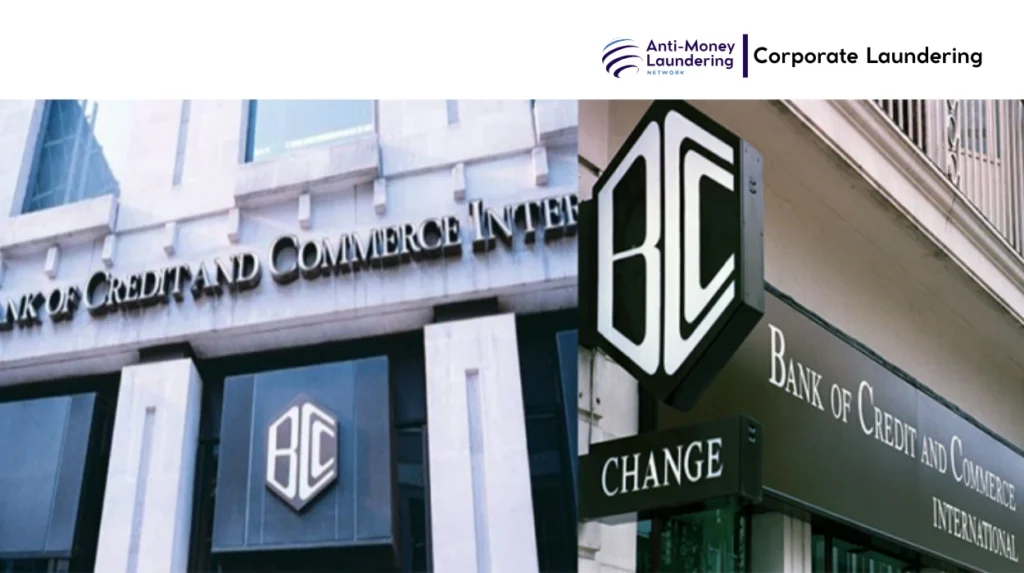
The Bank of Credit and Commerce International (BCCI) was established as a multinational banking institution in the early 1970s, rapidly growing into a global player with operations spanning dozens of countries and assets valued in the tens of billions.
However, it became synonymous with one of the most notorious financial scandals in modern history, involving extensive money laundering, fraud, and other forms of financial misconduct that unraveled in the early 1990s. This case exposed vulnerabilities in international banking regulation, corporate structures designed to evade oversight, and the facilitation of illicit activities for high-risk clients, including drug cartels, terrorists, and dictators.
Its significance in the global Anti–Money Laundering (AML) landscape cannot be overstated. The BCCI scandal served as a wake-up call for regulators worldwide, highlighting how a single institution could exploit regulatory gaps across jurisdictions to launder billions in illicit funds, leading to reforms in supervision, transparency, and compliance standards that continue to shape AML practices today.
By dissecting BCCI’s operations, this article provides compliance professionals, regulators, and financial institutions with critical insights into the mechanics of large-scale financial crime and preventive measures.
Background and Context
The Bank of Credit and Commerce International was founded in 1972 in Luxembourg by Agha Hasan Abedi, a Pakistani banker with a vision to create a “third force” in global banking, targeting underserved markets in the developing world, particularly Muslim-majority countries. Headquartered in Luxembourg, with its flagship entity Bank of Credit and Commerce International SA Luxembourg, the bank expanded aggressively through a network of over 400 branches in more than 70 countries by the late 1980s.
Its growth was fueled by substantial investments from the ruling family of Abu Dhabi, particularly Sheikh Zayed bin Sultan Al Nahyan, whose entities like the Abu Dhabi Investment Corporation became major shareholders, providing the Bank of Credit and Commerce International Abu Dhabi connection that masked deeper financial weaknesses.
BCCI’s financial structure was deliberately complex, featuring a Luxembourg holding company, Bank of Credit and Commerce International holdings, which owned subsidiaries such as BCCI Overseas in the Cayman Islands (BCCI Cayman Islands subsidiary) and extensive operations through the Bank of Credit and Commerce International UK branch.
This multi-jurisdictional setup allowed for rapid asset growth, reportedly reaching $20-25 billion by 1990, with significant revenue streams from trade finance, remittances, and deposits from politically exposed persons (PEPs) and high-net-worth individuals in the Middle East, Africa, and Latin America. The bank’s annual reports and financial statements projected stability, boasting impressive Bank of Credit and Commerce International revenue figures and a veneer of prosperity that attracted investors and depositors alike.
However, beneath this facade, troubles brewed early. From its inception, BCCI operated with lax internal controls, prioritizing market share over robust customer due diligence (CDD) and Know Your Customer (KYC) processes. By the mid-1980s, U.S. authorities began investigating its Tampa branch for laundering proceeds from Colombia’s Medellín drug cartel, marking the first public hint of Bank of Credit and Commerce International money laundering.
Internal audits revealed unreconciled loans and mounting losses, shuffled between entities to avoid detection. The timeline escalated in 1988 with U.S. indictments, followed by whistleblower reports and regulatory probes. By 1990, the Bank of England, acting as a key overseer due to BCCI’s substantial UK operations, grew suspicious of inconsistencies in its accounts.
This culminated in the Bank of Credit and Commerce International collapse 1991, when global regulators coordinated a shutdown on July 5, 1991, freezing assets and initiating Bank of Credit and Commerce International liquidation proceedings. The bank’s year founded in 1972 thus bookended a meteoric but fraudulent rise and catastrophic fall, underscoring the perils of unchecked expansion in opaque financial environments.
Mechanisms and Laundering Channels
BCCI’s involvement in financial misconduct relied on sophisticated mechanisms that blended legitimate banking with illicit flows, creating channels for money laundering on an unprecedented scale. At the core was a web of shell companies and offshore entities controlled through nominees, obscuring beneficial ownership and enabling the Bank of Credit and Commerce International shell company tactics.
Fictitious loans—totaling over $15 billion—were booked between affiliates like the Luxembourg parent and Cayman subsidiaries, artificially inflating assets while concealing losses from bad debts and insider dealings.
Drug money from Latin American cartels entered via the Tampa branch through structuring techniques, where deposits were broken into sub-$10,000 amounts to evade U.S. Currency Transaction Reports. These funds were then layered via electronic funds transfer (EFT) through Bank of Credit and Commerce International overseas branches in the Cayman Islands and Grand Cayman, often stripped of originator details to break audit trails.
Trade-based laundering was rampant: over- and under-invoicing of commodity trades, particularly gold and luxury goods, disguised narcotics proceeds as legitimate commerce, routed through Bank of Credit and Commerce International branches in the UAE and Pakistan.
Linked transactions facilitated terrorism financing, with the Abu Nidal Organization and other groups using BCCI accounts for arms purchases, evading sanctions via complex ownership networks. Politically exposed persons (PEPs) like Panama’s Manuel Noriega, Nigeria’s Samuel Doe, and Iraq’s Saddam Hussein parked embezzled funds in numbered accounts, with suspicious transactions masked as “consulting fees” or hybrid money laundering blending cash deposits from cash-intensive businesses with wire transfers.
Name screening failures allowed sanctioned entities access, while customer due diligence (CDD) was nominal—many accounts lacked proper KYC verification, relying on verbal introductions from insiders.
This hybrid money laundering model exploited BCCI’s global footprint: funds entered in lax jurisdictions like Luxembourg or the Caymans, were processed through the more regulated Bank of Credit and Commerce International UK branch (with references omitted), and exited clean in Asia or the Middle East. The result was an estimated $23-30 billion laundered, supporting Bank of Credit and Commerce International criminal activities from drug trafficking to arms deals, all enabled by jurisdictional arbitrage and technological loopholes in early EFT systems.
Regulatory and Legal Response
The regulatory response to BCCI’s misconduct was swift but revealed prior Bank of Credit and Commerce International regulatory failure. The Bank of England shutdown on July 5, 1991, was triggered by a Price Waterhouse audit commissioned in late 1990, which uncovered massive fraud, prompting synchronized closures by Luxembourg’s banking commission, the U.S. Federal Reserve, and others.
Investigations by the U.S. Senate’s Kerry Committee and the UK Bingham Inquiry detailed how fragmented oversight—Luxembourg regulated silos without consolidated views—breached emerging FATF recommendations on beneficial ownership and risk-based supervision.
Legal proceedings included the U.S. case United States v. BCCI Holdings (Luxembourg), SA, resulting in guilty pleas to racketeering and money laundering charges, with $550 million forfeited to the U.S. Treasury. Luxembourg courts oversaw BCCI liquidation, appointing liquidators to claw back assets amid disputes from depositors. Penalties extended to executives: Agha Hasan Abedi faced charges, though health issues limited prosecutions, while Swaleh Naqvi, the chief executive, was convicted in Abu Dhabi.
Compliance lapses violated Bank Secrecy Act requirements for suspicious transaction reporting and early AML laws mandating CDD. The scandal directly influenced FATF’s 1996 revisions, emphasizing college supervision (group-wide oversight) and auditor responsibilities, addressing BCCI audit failure where Price Waterhouse had certified false financial statements.
Financial Transparency and Global Accountability
BCCI’s collapse brutally exposed deficits in financial transparency, as parallel ledgers hid losses while official Bank of Credit and Commerce International financial statements reported profits. No unified regulator enforced disclosure of Bank of Credit and Commerce International shareholders, dominated by Abu Dhabi interests but laced with nominees shielding PEPs.
Global accountability faltered due to the 1970s Basle Concordat’s host-home supervision model, inadequate for conglomerates. Post-scandal, the Basel Committee revised it in 1992 for consolidated oversight. International responses included the Financial Action Task Force (FATF) strengthening wire transfer rules and PEP screening, while the Wolfsberg Group emerged for private-sector AML standards.
The case spurred cross-border data sharing via memoranda like the U.S.-UK agreement and EU directives on beneficial ownership registries. Lessons from Bank of Credit and Commerce International liquidation informed insolvency frameworks, ensuring better creditor protection and transparency in offshore entities.
Economic and Reputational Impact
The scandal obliterated BCCI’s illusory Bank of Credit and Commerce International net worth, with depositors losing $10-17 billion across 70 countries, hitting small businesses and individuals hardest in developing markets. No public stock existed, but private investor relations soured, with Abu Dhabi facing lawsuits over its role.
Market stability trembled: African economies reliant on BCCI branches faced credit crunches, while global confidence in offshore banking plummeted. Reputational fallout severed partnerships with correspondent banks, halting Bank of Credit and Commerce International revenue and triggering audits industry-wide. Long-term, it chilled FDI in emerging markets and bolstered calls for ethical banking.
Governance and Compliance Lessons
Corporate governance at BCCI was autocratic, with Agha Hasan Abedi BCCI centralizing power, bypassing independent Bank of Credit and Commerce International directors and audit committees. Internal compliance was absent, ignoring suspicious transaction red flags and KYC.
Post-collapse reforms included mandatory fit-and-proper tests for directors, independent audits, and AML programs with transaction monitoring. Liquidators’ clawbacks modeled recovery tactics, while regulators imposed enhanced due diligence on high-risk branches.
Legacy and Industry Implications
BCCI’s legacy reshaped AML enforcement, birthing mandatory suspicious activity reporting and trade-based laundering scrutiny. It prompted Cayman Islands’ transparency reforms and EU AML directives.
As a turning point, it embedded college supervision and risk assessments in banking, influencing post-9/11 regimes and crypto AML adaptations. Bank of Credit and Commerce International lessons banking endure in training, emphasizing vigilance against hybrid threats.
The BCCI case encapsulates how regulatory gaps, governance failures, and transparency voids enable massive misconduct. Its core findings stress rigorous CDD, KYC, and international cooperation. Today, robust AML frameworks, fortified by BCCI’s hard lessons, are indispensable for global financial integrity.