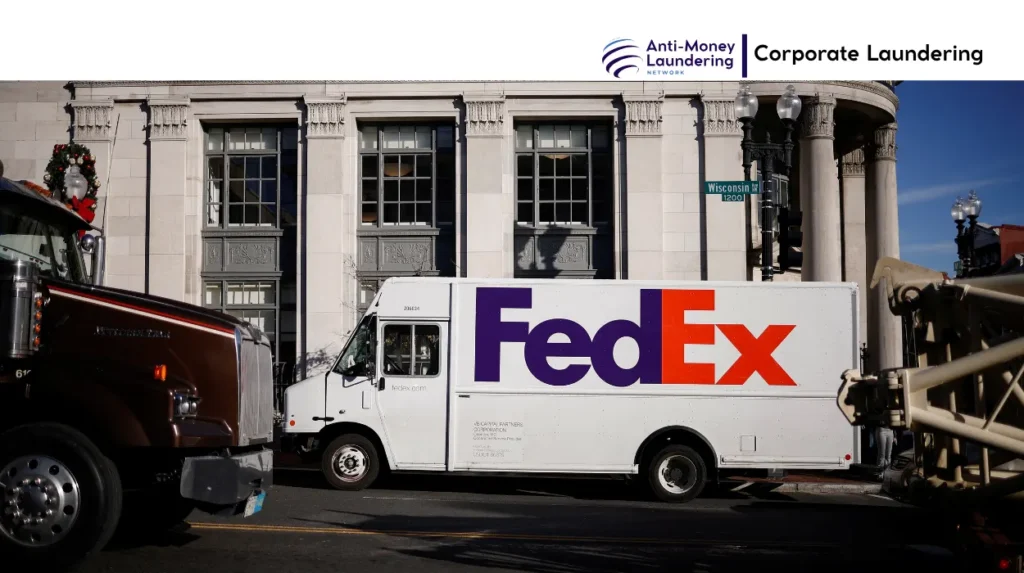
FedEx Corporation stands as a titan in the global logistics industry, renowned for pioneering express delivery services that transformed how goods move across borders. Established in 1971, the company has built an expansive network reaching over 220 countries and territories, facilitating everything from everyday e-commerce packages to critical high-value goods shipments.
Its business model relies on precision, speed, and reliability, handling millions of shipments daily through air, ground, and freight networks. Yet, FedEx Corporation’s history is not without shadows: allegations of money laundering tied to illicit online pharmacy shipments and internal bribery schemes have placed it under intense Anti–Money Laundering (AML) scrutiny.
These incidents highlight how logistics giants can become unwitting—or in some views, knowing—facilitators of suspicious transaction patterns, where cash-intensive business operations intersect with trade-finance arrangements.
This case holds profound significance in the global Anti–Money Laundering (AML) landscape. Logistics firms like FedEx Corporation process vast volumes of trade-based laundering risks, documentary-shipping risks, and high-value goods shipments that could mask illicit finance exposure.
The 2014 U.S. Department of Justice (DOJ) indictment, which explicitly charged money laundering, exposed compliance gaps in Know Your Customer (KYC) and customer due diligence (CDD) processes. It serves as a cautionary tale for regulators worldwide, emphasizing the need for name screening, sanctions risk mitigation, and robust anti-money-laundering controls in non-financial sectors.
By dissecting FedEx Corporation’s FedEx Corporation overview, this article educates compliance professionals on lessons from FedEx Corporation money laundering risk, ensuring such vulnerabilities do not undermine financial transparency.
Background and Context
The FedEx Corporation history traces back to founder Frederick W. Smith, a visionary Yale student whose term paper outlined an overnight air delivery system. Launching Federal Express in 1973 from Memphis, Tennessee—its permanent FedEx Corporation headquarters—the company overcame early hurdles like fuel crises to achieve profitability by 1976.
Strategic expansions defined its ascent: acquiring Gelco’s DASH network in 1984 boosted capacity, while the 1998 acquisition of Caliber System integrated ground services. The 2004 Kinko’s merger added printing capabilities, and the 2016 TNT Express deal solidified European dominance, amplifying FedEx Corporation global operations.
In terms of FedEx Corporation company profile, it operates as a publicly traded holding company (NYSE: FDX) with a FedEx Corporation company structure comprising integrated subsidiaries: FedEx Express for international air, FedEx Ground for North American deferred, FedEx Freight for less-than-truckload, and others like FedEx Logistics for supply chain management. This decentralized model drives FedEx Corporation business efficiency but also introduces oversight challenges.
FedEx Corporation revenue for fiscal 2025 topped $90 billion, with FedEx Corporation financials reflecting resilience amid e-commerce booms—2024 saw $84.2 billion amid supply chain disruptions. Investor relations emphasize dividend growth and share buybacks, while FedEx Corporation careers attract talent in aviation, tech, and compliance.
FedEx Corporation leadership, transitioned to CEO Rajesh Subramaniam in 2022, oversees a workforce of 500,000+. Before controversies, the firm enjoyed unblemished FedEx Corporation AML compliance repute. The timeline to exposure began in the late 2000s with surging online pharmacies peddling opioids. Internal couriers reported anomalies—shipments to parking lots, vacant homes, or via intermediaries—red flags of structuring and suspicious transactions.
By 2012, DEA probes linked these to rogue pharmacies generating $820 million illicitly. FedEx Corporation ignored closure requests, prioritizing volume, culminating in 2014 charges that illuminated FedEx Corporation illicit finance exposure through documentary-shipping risks.
Mechanisms and Laundering Channels
Delving into the core of FedEx Corporation’s issues reveals sophisticated laundering mechanisms exploiting its logistics prowess. The primary channel involved trade-based laundering via high-value goods shipments for illegal online pharmacies. From 2005-2012, FedEx Corporation knowingly transported over 200,000 packages of controlled substances like hydrocodone, generating $630,000 in shipping fees—deemed money laundering proceeds by prosecutors.
These linked transactions exemplified structuring: small, frequent shipments evading scrutiny, misdeclared as “supplements” to bypass customs. Freight services facilitated hybrid money laundering, blending physical goods with electronic funds transfer (EFT) payments for fees.
No FedEx Corporation shell company or FedEx Corporation offshore entity structures were implicated; as a transparent public entity, risks arose from operational blind spots. Beneficial owner transparency was not an issue, nor FedEx Corporation politically exposed person (PEP) links. Instead, FedEx Corporation documentary-shipping risks stemmed from lax bills of lading oversight, enabling trade-finance arrangements to conceal value transfers.
High-value goods shipments, like jewelry under FedEx Corporation’s $100,000 declared value program, posed cash-intensive business risks—potentially smuggling equivalents to laundered cash.
Compounding this was FedEx Corporation fraud via internal bribery. In a scheme spanning years, Senior Line Manager Ryan Mower awarded $280 million in fraudulent contracts to trucking firms for $900,000 in bribes, including cash, jobs, and gifts.
This FedEx Corporation Fraud indirectly bolstered illicit networks by inflating vendor pools potentially handling suspicious cargo. Customer due diligence (CDD) failures allowed high-risk clients persistence, with inadequate Know Your Customer (KYC) missing name screening hits on DEA watchlists. These mechanisms underscore FedEx Corporation money laundering risk in global ops, where volume trumps vigilance.
Regulatory and Legal Response
Regulatory scrutiny peaked with the DOJ’s July 2014 indictment in San Francisco federal court, charging FedEx Corporation on 15 counts: conspiracy to distribute controlled substances and aiding/abetting drug trafficking. The August revision added money laundering, arguing fees were crime-derived. Investigators cited ignored red flags—DEA warnings, courier complaints—and emails boasting “special handling” for pharmacies.
This invoked Bank Secrecy Act AML mandates, paralleling FATF Recommendation 15 on non-financial businesses.
FedEx Corporation pled not guilty in September 2014. Amid trial prep exposing internal docs, a June 2016 deferred prosecution agreement (DPA) resolved it: $28 million civil penalty, three-year oversight, and compliance overhaul. No admission of guilt, but reforms included enhanced training and monitoring. The bribery probe, unsealed March 2020, led to Mower’s indictment; by 2026, contractors faced sentencing for $300,000 bribes yielding $150 million revenue.
DOT’s Office of Inspector General probed sanctions risk, while FinCEN eyed reporting lapses. Beneficial Ownership rules under the 2021 Corporate Transparency Act indirectly influenced, mandating transparency absent in the public FedEx Corporation structure. No blacklisting ensued, but the case reinforced FATF calls for CDD in trade hubs, elevating FedEx Corporation anti-money-laundering controls scrutiny.
Financial Transparency and Global Accountability
The scandal pierced FedEx Corporation’s financial transparency veil, exposing global accountability gaps. Cross-border shipments fragmented data, hindering linked transactions visibility. U.S. prosecutors lambasted due diligence shortfalls, where siloed FedEx Corporation subsidiaries missed holistic KYC. Internationally, FATF-style bodies in Europe and Asia flagged similar logistics vulnerabilities post-TNT integration.
FedEx Corporation responded with its Corporate Integrity program: AI-powered name screening, transaction analytics, and third-party audits. Ethisphere’s 2024 recognition validated ethics enhancements. The case spurred cross-border data sharing akin to FATF’s Travel Rule for virtual assets, adapted to freight manifests.
It influenced EU AML directives, tightening reporting for high-risk shippers, and prompted banks financing FedEx Corporation trade-finance arrangements to bolster sanctions risk checks. Lessons amplified global Anti–Money Laundering (AML) cooperation, positioning logistics as FATF focus.
Economic and Reputational Impact
Economically, the $28 million hit was negligible against FedEx Corporation revenue, but shares fell 5% post-indictment, pressuring FedEx Corporation financials. Compliance costs soared past $100 million, with legal fees and audits denting margins. Partnerships frayed—pharma clients defected amid illicit finance exposure fears—while insurers hiked premiums for high-value goods shipments.
Reputational scars lingered: FedEx Corporation leadership faced backlash, accelerating Smith’s CEO exit. Stakeholder trust eroded, spiking FedEx Corporation investor relations scrutiny; Vanguard and BlackRock queried governance.
Broader impacts rippled: UPS and DHL fortified AML, stabilizing markets. Globally, customs delays in high-risk jurisdictions hiked FedEx Corporation global operations costs, warning of forced liquidation for tainted partners. Recovery hinged on robust FedEx Corporation careers in compliance, restoring confidence.
Governance and Compliance Lessons
Corporate Governance cracks were foundational: decentralized subsidiaries bred inconsistent anti-money-laundering controls, ignoring suspicious transaction patterns. Internal audits overlooked pharmacy surges, flouting due diligence. Post-DPA, FedEx Corporation centralized compliance under a Chief Ethics Officer, mandating annual training for 500,000+ employees and integrating real-time KYC across platforms.
Lessons abound: logistics demands shipment-level CDD, predictive analytics for structuring, and vendor name screening. Regulators codified these via enhanced oversight, closing hybrid money laundering gaps. FedEx Corporation leadership’s overhaul—Subramaniam’s ethics focus—models resilience, earning industry accolades.
Legacy and Industry Implications
FedEx Corporation’s saga reshaped AML in logistics, birthing “cargo risk” frameworks. DOJ’s DPA template standardized non-bank resolutions, emphasizing trade-based laundering via docs. FATF issued 2018 guidance on cash-intensive business, citing FedEx Corporation analogs. Peers adopted monitoring, curbing structuring in freight.
As a turning point, it elevated transparency standards, influencing IFRS disclosures on compliance risks. Legacy persists in proactive FedEx Corporation AML compliance, benchmarking ethics amid e-commerce surges.
FedEx Corporation’s money laundering brush and fraud expose logistics’ perils. Key findings: structuring via high-value goods shipments, governance silos—addressed via reforms and penalties. It affirms financial transparency, accountability, and AML frameworks’ vitality in global finance.