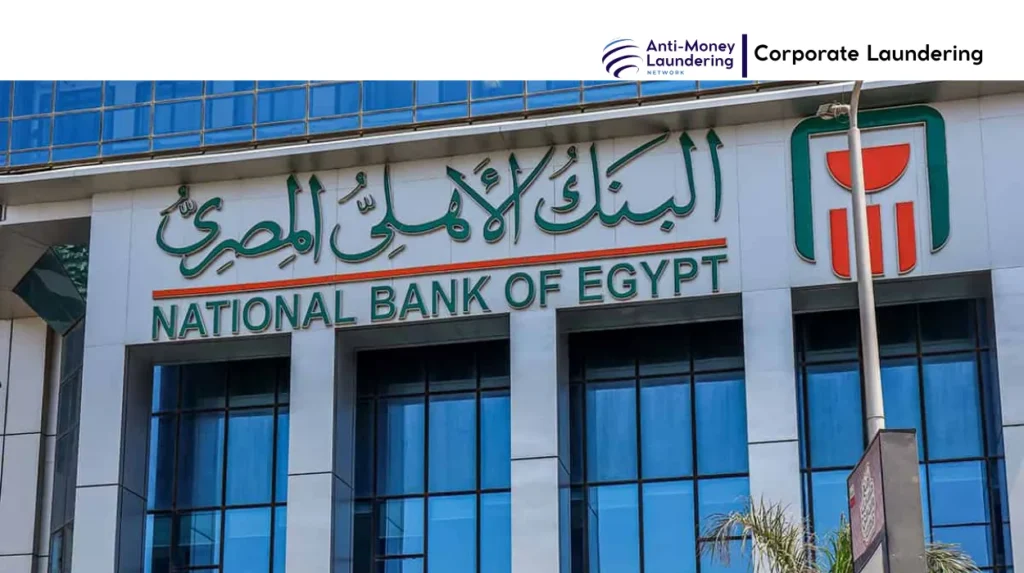
The National Bank of Egypt is Egypt’s oldest and largest commercial bank, established in 1898 and now wholly owned by the Egyptian state through the Ministry of Finance. From its head office in Cairo, it oversees a vast domestic branch network and international units, including operations in the United Kingdom and representative or historical presences in other jurisdictions, giving it systemic importance in Egypt’s financial sector.
Because of its size, central role in government financing, and exposure to politically exposed persons, the bank inevitably attracts attention in discussions of money‑laundering risk, even though public records and mutual evaluation reports do not attribute a discrete, well‑documented corporate laundering case to it.
Instead, the National Bank of Egypt features in the AML landscape as a flagship state bank within a jurisdiction that has faced criticism and then gradual improvement under FATF‑style evaluations, rather than as a named offender in major leaks or global enforcement actions.
This situation makes the bank an instructive case study for compliance professionals: it shows how a dominant, state‑owned institution can carry high inherent risk factors without necessarily appearing in headline money‑laundering prosecutions. It also illustrates how supervisory expectations, governance frameworks and international perceptions evolve around such an institution inside a medium‑risk jurisdiction.
Background and Context
The National Bank of Egypt began as a joint‑stock company under British influence and gradually evolved into a fully nationalized entity, particularly after the 1960s, when Egypt restructured its central banking and commercial banking functions. Today, it functions as a commercial bank rather than the central bank, but remains heavily intertwined with public finances and sovereign priorities, and maintains a dominant market share of deposits, loans and total banking assets in Egypt.
The bank’s geographic footprint is extensive. Domestically it operates thousands of branches and service outlets across Cairo, Alexandria, Upper Egypt and coastal regions, including major business and residential districts that handle large volumes of cash and retail flows. Internationally, it has maintained operations in London through National Bank of Egypt (UK) Limited and has had historical presences in locations such as New York and Sudan, providing correspondent banking links, trade finance and remittance services for Egyptian and regional clients.
This network exposes the institution to cross‑border transaction risks, including potential misuse of correspondent accounts or trade‑finance structures, even when no specific case has been proven.
From a governance perspective, the National Bank of Egypt is chaired by a non‑executive chairman and run by an executive chief executive officer, with a board of directors appointed under state ownership and subject to central bank oversight. The bank publishes corporate governance reports and financial statements that outline its risk management, internal audit and compliance structures, including the presence of specialized AML and sanctions units reporting to senior management and board committees.
These disclosures are broadly consistent with expectations for systemically important financial institutions in emerging markets, although they do not necessarily provide granular detail on specific suspicious transaction monitoring models or enforcement actions.
The wider context is that Egypt, as a jurisdiction, has long been viewed as vulnerable to money laundering due to a large informal economy, cash‑intensive sectors, smuggling, corruption and proximity to conflict zones. International reports highlight weaknesses in enforcement and supervision during the 2000s and early 2010s, even as legal frameworks formally met many FATF standards. The National Bank of Egypt operates squarely within this risk environment, so its AML posture and performance are intertwined with Egypt’s national reforms and mutual evaluation outcomes.
Mechanisms and Laundering Channels: Risk, Not Proven Cases
Publicly available information does not document a specific, large‑scale money‑laundering scheme orchestrated through the National Bank of Egypt, such as a named trade‑based laundering network, a shell‑company layering ring, or an offshore structure explicitly controlled by the bank and used to obscure beneficial owners. Instead, the institution appears in the AML conversation primarily through the lens of potential risk channels inherent in its business model and context.
The main risk vectors can be summarized as follows:
- Large domestic retail and corporate footprint
The bank handles enormous volumes of cash deposits, domestic transfers and retail lending, creating exposure to placement and layering attempts by local criminal groups and tax evaders. In an economy with a high share of informal activity and cash‑based trade, this raises the baseline risk that illicit proceeds may enter the banking system through routine retail and SME accounts. - Cross‑border flows and trade finance
Through international branches and correspondent relationships, the bank supports trade finance, remittances and corporate flows between Egypt and other regions, which are classic channels for trade‑based money laundering and invoice manipulation. Even without named public cases against the bank, the sector‑wide vulnerability to mis‑priced imports, phantom exports and dual‑use goods is well documented for Egypt and the broader MENA region. - Politically exposed person exposure
As a state‑owned bank with government entities and politically connected individuals among its key clients, the National Bank of Egypt has significant exposure to PEP‑related risk. This includes managing accounts for ministries, state‑owned enterprises and senior officials, especially during periods when corruption and asset‑flight concerns were prominent, such as the years surrounding the 2011 uprising and subsequent investigations into former regime figures. While various international asset‑recovery and money‑laundering cases involved Egyptian elites, the public record does not show the bank itself being sanctioned or prosecuted as a knowing facilitator. - Legacy and correspondent risk
Historic correspondent banking links, including with US and European banks, required the National Bank of Egypt to adhere to increasingly stringent AML expectations and sanctions controls, especially regarding US dollar clearing. Resolution‑planning documents and risk disclosures from foreign regulators treat the bank as a material foreign banking organization but do not cite specific enforcement actions for money‑laundering breaches.
In sum, the available record supports an assessment that the National Bank of Egypt is exposed to high‑risk channels due to its size, client base and environment, but it does not support the claim that it has been publicly identified as the central vehicle in a major corporate laundering scheme. For AML practitioners, the bank is therefore a case study in high inherent risk mitigated—at least in part—by evolving compliance controls rather than an example of overt misconduct.
Regulatory and Legal Response
To understand the bank’s situation, it is necessary to examine how regulators and international bodies have evaluated Egypt’s AML framework and banking supervision, rather than focusing on nonexistent direct enforcement actions against the institution itself. The key reference points here are the MENAFATF mutual evaluation reports and subsequent follow‑up assessments.
The 2009 mutual evaluation for Egypt identified a number of weaknesses in the country’s anti‑money‑laundering and counter‑terrorist‑financing regime, including limited effectiveness of suspicious transaction reporting, gaps in supervision of some sectors, and challenges in implementing customer due diligence requirements consistently across financial institutions. While the report discussed supervisory arrangements for banks, it did not single out the National Bank of Egypt for specific deficiencies or sanctions, treating the issues as systemic rather than institution‑specific.
In later follow‑up reports, MENAFATF documented legislative improvements, enhanced supervisory practices by the Central Bank of Egypt, and gradual progress in aligning with FATF Recommendations. By the early 2020s, Egypt was assessed as Compliant or Largely Compliant with the majority of technical standards, though questions remained around effectiveness metrics such as prosecutions, confiscations and the number and quality of suspicious transaction reports.
Crucially for this analysis, none of these reports or subsequent public enforcement bulletins show a major administrative or criminal penalty directed at the National Bank of Egypt for money‑laundering or terrorist‑financing violations. International financial institutions and rating agencies, such as Fitch, have continued to interact with the bank, providing funding or assessing its credit profile without flagging unresolved AML enforcement actions.
The legal response is therefore characterized by:
- System‑wide reforms driven by mutual evaluation findings, including updates to AML laws, beneficial‑ownership requirements and supervisory frameworks.
- Central bank oversight of major banks, including the National Bank of Egypt, to ensure implementation of customer‑due‑diligence and suspicious‑transaction‑reporting obligations.
- Absence of publicly disclosed, bank‑specific sanctions for money‑laundering misconduct.
This does not mean the bank has never faced regulatory queries or internal remediation demands; it means only that such matters, if they exist, have not been publicized as major enforcement cases.
Financial Transparency and Global Accountability
One of the core questions for AML professionals is whether a state‑owned institution of this scale contributes to or mitigates opacity in a medium‑risk jurisdiction. In the case of the National Bank of Egypt, several transparency and accountability features are visible from public sources.
The bank publishes annual reports and corporate governance documents that provide overviews of its risk‑management framework, board composition, committee structures and audit arrangements. These materials typically describe the existence of compliance and AML functions, the role of internal audit and the oversight of the board and relevant committees.
While they are not detailed technical manuals, they are consistent with disclosure norms for large banks in emerging markets.
International benchmarks and civil‑society assessments provide additional context. BankTrack, for example, profiles the National Bank of Egypt mainly from an environmental and social lens, and does not list the bank as involved in high‑profile financial crime or corruption scandals. The World Benchmarking Alliance also includes the bank within its financial system assessments, signalling recognition in global accountability debates.
In parallel, Egypt’s broader AML efforts have attracted attention from FATF and related bodies. In recent years, public communications have highlighted improvements in financial inclusion, payments digitization and AML/CFT risk management, citing initiatives led by the Central Bank of Egypt and major banks.
The National Bank of Egypt, as a flagship institution, benefits from and contributes to these system‑wide initiatives, even though it is not individually praised or criticized in most international statements.
From an accountability standpoint, this profile suggests a large state bank operating within a gradually improving regulatory environment, under international observation but without explicit, public findings of money‑laundering misconduct against it. Transparency is therefore partial: sufficient to infer governance structures and policy directions, but not detailed enough to allow outside analysts to fully evaluate its transaction‑monitoring and sanctions‑screening performance.
Economic and Reputational Impact
Because there is no documented, high‑profile laundering scandal centered on the National Bank of Egypt, there has been no specific, scandal‑driven shock to its finances, market access or reputation equivalent to the crises experienced by certain international banks. Instead, the bank’s economic and reputational trajectory reflects broader Egyptian macroeconomic conditions and sovereign risk dynamics.
Credit‑rating agencies such as Fitch consistently treat the bank’s ratings as closely linked to the creditworthiness of the Egyptian state, rather than to idiosyncratic operational problems. In its 2025 affirmation, Fitch highlighted the bank’s role as a key lender to the government and its systemic importance, while noting asset‑quality and capital‑adequacy challenges common to the domestic banking sector. AML or sanctions risk did not feature as central drivers of the rating.
On the reputational front, the National Bank of Egypt faces the same perception challenges as other large institutions in higher‑risk jurisdictions: correspondents and investors may view the entire jurisdiction as carrying elevated money‑laundering and corruption risk, regardless of the internal controls of individual banks. This can result in higher compliance costs, de‑risking pressures from foreign banks, and intensive due‑diligence demands in cross‑border relationships. However, absent a specific scandal, such pressures translate into ongoing scrutiny and documentation requirements, not into blacklisting or loss of market access.
Thus, the bank’s economic and reputational profile is shaped more by country risk and sovereign dynamics than by any proven corporate laundering case. For AML practitioners, this underlines the importance of separating jurisdictional risk assessments from institution‑specific misconduct when designing controls, especially for counterparties in emerging markets.
Governance and Compliance Lessons
Even though the National Bank of Egypt does not provide a classic “case study” of exposed corporate laundering, it offers several governance and compliance lessons relevant to AML frameworks.
First, the combination of state ownership, systemic importance and exposure to politically connected clients demands heightened governance standards. The bank’s corporate governance report describes a board and committee structure with oversight responsibilities for risk, audit and compliance, including AML. While external observers cannot fully verify effectiveness, the existence of these structures shows formal alignment with global governance norms for large banks.
Second, the evolution of Egypt’s AML regime illustrates how external evaluations can drive internal reform. The critical findings of the 2009 mutual evaluation and subsequent follow‑up reports pushed authorities and major banks to strengthen customer‑due‑diligence procedures, beneficial‑ownership identification and suspicious‑transaction reporting. The National Bank of Egypt, as a leading institution, would have been a primary focus of these reforms, needing to update policies, train staff and invest in transaction‑monitoring systems.
Third, the absence of public enforcement cases does not imply low risk; rather, it underscores the need for continuous, independent assurance. For counterparties and investors, an institution like the National Bank of Egypt should be assessed through enhanced due diligence that examines governance frameworks, audit practices, sanctions controls and exposure to high‑risk customers and sectors, regardless of whether it has been publicly sanctioned.
This reflects a broader AML lesson: the goal is to evaluate risk and controls proactively, not wait for scandals to surface.
Finally, the bank’s situation highlights the importance of integrating AML with broader corporate‑governance and risk‑management agendas. Issues such as credit risk, operational risk and reputational risk are intertwined with money‑laundering risk, especially for a bank so closely linked to the state and to strategic sectors of the economy. Effective governance must therefore treat AML as a core component of enterprise risk management, rather than as a narrow compliance checkbox.
Legacy and Industry Implications
The legacy of the National Bank of Egypt in the AML domain is less about a single, defining scandal and more about its role in a jurisdiction undergoing gradual improvement in line with FATF standards. In that sense, the bank stands as an example of how large, state‑owned institutions in higher‑risk environments can evolve under international pressure without being cast as primary villains in global money‑laundering narratives.
For the wider industry, this case underscores several implications:
- International standards and mutual evaluations can reshape entire banking sectors, including flagship state banks, even in the absence of headline‑grabbing enforcement cases.
- AML practitioners must resist the temptation to equate the absence of public sanctions with low risk, especially in jurisdictions where enforcement transparency may be limited.
- Correspondent banks and investors should develop nuanced, institution‑specific risk views that consider governance quality, public disclosures and engagement with supervisors, instead of relying solely on jurisdiction labels.
In regions where public enforcement records are sparse, institutions like the National Bank of Egypt become test cases for how far global AML expectations can penetrate state‑dominated banking systems. Their performance and disclosures, even if imperfect, influence perceptions of entire jurisdictions and shape the willingness of foreign banks to maintain relationships.
An examination of the National Bank of Egypt and publicly available AML‑related material does not reveal a discrete, well‑documented corporate laundering or fraud scandal directly attributable to the institution. Instead, it portrays a large, state‑owned commercial bank operating within a jurisdiction long viewed as vulnerable to money‑laundering and corruption, yet undergoing gradual reform and closer alignment with FATF standards.
For AML and compliance professionals, the key lessons are therefore analytical rather than narrative. The National Bank of Egypt illustrates how inherent risk—stemming from size, state ownership, PEP exposure and cross‑border activity—must be managed through governance structures, supervisory engagement and continuous enhancement of due‑diligence and monitoring practices, even when no major public enforcement case has surfaced.
It also shows how international evaluations and country‑level reforms can reshape expectations for flagship institutions, influencing their policies and disclosures over time.