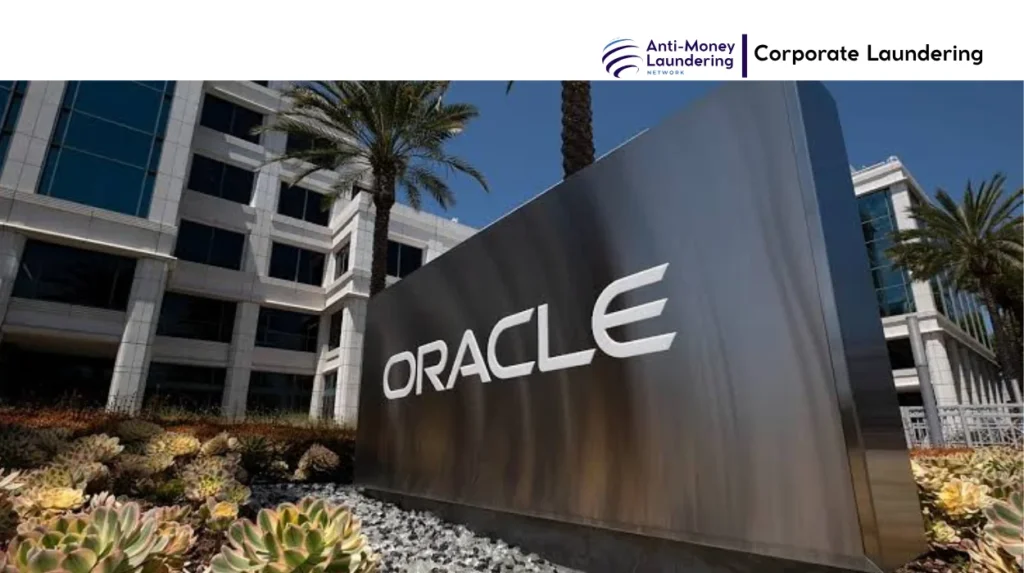
Oracle Corporation is a U.S.-based multinational technology company and one of the world’s largest providers of enterprise software, database systems, and cloud infrastructure. Founded in 1977 and headquartered in Austin, Texas, Oracle’s global operations span more than 175 countries, with a dominant market position in relational databases, enterprise resource planning (ERP), and cloud services.
While Oracle is not itself a classic money-laundering vehicle, its corporate history includes significant Foreign Corrupt Practices Act (FCPA) violations involving slush funds, off-book payments, and bribery of foreign officials through subsidiaries in India, Turkey, and the United Arab Emirates (UAE). These misconduct patterns are directly relevant to Anti–Money Laundering (AML) risk assessments, as they illustrate how large, seemingly legitimate enterprises can enable financial crime, obscure beneficial ownership, and create channels for trade-based laundering and suspicious transactions.
This article examines Oracle’s company profile, the mechanisms behind its financial misconduct, regulatory responses, and the broader implications for corporate governance, financial transparency, and global AML frameworks.
Introduction
Oracle Corporation is a cornerstone of the global digital economy, providing database software, enterprise software suites, and cloud infrastructure services to governments, financial institutions, and multinational corporations. Its revenue streams include software licenses, cloud subscriptions, hardware, and professional services, with a revenue breakdown heavily weighted toward high-value, recurring enterprise contracts.
Despite its stature, Oracle has faced repeated enforcement actions for foreign bribery and books-and-records violations. In 2012 and again in 2022, the U.S. Securities and Exchange Commission (SEC) charged Oracle with using slush funds at foreign subsidiaries to make unauthorized payments, including bribes to foreign officials. While these cases are framed primarily as FCPA violations, they intersect with money laundering concerns, as off-book funds, fake vendors, and disguised payments can facilitate layering and integration of illicit proceeds.
For AML professionals, Oracle’s case underscores the importance of scrutinizing corporate governance, compliance and audit practices, and global subsidiaries in high-risk jurisdictions. It also highlights how Oracle Corporation AML risks arise not only from its own conduct but also from the potential misuse of its complex billing and licensing structures by third parties.
Background and Context
Oracle’s founding history traces back to 1977, when Larry Ellison, Bob Miner, and Ed Oates launched the company in Santa Clara, California. Oracle’s database solutions quickly became industry standards, and its enterprise software suite expanded into ERP, supply chain, and human resources applications. Major acquisitions—including PeopleSoft, Siebel, and Sun Microsystems—cemented Oracle’s market share and diversified its revenue streams.
By the 2020s, Oracle’s cloud services overview showed a strategic pivot toward cloud infrastructure services and subscription-based models. Its leadership team, including Ellison (Executive Chairman & CTO), Safra Catz (Executive Vice Chair), and co-CEOs Clay Magouyrk and Mike Sicilia, oversaw a company with tens of billions in annual revenue and a vast network of global subsidiaries and channel partners.
Oracle’s misconduct did not emerge in isolation. Key milestones include the period from 2005 to 2007, when Oracle India employees structured government sales so distributors parked approximately $2.2 million in side funds off Oracle’s books. These funds were used to pay phony vendors and create potential for bribery. In 2012, the SEC charged Oracle with FCPA books-and-records and internal controls violations. Oracle agreed to pay a $2 million penalty without admitting or denying the allegations. Between 2016 and 2019, subsidiaries in India, Turkey, and the UAE used discount schemes and sham marketing reimbursements to create slush funds, which were used to bribe foreign officials and fund improper travel and conference benefits. In 2022, the SEC announced a $23 million settlement comprising a $15 million penalty plus approximately $8 million in disgorgement and interest for FCPA violations linked to these slush funds. This pattern reveals repeated compliance lapses across multiple jurisdictions and years, despite Oracle’s public commitment to corporate governance and compliance and audit practices.
Mechanisms and Laundering Channels
Oracle’s misconduct did not involve a dedicated shell company or offshore entity in the classic sense, but it relied on mechanisms that overlap with money laundering typologies. In India between 2005 and 2007, Oracle employees structured transactions with the Indian government so that distributors retained excess proceeds—about $2.2 million—outside Oracle’s official records. These side funds were then used to pay purported local vendors, some of which were merely storefronts that provided no real services. Fake invoices were used to document certain payments. This scheme created off-book assets that could be used for unauthorized payments, fake vendors that functioned similarly to shell companies or front entities, and a mechanism for structuring payments to avoid internal controls and external scrutiny.
In the later scheme, Oracle subsidiaries in India, Turkey, and the UAE used discount schemes on software licenses and services, along with sham marketing reimbursement payments to channel partners. These mechanisms generated slush funds held at Oracle’s channel partners. The funds were used to bribe foreign officials to secure or retain business and to pay for officials’ travel to technology conferences, including side trips and family members’ expenses, in violation of Oracle policies. From an AML perspective, these practices resemble trade-based laundering and linked transactions designed to obscure the true purpose and beneficiary of payments. While the primary legal characterization is bribery, the underlying financial flows exhibit features of suspicious transactions, structuring, and potential hybrid money laundering where corruption proceeds are integrated through seemingly legitimate business channels.
Oracle’s global subsidiaries and extensive partner network enabled these schemes. The company’s corporate structure—with multiple legal entities, local distributors, and channel partners—created opportunities to park funds outside central accounting systems, use intermediaries to make payments that were difficult to trace back to Oracle’s core books, and exploit jurisdictional differences in oversight and reporting. While Oracle is not a shell company or offshore entity by design, its global operations and reliance on local partners introduced vulnerabilities that could be exploited for financial crime compliance breaches and money laundering risks.
Regulatory and Legal Response
The SEC has pursued Oracle twice for FCPA-related misconduct. In the 2012 case, the SEC charged Oracle with violating the books-and-records and internal accounting controls provisions of the FCPA. The complaint alleged that Oracle India employees directed distributors to hold proceeds off Oracle’s books and make payments to fake vendors. Oracle agreed to pay a $2 million civil penalty and consented to a permanent injunction against future violations. In the 2022 case, the SEC found that Oracle subsidiaries in India, Turkey, and the UAE created and used slush funds to bribe foreign officials between 2016 and 2019. The order required Oracle to pay approximately $8 million in disgorgement, $15 million in penalties, and cease-and-desist from further FCPA violations. In both cases, Oracle did not admit or deny the findings but agreed to settle, citing its cooperation and remedial measures.
The SEC’s orders highlighted specific failures, including inadequate internal accounting controls to prevent off-book funds, failure to maintain books and records that accurately reflected transactions, insufficient customer due diligence (CDD) and oversight of distributors and channel partners in high-risk markets, and weak name screening and monitoring of vendor payments. These lapses allowed suspicious transactions to occur over multiple years and across multiple jurisdictions.
While the SEC actions were grounded in the FCPA and U.S. securities laws, they intersect with broader AML frameworks, including Financial Action Task Force (FATF) recommendations on beneficial ownership, corporate transparency, and risk-based supervision of non-financial businesses, Know Your Customer (KYC) and CDD expectations for understanding third-party intermediaries and high-risk customers, and beneficial ownership disclosure requirements aimed at preventing the misuse of corporate structures for bribery and laundering. Oracle’s case illustrates how corporate governance failures in a major technology firm can create AML-relevant exposure, even when the primary charge is foreign bribery.
Financial Transparency and Global Accountability
Oracle’s cases revealed several weaknesses in financial transparency and accountability. Off-book funds undermined the reliability of Oracle’s financial statements and internal controls. Fake vendors and slush funds demonstrated how legitimate enterprises can be used to conceal improper payments. Inadequate visibility into global subsidiaries and channel partners allowed misconduct to persist across multiple regions. These issues are not unique to Oracle but reflect systemic challenges in enforcing financial transparency across complex multinational organizations.
While the SEC led the enforcement actions, Oracle’s misconduct had global implications. Regulators in India, Turkey, and the UAE could theoretically have pursued parallel actions, though public records focus on the U.S. settlements. The cases reinforced the need for stronger cross-border data sharing and coordination between securities regulators, anti-corruption agencies, and AML watchdogs. They highlighted gaps in monitoring global subsidiaries and third-party intermediaries, especially in jurisdictions with elevated corruption risk.
Oracle’s settlements required enhancements to its compliance programs, including strengthened internal controls over distributor payments and discounts, improved compliance and audit practices for high-risk markets, and more rigorous name screening and vendor due diligence. While these reforms were Oracle-specific, they contribute to broader efforts to enhance corporate governance, beneficial ownership transparency, and AML cooperation across borders.
Economic and Reputational Impact
Oracle’s FCPA settlements imposed direct financial costs, including a $2 million penalty in 2012 and $23 million in 2022 comprising penalty plus disgorgement and interest. While these amounts are modest relative to Oracle’s overall revenue breakdown and market capitalization, they signal regulatory scrutiny and potential exposure to further enforcement.
Oracle’s stock (NYSE: ORCL) has generally remained resilient, buoyed by its dominant market position in databases and growing cloud infrastructure services. However, repeated compliance failures can erode investor confidence over time, especially as ESG (environmental, social, and governance) considerations gain prominence. Class-action lawsuits alleging securities fraud and misleading disclosures about Oracle’s capabilities (e.g., AI infrastructure) further underscore the reputational and legal risks tied to corporate governance and financial transparency.
Oracle’s misconduct may affect government and public-sector contracts, where FCPA violations can trigger debarment or heightened scrutiny, partnerships with financial institutions that must assess Oracle’s AML risks and sanctions and regulatory risks as part of their own compliance programs, and customer perceptions, especially among entities sensitive to financial crime compliance and ethical sourcing.
Governance and Compliance Lessons
Oracle’s cases highlight several governance and compliance gaps, including inadequate oversight of global subsidiaries and channel partners in high-risk jurisdictions, weak internal controls over discounts, reimbursements, and vendor payments, and insufficient integration of AML, KYC, and anti-corruption functions into enterprise risk management. Although Oracle markets sophisticated AML solutions and financial crime compliance tools to banks, its own internal practices revealed vulnerabilities.
Following the SEC actions, Oracle reportedly terminated employees involved in the misconduct, enhanced its FCPA compliance program including training and monitoring, and improved controls over distributor relationships and off-book arrangements. For AML practitioners, Oracle’s experience underscores the need for robust CDD on distributors, agents, and joint-venture partners, continuous monitoring of linked transactions and unusual payment patterns, and strong corporate governance frameworks that integrate anti-corruption and AML controls.
Legacy and Industry Implications
Oracle’s FCPA cases have become reference points for the risks of slush funds and off-book payments in multinational corporations, the importance of beneficial ownership transparency and corporate governance in non-financial sectors, and the need for regulators to look beyond traditional financial institutions when assessing money laundering concerns. While Oracle remains a major player in enterprise software and cloud services, its enforcement history serves as a cautionary tale for other technology firms with complex global operations and extensive partner networks. The cases also reinforce the convergence of anti-corruption and AML enforcement, where bribery, fake vendors, and trade-based laundering typologies often overlap.
Oracle Corporation is not a shell company, offshore entity, or dedicated laundering vehicle, but its FCPA violations involving slush funds, fake vendors, and bribery of foreign officials demonstrate how large, legitimate enterprises can facilitate financial crime and create AML risks. The company’s corporate governance failures, inadequate internal controls, and insufficient oversight of global subsidiaries allowed misconduct to persist across multiple jurisdictions and years.
For AML professionals, Oracle’s case offers several lessons. Financial transparency and accurate books-and-records are foundational to preventing money laundering and corruption. Beneficial ownership and third-party due diligence are critical, even for non-financial corporates. Strong corporate governance, compliance and audit practices, and cross-border regulatory cooperation are essential to safeguard the integrity of global finance.
As enterprises like Oracle continue to expand their cloud services, database solutions, and global operations, the intersection of corporate governance, financial crime compliance, and Anti–Money Laundering (AML) will only grow in importance. Oracle’s history underscores the need for vigilance, robust controls, and a commitment to financial transparency to mitigate Oracle Corporation AML risks and protect the broader financial system from money laundering, fraud, and corruption.