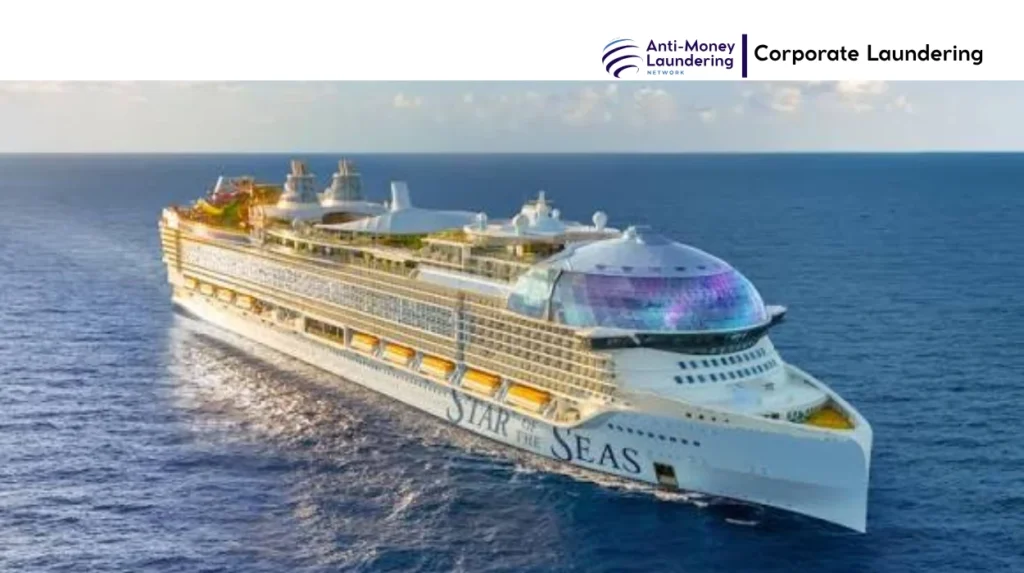
Royal Caribbean Group is a global cruise and resort operator formed from the rebranding of Royal Caribbean Cruises Ltd., one of the world’s largest cruise‑holding companies. The group operates under brands such as Royal Caribbean International, Celebrity Cruises, Silversea Cruises, and Azamara, and owns a 50% stake in the TUI Cruises/Hapag‑Lloyd Cruises joint venture. Its Royal Caribbean Group headquarters are in Miami, Florida, but the entity is incorporated in Liberia, with substantial operations across the Caribbean, Europe, Latin America, Asia, and Australia.
While Royal Caribbean Group is not a textbook example of organized‑crime‑led money laundering, its operational model and corporate structure exhibit several Anti–Money Laundering (AML)‑relevant risk features. The company’s cash‑intensive business environment on board ships, extensive use of prepaid cruise accounts and card‑based payments, and its cross‑border corporate web touching offshore entities and tax‑sensitive jurisdictions have raised regulatory and compliance‑risk questions. This case matters in the global Anti–Money Laundering (AML) landscape because it illustrates how large‑scale tourism and leisure corporations can become potential conduits for structured, layered, or hybrid money laundering, even without being a traditional shell‑launderer.
Background and Context
Royal Caribbean Group’s history is rooted in the 1969 founding of Royal Caribbean Cruises, which began as a Norwegian‑backed consortium and later evolved into a publicly traded cruise‑holding company. Over several decades, the company expanded its fleet and brand portfolio, acquiring or partnering with other cruise operators and gradually reshaping its identity into Royal Caribbean Group. The Royal Caribbean Group history is characterized by a mix of organic growth and strategic acquisitions, including Celebrity Cruises, Azamara, and Silversea Cruises, as well as the formation of TUI Cruises.
By the 2020s, Royal Caribbean Group ships numbered in the dozens, offering a diverse portfolio of vessels that span the global cruise markets. The company serves hundreds of Royal Caribbean Group destinations, from Caribbean ports and Mediterranean harbors to Southeast Asian and Australian routes. Its Royal Caribbean Group passengers include a broad mix of leisure travelers, premium‑tier clients, and group‑charter bookings, contributing to a highly diversified top‑line. The Royal Caribbean Group revenue model reflects this complexity, combining ticket sales, extensive on‑board spend, and land‑based income from cruise‑related resorts and destinations.
This growth has been accompanied by an increasingly intricate corporate structure. The Liberia‑incorporated parent controls subsidiaries and joint ventures in multiple jurisdictions, including Germany, the Bahamas, and other offshore‑linked locations. The Royal Caribbean Group ownership web is therefore not a simple, single‑jurisdiction setup but a layered arrangement that reflects both global operational needs and tax‑planning considerations. The company’s Royal Caribbean Group overview emphasizes its scale, brand strength, and technological Royal Caribbean Group innovations, but this same structure also creates surfaces where AML‑related risks can accumulate.
Mechanisms and Laundering Channels
From a corporate laundering standpoint, Royal Caribbean Group is not documented as a front for organized‑crime money laundering. Instead, its business model generates several AML‑relevant channels that, if exploited, could be used to layer illicit funds into legitimate operations. The most significant of these channels relate to onboard cash flows, prepaid and card‑based payment systems, and the company’s cross‑border corporate structure.
The cash‑intensive business environment on board Royal Caribbean Group ships is a primary risk factor. Passengers routinely spend on casinos, duty‑free retail, shore excursions, beverage packages, and spa services, many of which accept cash or cash‑top‑ups to onboard accounts. This setting is structurally similar to high‑risk retail or gaming sectors, where structuring and smurfing can occur. A customer could, for example, repeatedly deposit small‑value cash sums into a cruise account, then convert those balances into high‑value excursions, jewelry, or casino‑chip purchases, effectively layering illicit funds into seemingly legitimate passenger activity. Because the ship operates in multiple jurisdictions and currencies, tracking such patterns across borders adds complexity to suspicious transaction‑detection efforts.
Beyond onboard cash, Electronic funds transfer (EFT) and card‑based systems introduce another layer of AML‑risk. A substantial share of Royal Caribbean Group revenue is booked in advance, with many customers using credit cards or digital payment methods. On‑board accounts can also be topped up via card or mobile‑payment channels, creating a hybrid environment where cash and non‑cash flows intertwine. These systems are attractive substitution channels for hybrid money laundering, where illicit funds are mixed with legitimate passenger funds and then converted into non‑cash experiences or goods that are harder to trace. For instance, an individual could use fraud‑financed card payments to fund a luxury cruise package, then later convert those benefits into third‑party services or goods, obscuring the origin of the funds.
The company’s corporate structure also contributes to Money laundering‑relevant risk patterns. Royal Caribbean Group is incorporated in Liberia, a jurisdiction historically associated with flexible ship‑registration rules and corporate‑law frameworks. The company operates through a network of subsidiaries and joint ventures in jurisdictions such as the Bahamas, Germany, and other offshore‑linked locations. While these entities are tied to tangible assets like ships, ports, and resort developments, they still function as offshore entities with potential for trade‑based laundering‑style exploitation.
In principle, offshore entity‑linked intercompany transfers and management‑fee arrangements could be used to shift profits or obscure beneficial ownership. For example, inflated management fees or service contracts paid to an offshore‑linked subsidiary could serve as a mechanism for loan‑back schemes or disguised profit‑shifting. Real‑estate‑related projects, such as the Royal Caribbean Group‑linked cruise‑destination developments in Freeport, Bahamas, add another dimension. High‑value property purchases or redevelopments in these ventures could, in a hypothetical case, be used to immobilize or “park” funds in a way that mirrors real‑estate‑driven money laundering.
The company’s Royal Caribbean Group partners and joint ventures further expand the web of linked transactions. Contracts between the parent company and its subsidiaries or partners for ship‑repair services, port‑development, branding, and operating rights create flows that are difficult to monitor without robust internal controls. If documentation is inconsistent or inflated, these flows could be misused to justify abnormal transfers of value, masking the movement of illicit funds across borders. This structural risk is not unique to Royal Caribbean Group, but its size and global footprint make it a high‑visibility example of how multinational leisure operators can intersect with AML‑related vulnerabilities.
Regulatory and Legal Response
To date, there is no public evidence that Royal Caribbean Group has been formally charged as a money laundering vehicle or a shell company tied to organized crime. The company remains a publicly listed entity with active operations and no AML‑related blacklisting or sanctions. However, its interactions with regulators and law‑enforcement bodies reveal important AML‑relevant dynamics.
The most notable regulatory engagement in recent years involves a 2018 U.S. data‑order case in which federal authorities compelled Royal Caribbean Cruises Ltd. to disclose stored electronic communications and customer‑related data in connection with a money laundering investigation. The court treated the company as a provider of electronic‑communication services, requiring it to hand over onboard data that could be relevant to tracing illicit financial activity. This case demonstrates that Royal Caribbean Group’s onboard systems are viewed as relevant to AML investigations, even if the company itself is not accused of laundering.
From a compliance perspective, the ruling underscores the expectation that Royal Caribbean Group must maintain robust customer due diligence (CDD) and Know Your Customer (KYC) processes. This includes name screening against sanctions lists and Politically Exposed Person (PEP) registers, as well as transaction‑monitoring rules capable of detecting suspicious transactions on board ships or in pre‑booking systems. The data‑order case also signals that regulators may treat cruise‑line operators not only as tourism providers but as data‑rich nodes in the broader AML‑investigation ecosystem.
Beyond this specific engagement, Royal Caribbean Group operates under broader U.S. and international regulatory frameworks. As a New York Stock Exchange‑listed company (RCL), it is subject to securities laws, corporate‑governance rules, and AML‑aligned requirements that emphasize transparency, internal controls, and financial‑reporting discipline. The company’s Royal Caribbean Group CEO and board are expected to oversee risk‑management frameworks that address financial‑crime threats, including fraud, money laundering, and trade‑based laundering‑style risks.
Historically, the group has faced non‑AML‑related enforcement actions, most notably a 1999 environmental‑crime case in which Royal Caribbean Cruises Ltd. pleaded guilty to illegal waste‑disposal practices at sea and paid an 18 million dollar fine. While this case is not directly about money laundering, it establishes a precedent for large‑value forced liquidation‑style penalties when regulators find corporate‑level compliance failures. This history signals that Royal Caribbean Group operates in a sector where regulatory tolerance for misconduct is low, and that repeated failures in risk‑management or disclosure could trigger significant financial and reputational consequences.
Financial Transparency and Global Accountability
The Royal Caribbean Group case highlights the friction between legitimate corporate‑tax planning and the need for greater financial transparency in global finance. The company’s use of a Liberia‑incorporated parent with subsidiaries and joint ventures in tax‑sensitive jurisdictions reflects a common strategy for multinational operators, but it also complicates beneficial ownership mapping and cross‑border supervision.
International regulators and watchdog organizations have increasingly focused on beneficial ownership disclosure requirements for offshore‑linked entities, as well as enhanced data‑sharing mechanisms between jurisdictions. The Royal Caribbean‑related data‑order case illustrates how electronic‑communication data and onboard‑payment records can be treated as part of the broader AML‑investigation toolkit. It also reinforces the need for financial institutions that process Electronic funds transfer (EFT) flows related to cruise‑bookings to strengthen their monitoring of high‑value, cross‑border spending patterns.
For Royal Caribbean Group, this regulatory environment means that the company must balance its operational and tax‑planning objectives with transparency expectations. The group’s Royal Caribbean Group policies and internal controls must therefore address not only financial‑reporting quality but also AML‑related transparency, including the ability to trace intercompany flows, reconcile management‑fee arrangements, and justify linked transactions with clear documentation. Failure to meet these standards could expose the company to scrutiny from regulators, civil‑society investigators, and AML‑focused media outlets.
The case also has implications for global AML‑cooperation frameworks. As cruise‑line operators and similar tourism‑related corporations become more integrated into cross‑border financial systems, regulators will need to coordinate more closely on issues such as Suspicious transaction reporting, name screening, and the sharing of ownership‑related information. The Royal Caribbean Group experience suggests that tourism‑related sectors cannot be treated as low‑risk add‑ons to AML‑frameworks but must be included in risk‑assessment processes and supervisory practices.
Economic and Reputational Impact
The Royal Caribbean Group case has not yet triggered a major financial or reputational crisis directly tied to money laundering or fraud allegations. The company’s Royal Caribbean Group stock performance has been shaped more by sector‑wide shocks—most notably the COVID‑19 pandemic’s impact on global travel—than by AML‑related enforcement actions. However, the company’s exposure to regulatory data‑order demands and its offshore‑linked structure create latent reputational risk that could surface if future investigations or leaks tied it to illicit financial flows.
For investors, the key concern is not only the possibility of direct AML‑related fines or sanctions but also the broader regulatory and operational cost of enhanced compliance. If Royal Caribbean Group were to face a formal AML‑related investigation or be linked to shell company‑style structures in offshore jurisdictions, the consequences could include increased investor‑scrutiny, higher capital‑costs, and potential withdrawal of partnerships with financial‑institution or payment‑processing providers. These dynamics would in turn affect the company’s Royal Caribbean Group revenue growth and capital‑allocation flexibility.
Reputationally, the cruise industry as a whole could also be affected. Other operators might face pressure to demonstrate that their customer due diligence (CDD) and Know Your Customer (KYC) practices are robust enough to prevent Royal Caribbean Group Money laundering‑style vulnerabilities. This could lead to industry‑wide reforms, such as stricter onboard‑cash‑monitoring rules, enhanced PEP‑screening protocols, and greater transparency in joint‑venture and ownership structures.
Governance and Compliance Lessons
The Royal Caribbean Group case offers several clear Corporate Governance and compliance lessons for practitioners focused on Anti–Money Laundering (AML) risk. The company’s cash‑intensive business, digital‑payment channels, and cross‑border corporate structure require disciplined oversight, clear policies, and proactive monitoring.
First, cash‑intensive operations demand robust transaction‑monitoring systems. The company must implement rules that can detect patterns of structuring or unusually high‑value account top‑ups, as well as abnormal onboard‑spending behavior. This includes monitoring for repeated small‑cash deposits converted into high‑value goods or services, which are classic indicators of AML‑related activity.
Second, the company’s use of offshore entities and layered corporate‑ownership arrangements calls for clear internal documentation and transparent intercompany‑flow reporting. Regulators and auditors expect that beneficial ownership structures be traceable and that intercompany transfers be justified by legitimate business purposes. If Royal Caribbean Group cannot demonstrate that its offshore‑linked entities serve genuine operational or tax‑efficiency purposes, it risks being perceived as a shell company‑style structure, regardless of its actual asset base.
Third, the growing reliance on prepaid cruise accounts, card‑on‑file bookings, and Electronic funds transfer (EFT) channels requires strict KYC and CDD enforcement. The company must verify the identity of customers, assess their risk profiles, and apply name screening procedures against sanctions and PEP lists. This is especially important for premium‑tier passengers and charter‑clients, who may have higher‑value AML‑risk profiles.
Finally, the company’s network of Royal Caribbean Group partners and joint ventures demands careful oversight of linked transactions. Contracts with shipyards, destination‑developers, and local‑tour operators must be subject to due‑diligence and anti‑fraud controls to prevent trade‑based laundering‑style schemes. Internal‑audit and compliance functions must review these arrangements regularly to ensure that documentation aligns with underlying economic substance.
Legacy and Industry Implications
The Royal Caribbean Group case is not a scandal‑driven turning point like the Panama Papers or FinCEN Files, but it serves as a useful benchmark for how AML‑oriented analysis can be applied to non‑banking sectors. The company illustrates that corporate laundering and hybrid money laundering risks are not confined to financial institutions or shell‑company networks but can intersect with global tourism‑related operators whose structures and flows are just as complex and cross‑border‑intensive.
For regulators, the case reinforces the need to treat cash‑intensive businesses such as cruise‑line operators as part of the broader AML‑risk picture. This includes requiring robust customer due diligence (CDD), name screening, and transaction‑monitoring rules for high‑value travelers and charter‑clients. It also implies that data‑sharing and cross‑border cooperation mechanisms should extend to tourism‑related sectors, where large‑scale cross‑border flows are common.
For the cruise industry, the case underscores the importance of Financial Transparency and Corporate Governance in maintaining investor and regulatory confidence. Even in the absence of formal AML‑related charges, companies must proactively manage their AML‑risk profiles by strengthening internal controls, clarifying offshore‑linked structures, and aligning with FATF‑style recommendations. The Royal Caribbean Group example shows that AML‑related scrutiny can arise from data‑order demands, cross‑border investigations, or future regulatory reforms, not only from traditional banking‑sector channels.
The Royal Caribbean Group case illustrates how a large, legitimate cruise‑holding company can occupy a high‑risk position in the Anti–Money Laundering (AML) landscape without being a formal money laundering entity. Its cash‑intensive business, extensive use of prepaid accounts and card‑based systems, and cross‑border corporate web touching offshore entities create surfaces where structuring, hybrid money laundering, and trade‑based laundering‑style schemes could be layered into legitimate operations.
From a regulatory and compliance perspective, the case highlights the importance of Financial Transparency, clear beneficial ownership mapping, and robust customer due diligence (CDD) and Know Your Customer (KYC) practices. It also demonstrates that even non‑banking corporations can become subjects of AML‑related data‑order demands and cross‑border scrutiny, reinforcing the need for strong internal controls and proactive Anti–Money Laundering (AML) frameworks.
For AML practitioners, the Royal Caribbean Group case serves as a reminder that corporate‑laundering risks extend beyond traditional banking and shell‑company environments into global tourism‑related operators whose structures and flows are just as complex and cross‑border‑intensive. As regulators and institutions continue to refine their AML‑frameworks, this case will likely inform how they treat cash‑intensive, multinational corporations in the broader effort to safeguard the integrity of global finance.