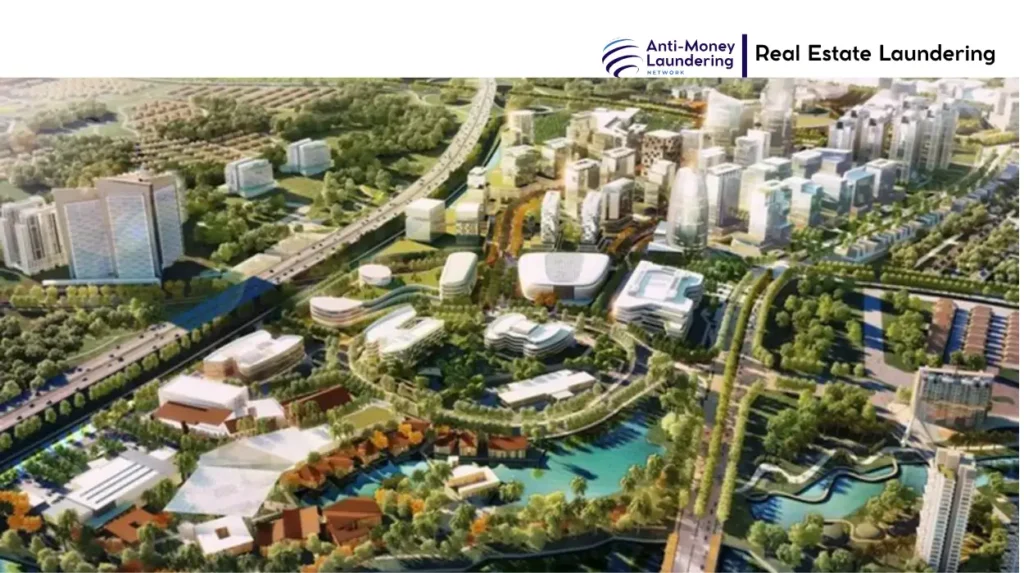
Bumi Serpong Damai (BSD City) is Indonesia’s largest privately developed new town, a 6,000‑hectare master‑planned urban zone in South Tangerang and Tangerang Regency, Banten, on the southwestern edge of Greater Jakarta. Launched in the mid‑1980s and physically implemented from 1989, BSD was conceived as a self‑contained “city within a city” for Indonesia’s growing upper‑middle class, combining residential enclaves with offices, retail, schools, hospitals, and leisure facilities. The project is developed and managed by PT Bumi Serpong Damai Tbk (stock code: BSDE), a listed property company under Sinar Mas Land, part of the Sinar Mas Group conglomerate.
While widely promoted as a model of modern urban planning and, more recently, as a “smart city” and transit‑oriented hub linked to Indonesia’s new capital (Nusantara) ambitions, BSD’s scale and long development horizon also make it a focal point for questions about real‑estate transparency, beneficial ownership, and anti‑money laundering (AML) risk in Indonesia’s high‑value property market. This article examines the formation, ownership, and evolution of Bumi Serpong Damai, then analyzes its exposure to money‑laundering typologies and regulatory scrutiny, using an analytical, evidence‑based lens.
Project Introduction: Formation & Background
Bumi Serpong Damai was initiated in 1984 by a group of private developers and formally launched as a township project in 1989, with the first stone laid on 16 January 1989. The development was structured around a phased master plan: Phase I covered around 1,300 hectares, with subsequent phases planned for an additional 4,700 hectares, bringing the total to approximately 6,000 hectares.
The initial vision was to create a satellite city that would reduce pressure on central Jakarta by offering integrated housing, employment, and services in a controlled, master‑planned environment. Over time, BSD evolved from a residential suburb into a full‑fledged urban node with its own economic base.
The developer behind BSD is PT Bumi Serpong Damai Tbk, established on 16 January 1984. The company is part of Sinar Mas Land, the property arm of the Sinar Mas Group, one of Indonesia’s oldest and largest conglomerates, with interests spanning agribusiness, financial services, energy, and property. The group’s founding family, the Widjajas (Eka Tjipta Widjaja and descendants), are central figures in Indonesia’s corporate landscape.
The initial vision for Bumi Serpong Damai location—Serpong and surrounding areas in South Tangerang—was to build an integrated, gated community targeting Indonesia’s emerging affluent class, with themed residential clusters, golf courses, and supporting infrastructure. This aligned with broader state‑led urban expansion policies in the Jakarta metropolitan region during the 1980s and 1990s.
Management and Project Head
PT Bumi Serpong Damai Tbk is governed by a board of directors and commissioners typical of Indonesian listed companies. Public disclosures and corporate profiles identify senior management linked to Sinar Mas Land, including figures such as Hermawan Wijaya in leadership roles within Sinar Mas Land’s BSD operations. Detailed, up‑to‑date board compositions are disclosed in annual reports and stock exchange filings rather than in general web summaries.
As a BSDE stock Indonesia‑listed entity, the company’s governance is subject to Indonesia Stock Exchange (IDX) rules and Financial Services Authority (OJK) oversight, with major shareholders including Paraga Arta Mida (26.57%) and Ekacentra Usahamaju (25.73%).
Sinar Mas Land’s portfolio extends beyond BSD City Tangerang to other large mixed‑use and residential projects across Indonesia, often under the Sinar Mas Land BSD City brand or related subsidiaries. The group’s reputation is that of a dominant, well‑capitalized developer capable of long‑term, capital‑intensive township development.
Financially, PT Bumi Serpong Damai Tbk reported a market capitalization of around IDR 24.15 trillion as of end‑2019 and has accessed international debt markets via senior notes. In 2024, the company reported a 20% year‑on‑year increase in attributable pre‑sales to IDR 6.8 trillion, with a stable credit outlook from Fitch Ratings in early 2025. These figures underline the project’s significance within Indonesia’s property sector and its role as a major source of revenue and landbank value for the group.
Controversies & Scandals
As of available public information, there is no single, widely documented scandal that names Bumi Serpong Damai itself as the direct subject of a corruption or money‑laundering prosecution. However, the broader context is important.
Indonesia has faced repeated high‑profile corruption and money‑laundering cases involving tax officials, prosecutors, energy sector executives, and other politically exposed persons (PEPs), with real estate frequently used to store and conceal illicit wealth. Academic and policy analyses of real estate in the Global South, including Indonesia, highlight systemic difficulties in identifying genuine property owners, the prevalence of cash or complex payment methods, and regulatory gaps that facilitate opacity.
Local media and commentary have occasionally raised questions about the political economy of large private townships, including BSD’s role in national strategic projects and the benefits accruing to conglomerates. For example, a 2024 VOI.id article referenced suspicions around BSD’s appointment to represent Sinar Mas Group in obtaining national strategic projects, though this is not a formal legal finding.
In this environment, Bumi Serpong Damai is not uniquely implicated but is structurally embedded in a high‑risk jurisdiction for real‑estate‑enabled financial crime.
There are no publicly confirmed reports specifically tying “black money” or hidden illicit funds to particular BSD transactions in English‑language open sources. Nonetheless, the combination of high property values, elite residential demand, and Indonesia’s documented challenges with beneficial ownership transparency creates conditions where undisclosed or opaque real estate transaction activity could, in principle, be used to integrate illicit proceeds. This is a sector‑wide risk rather than a BSD‑specific, proven fact.
Money Laundering Activities: Typologies and Risk Patterns
Indonesia’s mutual evaluation reports and AML assessments identify corruption, tax crimes, narcotics, and forestry‑related offenses as primary sources of money‑laundering risk, with real estate a key integration channel. Within this framework, Bumi Serpong Damai can be examined through standard AML typologies rather than specific proven cases.
In high‑value markets like BSD, typical laundering techniques identified in regional research include overvaluation and under‑invoicing. Overvaluation can inflate asset values for loan collateral or balance‑sheet purposes. Under‑invoicing in notarized sale‑and‑purchase deeds reduces transfer taxes, with side payments made in cash or via separate agreements.
Use of shell‑like local PTs and project companies is another common pattern. Luxury units, commercial blocks, and land parcels are often held by Indonesian limited liability companies (PT) or joint‑venture vehicles, which can obscure the natural persons behind transactions if beneficial ownership data is not fully transparent.
Nominee arrangements also feature in regional typologies. Foreigners and some PEPs may use local nominees to hold title, a practice recognized as a vulnerability in Indonesia’s property market. Layering through multiple transactions is another technique, where repeated sales or transfers between related entities create complex trails that hinder tracing of original funds.
These patterns are consistent with how Bumi Serpong Damai Layering (money laundering stage) might manifest in practice: funds are moved through multiple corporate and transactional steps before settling in high‑value BSD assets.
A Bumi Serpong Damai Real estate transaction that raises AML red flags might display rapid resale of high‑value units at prices inconsistent with market trends. Purchases by newly established PTs with no clear operating history can also be suspicious. Large cash components or complex financing structures complicate Bumi Serpong Damai Source of funds verification. Repeated transfers among related parties within the same development or cluster further increase risk.
For real estate professionals, such patterns trigger the need for enhanced Bumi Serpong Damai Client verification and Bumi Serpong Damai Risk assessment, particularly where the buyer is a corporate entity or a politically connected individual.
International Links & Benefited Countries
Bumi Serpong Damai has attracted foreign capital primarily through joint ventures with international partners. Collaboration with Mitbana (a Surbana Jurong–Mitsubishi Corporation partnership) has been used to develop transit‑oriented, mixed‑use projects on over 100 hectares within BSD. Partnerships with Japanese consortiums for premium mixed‑use projects on specific parcels, such as 19‑hectare developments, are also part of the project’s international linkages.
International debt financing is another channel. BSDE has issued senior notes in international markets, repaid in part in early 2025. While these are legitimate investment channels, they also create cross‑border financial flows that can be exploited if Bumi Serpong Damai Beneficial ownership transparency is weak. In regional typologies, offshore entities sometimes sit upstream of local SPVs that ultimately acquire property, although no specific offshore structure tied to BSD has been publicly detailed in major leaks (e.g., Panama or Pandora Papers) in open sources.
Countries that indirectly benefit include those supplying capital, expertise, and residents: Japan, Singapore, and other regional economies with investors or expatriates purchasing or leasing BSD properties.
Regulatory Actions & Legal Proceedings
There are no known FATF‑level actions, seizures, or freezes specifically targeting PT Bumi Serpong Damai Tbk or BSD City for money laundering. Indonesia’s Financial Transaction Reports and Analysis Centre (PPATK) and the Corruption Eradication Commission (KPK) have pursued numerous corruption‑linked laundering cases, some involving real estate and high‑value assets, but these have not named BSD as a direct target.
Regulatory focus on BSD is more indirect. As a listed issuer, BSDE must comply with disclosure rules, but these do not require unit‑level buyer identification to be public. Land registration is centralized but not fully transparent online, limiting external scrutiny of beneficial owners. Indonesia’s AML/CFT regime has been assessed as improving but still challenged by implementation gaps, especially in real estate.
No public court rulings specifically address Bumi Serpong Damai Suspicious real estate deal allegations in a money‑laundering context. The absence of named cases does not eliminate risk; it reflects the broader difficulty of linking specific property transactions to predicate offenses without investigative leaks or targeted enforcement.
Public Impact & Market Reaction
For mainstream investors and homebuyers, BSD remains one of Indonesia’s most desirable addresses, with strong demand for Bumi Serpong Damai housing, Bumi Serpong Damai apartments, and commercial space. The project’s scale and amenities—Bumi Serpong Damai schools, Bumi Serpong Damai hospitals, Bumi Serpong Damai malls, and Bumi Serpong Damai business park facilities—support its positioning as a self‑contained urban center.
However, for compliance‑focused investors and Bumi Serpong Damai Real estate professional actors (banks, brokers, notaries), the jurisdictional risk profile matters. Indonesia’s high AML risk rating in indices like the Basel AML Index (ranked 76 out of 110 in 2021) signals systemic vulnerabilities. Real estate is explicitly flagged as a Bumi Serpong Damai High‑risk sector in regional AML analyses due to opacity and cash usage.
Market trust in BSD as a brand remains strong, but the underlying AML environment requires robust Bumi Serpong Damai AML compliance practices by intermediaries handling large transactions.
BSD’s property values have generally tracked with Greater Jakarta’s premium market, supported by infrastructure improvements, the growth of office parks, and the narrative around Indonesia’s new capital. There is no public evidence of price collapses tied to laundering scandals; instead, the risk is more about latent reputational exposure if future investigations were to uncover systematic abuse of the market for illicit finance.
As of 2025–2026, Bumi Serpong Damai remains operational and expanding. Large portions of the township are built out and occupied, with tens of thousands of residential units and extensive commercial infrastructure. Significant landbank remains for future phases, with ongoing development of mixed‑use, transit‑oriented, and “smart city” initiatives. Financially, the company reported strong pre‑sales growth in 2024 and maintains a stable credit outlook.
The project is actively marketed in the context of Bumi Serpong Damai new capital Indonesia and BSD City new capital project narratives, given its location relative to transport corridors linking Jakarta to the new capital region in East Kalimantan.
Analysts view BSD as a core asset for Sinar Mas Land, with continued investment in BSD City transit oriented development around key transport nodes. Bumi Serpong Damai BSD City smart city Indonesia initiatives aim to integrate digital infrastructure and sustainability features. Expansion of Bumi Serpong Damai commercial area, offices, and lifestyle assets is intended to deepen the city’s economic base.
From an AML perspective, the trajectory is likely to involve greater scrutiny of large transactions and corporate buyers as Indonesia’s AML regime matures. Increased pressure for Bumi Serpong Damai Beneficial ownership transparency, especially for high‑value assets and foreign‑linked purchases, is expected. More formalized Bumi Serpong Damai Property acquisition due diligence by banks and developers will align with FATF‑style recommendations.
Future risk will depend less on BSD’s specific conduct and more on Indonesia’s broader success in tightening real estate AML controls, enhancing land registry transparency, and pursuing high‑profile corruption and laundering cases that currently define the jurisdiction’s risk profile.
Bumi Serpong Damai is a landmark of Indonesian urban development: a vast, privately governed city that has shaped housing, commerce, and lifestyle patterns for Greater Jakarta’s elite and upper‑middle class. Its history, from 1984 inception to present‑day “smart city” ambitions, is well documented in corporate materials and public profiles.
At the same time, BSD sits within Indonesia’s high‑risk sector for real‑estate‑enabled money laundering, characterized by challenges in client verification, source‑of‑funds checks, and beneficial ownership transparency. While no specific, publicly confirmed Bumi Serpong Damai Suspicious real estate deal has emerged in major leaks or court records, the structural conditions for misuse exist, as they do in many premium property markets in the Global South.
For policymakers, regulators, and real estate professionals, the imperative is not to single out BSD as uniquely corrupt, but to recognize it as a critical test case for whether Indonesia can align its ambitious urbanization model with robust Bumi Serpong Damai AML compliance and transparency standards. The project’s future significance will be measured not only in square meters and sales figures, but in how effectively it can operate as a transparent, rules‑based component of Indonesia’s financial and urban system.