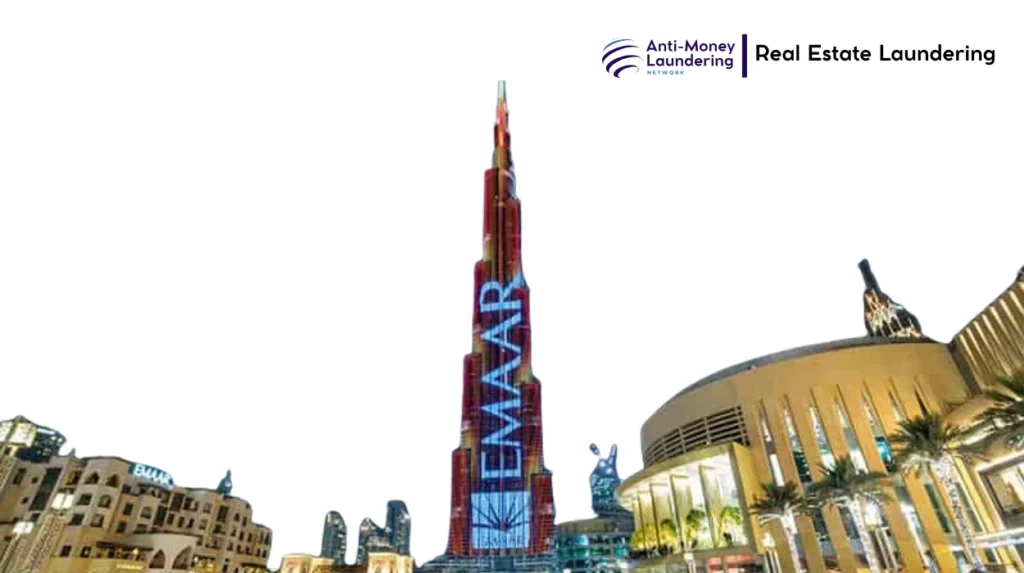
Emaar Properties

đź”´ High Risk

Emaar Properties stands as a cornerstone of the Dubai real estate sector, transforming the UAE property market through iconic master-planned developments. Established in 1997, the company has driven high-value real estate transactions that shaped modern Dubai while raising questions about luxury real estate AML risks and beneficial ownership transparency in UAE.​

Project Introduction

Emaar Properties launched in 1997 as a public joint-stock company under the Dubai government, with a vision to create integrated urban communities that blend residential, commercial, and leisure spaces. Mohamed Alabbar, the Emaar property owner and founder, spearheaded this initiative amid Dubai’s push for economic diversification beyond oil, drawing on his experience in government roles to attract foreign investment into ambitious projects.​

The company’s early focus centered on flagship developments like Dubai Marina, launched in 2000, which became the region’s largest man-made marina spanning 3.5 square kilometers. By 2003, Emaar unveiled plans for Downtown Dubai, encompassing the Burj Khalifa—the world’s tallest structure at 828 meters—and The Dubai Mall, the largest shopping center globally with over 1,200 outlets.

These projects established Emaar as a master community builder, prioritizing sustainable ecosystems with housing, schools, healthcare, and retail.​

Management and Project Head

Mohamed Alabbar serves as the Emaar property CEO and chairman, guiding the company’s strategy since inception. His background includes leading Dubai’s Department of Economic Development, where he fostered public-private partnerships that informed Emaar’s model of government-backed innovation.

Alabbar’s previous ventures, such as early commercial complexes, built his reputation for financial links with sovereign entities like the Investment Corporation of Dubai, which holds about 29% ownership.​

The board features seasoned executives from real estate and finance, including members with ties to Dubai Holding. Key decision-makers oversee Emaar’s subsidiaries, managing over 60 projects across 14,000 buildings at various stages. Their track record includes award-winning communities like Arabian Ranches and The Meadows, though scrutiny has grown around Emaar Properties risk assessment in high-risk sectors amid evolving real estate AML regulations.​

Controversies and Scandals

Emaar Properties has faced allegations tied to suspicious real estate deals, particularly in luxury properties attracting illicit funds. Investigative reports highlight Emirates Hills, an Emaar development dubbed the “Beverly Hills of Dubai,” as a hub for politically exposed persons (PEPs) from Africa and the Middle East. Leaked data revealed units owned by figures like former Nigerian oil minister Dan Etete, linked to the $1.1 billion OPL 245 scandal, and entities connected to Pakistan’s Zardari family.​

In India, India’s Enforcement Directorate attached Emaar-MGF properties worth Rs 834 crore (about $100 million) in 2024 over money laundering probes involving land deals, signaling concerns over Emaar property acquisition practices. Reports of black money involvement surfaced through patterns of rapid resales in Downtown Dubai, where high-value real estate transactions often bypassed robust client verification during the UAE’s pre-2010 regulatory gaps.​

Money Laundering Activities

Money laundering through property has spotlighted Emaar’s portfolio due to real estate financial crime risks in the UAE property market compliance landscape. Tactics include layering via shell companies, with BVI and Seychelles entities registering as Emaar property owners to obscure beneficial ownership transparency UAE standards demand today but struggled to enforce historically.​

Transaction patterns show cash-heavy purchases during Dubai’s 2003-2008 boom, when developers like Emaar faced limited AML compliance mandates. Offshore wealth and Dubai property inflows from sanctioned Russians post-2022 and PEP networks fueled suspicions, with Emirates Hills villas valued up to $52 million serving as asset concealment vehicles. Emaar Properties source of funds scrutiny remains critical, as real estate professionals in Dubai must now conduct enhanced due diligence under post-FATF reforms.​

PEP involvement in real estate persists, with cross-border property investments UAE attracting kleptocrats exploiting luxury overvaluation—properties trading far above construction costs to park illicit capital. Emaar Properties layering, a key money laundering stage, allegedly occurred via intra-group transfers among SPVs, complicating traceability.​

Emaar’s expansion since 2004 via Emaar International LLC has spanned India, Pakistan, Egypt, Saudi Arabia, and North America, channeling cross-border investments into mixed-use projects. In India, joint ventures like Emaar-MGF developed townships but drew regulatory heat; Egypt saw urban expansions benefiting local economies through job creation, though tied to Gulf capital flows.​

Pakistan’s market absorbed Emaar communities, inadvertently hosting PEP assets flagged by the National Accountability Bureau. North American and European ventures, including hospitality assets, have integrated UAE funds globally, with offshore accounts facilitating entry. Countries like India and Pakistan indirectly benefited from infrastructure but faced distorted local markets due to foreign dominance.​

UAE authorities imposed real estate AML regulations post-FATF greylisting in 2022, mandating Emaar Properties AML compliance through KYC, PEP screening, and suspicious activity reporting. Dubai Land Department and RERA now require beneficial ownership registers, though enforcement in luxury segments lags, per 2025 legal analyses.​

Internationally, India’s Enforcement Directorate pursued Emaar-linked assets in 2024, while Pakistan’s NAB sought freezes on Emirates Hills properties owned by Ishaq Dar. No direct fines hit Emaar UAE, but FATF scrutiny elevated UAE property market compliance, delisting the nation in 2024 after reforms. Pending probes in India highlight ongoing Emaar Properties suspicious real estate deal exposure.​

Public Impact and Market Reaction

High-value real estate transactions in Emaar projects inflated Dubai prices, with Downtown Dubai apartments yielding 6-8% returns but eroding affordability for locals amid foreign inflows. Illicit funds in luxury properties strained market trust, prompting 2025 EU delisting of UAE from high-risk lists yet sustaining investor caution.​

Public reaction mixed investor enthusiasm—Emaar stock rose post-2023 dividends of AED 8.8 billion—with wariness over real estate high-risk sector status. Economic effects included tourism boosts from Dubai Mall (120 million visitors yearly) but widened inequality, as luxury enclaves like Emirates Hills isolated wealth from broader UAE society.​

Emaar thrives operationally, reporting Q3 2025 sales strength and 141 million sq ft land acquisitions worth AED 96 billion. Projects like Dubai Creek Harbour and Zabeel Square advance, with joint ventures emphasizing sustainability via AI traffic systems and green spaces.​

Experts predict sustained growth if Emaar bolsters client verification and risk assessment amid luxury real estate AML risks. Future outlook hinges on transparent source of funds checks and navigating geopolitical shifts, positioning Emaar as a resilient force in Dubai’s evolution while addressing persistent beneficial ownership transparency UAE challenges.​

Location

Dubai and Abu Dhabi, United Arab Emirates (UAE, Middle East)​

Mixed portfolio: master‑planned luxury villa communities (e.g. Emirates Hills, Emirates Living), high‑rise residential towers (Downtown Dubai, Dubai Marina), commercial and hospitality assets used as vehicles for cross‑border capital flows.​

Public joint‑stock company listed in Dubai; c. 29 percent owned by the Government of Dubai via the Investment Corporation of Dubai, with remaining shares held by institutional and private investors.​
Individual units within Emaar projects are commonly held through a mix of:

  • Offshore companies and free‑zone entities (BVI, Seychelles, UAE free zones) acting as shell owners.

  • Locally incorporated SPVs and nominees used to detach the legal title from the true controller.​

  • ontrolling public shareholder: Investment Corporation of Dubai (on behalf of the Government of Dubai).​

  • Unit‑level beneficial owners in high‑risk communities (e.g. Emirates Hills, Downtown Dubai) include:

    • Dan Etete (former Nigerian oil minister linked to the OPL 245 corruption scandal), associated with a luxury Emirates Hills villa.​

    • Companies linked to the family of former Pakistani President Asif Ali Zardari (e.g. Tempo Global Gains), owning an Emirates Hills property valued around USD 2.9 million.​

    • Former Pakistani finance minister Ishaq Dar, whose Emirates Hills property was targeted for asset freezing by Pakistan’s National Accountability Bureau.​

    • Other regional PEPs and business elites from Africa and the Middle East identified in leaked Dubai property/residency datasets.​

  • For many units the true beneficial owners remain unknown or “Suspected but not confirmed” due to layers of offshore and nominee structures.​

Yes – significant and systemic.
Emirates Hills, an Emaar‑launched enclave, is documented as a preferred address for multiple PEPs and alleged kleptocrats linked to large‑scale state looting in Nigeria, Pakistan, Zimbabwe and other jurisdictions.​

  • High‑value cash purchases and wire transfers routed via foreign banks, often with limited publicly visible scrutiny of source of funds during Dubai’s 2003–2008 “buccaneer” property boom.​

  • Offshore financing and layered ownership through BVI and other secrecy‑jurisdiction shells that appear as registered owners on Dubai records instead of individuals.​

  • Use of local SPVs and corporate owners to acquire multiple units within Emaar developments, allowing portfolio‑style layering and intra‑group transfers.​

  • Use of shell companies and offshore entities to obscure beneficial ownership, particularly in Emirates Hills and other Emirates Living villas.​

  • Layering through repeated transfers between related corporate vehicles, often with minimal visible economic rationale.​

  • Overvaluation of trophy villas and apartments in “Beverly Hills of Dubai”‑style communities, enabling parking of disproportionate amounts of capital relative to underlying construction cost or local income levels.​

  • Use of nominee owners and proxies to distance politically exposed controllers from registered title.​

  • Exploiting historically weak AML coverage of estate agents and developers before 2007, when they were not subject to mandatory customer due diligence.​

  • 1999: Emaar launches Emirates Hills as Dubai’s premier gated villa estate; in 2002, a decree allows foreign freehold ownership in selected developments, triggering a speculative property boom.​

  • 2003–2008: Rapid price escalation in Emaar communities (villas reportedly quadrupling in value), during a period when estate agents and many intermediaries had no binding AML duties, allowing high‑risk and unexplained funds to enter the market largely unchecked.​

  • 2010s: Leaked Dubai property data reveal concentration of PEP and kleptocrat ownership in Emirates Hills and other Emaar developments, including individuals linked to OPL 245, Pakistani corruption probes and Zimbabwean political elites.​

  • 2020s: UAE adopts stricter AML rules and is later removed from the FATF grey list, but legal commentary notes that luxury real estate, including Emaar projects, remains vulnerable due to ongoing reliance on complex corporate owners and high‑risk foreign buyers.​

Exact total unknown; “Suspected but not confirmed” due to secrecy and lack of public registers.​
However:

  • Individual villa values in Emirates Hills reach up to USD 52 million each.​

  • Investigative work and AML watchdog analysis describe “billions” of dollars in suspect or unexplained wealth flowing into high‑end Dubai real estate, with Emirates Hills repeatedly cited as a major node.​
    Given the scale of Emaar’s luxury portfolio, the aggregate laundering exposure can reasonably be assessed as high and systemic rather than incidental.​

  • Dubai’s Golden Sands / “Klepto Hills” investigations by OCCRP, Finance Uncovered and C4ADS based on leaked Dubai property and residency data, explicitly naming Emirates Hills (an Emaar project) as a PEP and kleptocrat hub.​

  • AML Network case file on “Emirates Hills Luxury Villas” describing systemic use of offshore shells, PEPs and weak enforcement in an Emaar‑developed enclave.​

  • Broader academic and policy analyses linking UAE luxury real estate (including Emirates Hills and similar developments) to global kleptocracy and capital flight from Africa and Asia.​

  • Pakistan’s accountability court approved the freezing of former finance minister Ishaq Dar’s assets, including his Emirates Hills property, following NAB requests; this illustrates how home‑state authorities view Emaar‑area assets as repositories for potentially illicit wealth.​

  • No major public enforcement case has directly targeted Emaar Properties as a corporate entity for money laundering; instead, individual owners and foreign investigations have spotlighted its communities as risk hotspots while UAE authorities maintain a largely promotional stance toward the sector.​

  • UAE has introduced AML/CFT reforms for real estate (KYC, UBO disclosure, enhanced due diligence for high‑risk buyers), but enforcement in luxury segments remains widely criticized as inconsistent and highly deferential to political and economic interests.​

High.

  • UAE historically operated under high financial opacity, with real estate developers and agents only gradually brought under AML rules and with patchy, non‑public beneficial ownership registers.​

  • Despite FATF grey‑list removal and new regulations, high‑risk luxury enclaves continue to attract controversial PEPs and offshore structures, indicating persistent vulnerabilities and political complicity.​

  • Investment Corporation of Dubai (state investment arm; major shareholder).​

  • Emaar Community Management and associated SPVs managing Emirates Living / Emirates Hills and other master‑planned communities.​

  • Local and international real estate brokers and law firms involved in high‑value unit sales.​

  • Regional and global banks processing cross‑border payments into UAE real estate; specific names often undisclosed in public reporting, but multiple foreign banks have faced UAE AML scrutiny more broadly.​

Mixed (Residential – Luxury Villas & Apartments; Commercial & Hospitality Platform)

Shell companies, offshore layering, overvaluation, nominee ownership, cash/high‑value transfers.

Middle East (Gulf – UAE)

High

Emaar Properties

Emaar Properties
Country:
United Arab Emirates
City / Location:
Dubai and Abu Dhabi (Emirates Hills, Downtown Dubai, Dubai Marina) ​
Developer / Owner Entity:
Emaar Properties PJSC (29% owned by Government of Dubai via Investment Corporation of Dubai) ​
Linked Individuals :

Dan Etete (former Nigerian oil minister, OPL 245 scandal); Asif Ali Zardari family entities (e.g. Tempo Global Gains); Ishaq Dar (former Pakistani finance minister); other PEPs from Africa/Middle East scandals

Source of Funds Suspected:

Embezzlement/state looting (e.g. Nigerian OPL 245 oil scandal); political corruption proceeds (Pakistan NAB probes); kleptocratic capital flight from Africa/Middle East

Investment Type:
High-value luxury villa/apartment purchases, master-planned community development ​
Method of Laundering:
Layers via offshore shells (BVI/Seychelles), nominee owners, overvaluation of trophy villas, cash/high-value transfers ​
Value of Property:
Individual Emirates Hills villas: up to USD 52 million; portfolio-scale exposure: billions in suspect flows ​
Offshore Entity Involved?
1
Shell Company Used?
1
Project Status:
Complete
Associated Legal / Leak Files:

OCCRP “Dubai’s Golden Sands / Klepto Hills” leaks; AML Network Emirates Hills case file; Pakistan NAB asset freeze on Ishaq Dar property ​

Year of Acquisition / Construction:
đź”´ High Risk