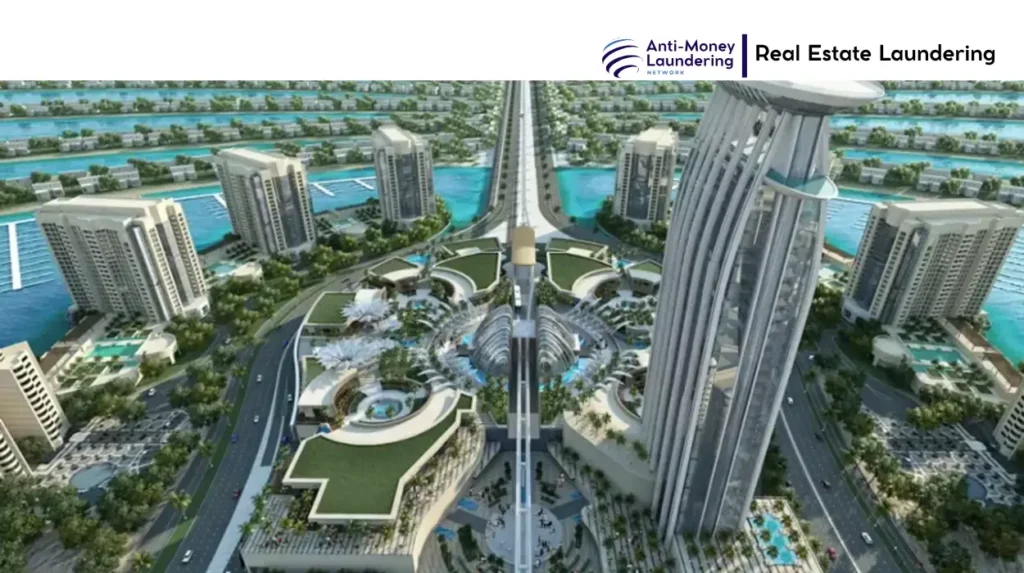
Nakheel Properties stands at the intersection of ambition, spectacle, and financial opacity in the United Arab Emirates real estate sector. As one of Dubai’s most visible developers, its projects—Palm Jumeirah, Dubai Islands, The World Islands, and other large‑scale waterfront communities—have reshaped the city’s coastline and become global symbols of Dubai’s rapid urbanization.
The Nakheel Properties UAE overview is not only a story of engineering and marketing, but also of how a state‑linked developer became embedded in a high‑risk real estate market where financial opacity, weak anti‑money laundering standards, and limited beneficial‑ownership transparency raise serious integrity questions. This article examines Nakheel Properties from multiple angles: its origins, governance, portfolio, financial and reputational controversies, alleged laundering‑related patterns, and its broader role in regional and global capital flows.
When and How Nakheel Was Launched
Nakheel Properties was established in 1992 as part of Dubai’s Investment and Development Establishment, a government‑linked entity tasked with transforming Dubai into a diversified, non‑oil‑dependent economy. The Nakheel Properties company history and background reflect Dubai’s broader strategy to pivot from hydrocarbons toward tourism, trade, and high‑value real estate.
From its inception, Nakheel was not conceived as a conventional private developer but as a strategic instrument of the Dubai government, with access to sovereign‑backed capital, public infrastructure, and close regulatory alignment. Over time, it evolved into a full‑fledged Nakheel Properties Dubai real estate developer, focusing on large‑scale, mixed‑use developments that combine residential, commercial, hotel, and leisure components across artificial islands and waterfront districts.
The pivotal moment in Nakheel’s trajectory came in 2001 with the launch of the Palm Jumeirah. Developed as the Nakheel Properties Palm Jumeirah developer, this palm‑tree‑shaped artificial island was marketed as a luxury residential and tourism destination, complete with villas, hotels, and leisure facilities. The project relied heavily on Nakheel Properties off‑plan projects in Dubai campaigns that emphasized exclusivity and premium pricing, attracting thousands of international buyers.
By the mid‑2000s, Palm Jumeirah had become a global symbol of Dubai’s real estate boom, with nearly all units sold before completion. This model was later replicated in Palm Jebel Ali, unveiled in 2002, and Nakheel Properties Dubai Islands, launched in 2014 as a cluster of 250 islands designed for tourism, residential, and commercial uses. Nakheel Properties The World Islands developer also pursued a 300‑island archipelago, aiming to mirror the world map and attract ultra high‑net‑worth foreign buyers.
These Nakheel Properties master planned communities differ from traditional urban developments in scale and governance. Nakheel functions as a quasi‑urban‑planning authority, managing not only construction but also long‑term infrastructure, service‑charge regimes, and common‑area enforcement.
This structure amplifies the company’s control over the Nakheel Properties real estate market, but it also concentrates risk and opacity within a single, state‑linked entity whose ultimate beneficial owners are difficult to map through public data.
Management, Governance, and Key Decision Makers
Nakheel Properties has been led by individuals closely tied to Dubai’s political and economic establishment. The most prominent figure is Sultan Ahmed bin Sulayem, who served as CEO from 2007 to 2021.
Bin Sulayem concurrently held leadership roles in Dubai Ports World and broader Dubai transport and investment entities, which gave him influence that extends beyond Dubai‑centric real‑estate decisions. Under his tenure, Nakheel expanded its Nakheel Properties portfolio of projects substantially, including the Palm islands, Dubai Festival City, Deira Islands, and other waterfront developments.
His leadership coincided with the 2008 financial crisis, during which Nakheel’s debt load of around 14 billion dollars triggered a Dubai‑wide restructuring effort, later reduced to about 3.5 billion dollars by 2015. This episode highlighted the Nakheel Properties investment risk inherent in an aggressive off‑plan sales model.
Bin Sulayem was later appointed chairman of Dubai World, reinforcing the perception that Nakheel is not a typical private company but a state‑linked vehicle whose financial health is closely tied to sovereign policy and support. Today, Nakheel Properties is led by CEO Julian Wingate, who assumed the role around 2022 and has focused on the Dubai Islands masterplan.
The Dubai Islands project is envisioned as a 1.2‑million‑person waterfront city by 2035, comprising 110,000 units across 11 neighborhoods. This scale reflects both the ambitions and the governance challenges of Nakheel Properties investments, where the complexity of delivery must be matched by robust oversight and transparency.
Board‑level oversight includes figures such as Khalid Al Bustani, managing director of Dubai Holding, and staff director George Gresham, both of whom bring extensive experience from major Gulf‑region projects. The Nakheel Properties headquarters in Dubai functions as a central nerve center for coordinating development, marketing, financing, and intergovernmental consultations.
Within this structure, Nakheel Properties operates as a technocratic‑oriented but politically embedded organization, whose decisions are shaped by both commercial objectives and broader Dubai‑state priorities in the Nakheel Properties real estate market.
Controversies, Scandals, and Governance Incidents
Despite its polished branding, Nakheel Properties has not been free from controversies and integrity‑related incidents. One of the earliest high‑profile cases involved the company’s then‑CEO, Noor Al Matta, who resigned in 2005 after being accused of misappropriating 50,000 dollars from a Nakheel‑linked project. Although he was later acquitted, the episode exposed vulnerabilities in internal controls and raised questions about how project funds are monitored and audited.
Subsequent cases involving Nakheel employees and contractors have continued to highlight governance shortcomings, reinforcing the impression that enforcement of internal discipline is uneven.
The 2008 global financial crisis brought a different form of scrutiny. Nakheel’s heavy dependence on Nakheel Properties off‑plan projects in Dubai meant that when investor confidence evaporated, the company faced a liquidity crunch and a near‑collapse of its debt structure.
The subsequent restructuring, conducted under Dubai‑government and Dubai World supervision, prevented outright insolvency but underscored the Nakheel Properties real estate market’s sensitivity to boom‑and‑bust cycles. Off‑plan sales models, where buyers commit large sums years before completion, amplify both investor returns and risks, especially in the absence of strong consumer‑protection and disclosure regimes.
More recently, Nakheel has come under indirect scrutiny through Dubai’s broader real‑estate‑laundering environment. In 2021, Dubai’s Real Estate Regulatory Agency fined several real estate agents a total of 105,000 dirhams for failing to complete adequate Nakheel Properties Client verification, revealing a_gap in basic compliance across the sector.
The Financial Action Task Force placed the United Arab Emirates on its “gray list” in 2022, citing weaknesses in beneficial‑ownership transparency and enforcement in high‑risk sectors such as real estate. Nakheel Properties, given its prominence, is widely regarded as a prime example of these systemic vulnerabilities.
Investigative reporting and data leaks suggest that a significant portion of units in Nakheel‑linked projects are held via offshore entities and Dubai‑world‑linked subsidiaries, which obscures Nakheel Properties Beneficial ownership transparency. Around 40 percent of Palm Jumeirah units are estimated to be owned through such structures, enabling complex ownership chains that complicate the tracing of Nakheel Properties Source of funds.
These patterns fit classic Nakheel Properties High‑risk sector profiles, where weak enforcement and political‑economic linkages undermine the effectiveness of Nakheel Properties AML compliance.
Money Laundering–Related Risks and Transaction Patterns
When analysts assess Nakheel Properties, they often situate it within the broader context of the Nakheel Properties High‑risk sector that Dubai real estate represents. The Nakheel Properties real estate market attracts high‑net‑worth foreign buyers, politically exposed persons, and opaque financiers who seek to park or anonymize capital in a jurisdiction perceived as politically stable and commercially attractive.
This environment creates opportunities for laundering‑type activity, where Nakheel Properties Suspicious real estate deal patterns can remain under‑enforced.
Several laundering‑related practices are commonly associated with Nakheel‑style projects. Nakheel Properties waterfront projects are frequently priced at premium levels that exceed functional or rental‑yield fundamentals, allowing large infusions of capital to be absorbed while masking the true Nakheel Properties Source of funds.
Layering through shell companies and nominee owners is another common mechanism. Units and portfolios are often held via UAE‑based special‑purpose vehicles, free‑zone entities, and offshore companies that obscure the link between the legal owner and the actual beneficiary, consistent with Nakheel Properties Layering (money laundering stage) techniques.
Nominee‑directed structures and circular ownership chains further complicate Nakheel Properties Beneficial ownership transparency, making it difficult for compliance officers to establish the ultimate controller of an asset.
Cash‑like payments and opaque financiers also feature in Nakheel‑linked transactions, creating challenges for Nakheel Properties Risk assessment and client‑centric due diligence. Some purchases are structured through private‑equity‑style vehicles or complex cross‑border arrangements, which blur the boundary between legitimate investment and suspicious capital.
Nakheel Properties Real estate professionals operating in Dubai must therefore navigate an environment where precautionary measures such as Nakheel Properties Client verification and enhanced AML checks are essential, even as enforcement in the United Arab Emirates remains patchy. The Nakheel Properties real estate market is thus characterized by high volume, high value, and high opacity, conditions that favor both legitimate investment and potential abuse.
International Links and Cross‑Border Flows
Nakheel Properties is not confined to Dubai in terms of its investor base or capital flows. The Nakheel Properties Real estate transaction chains that pass through its projects span multiple jurisdictions, including offshore financial centers, major economic hubs, and politically sensitive regions. The Nakheel Properties real estate market has attracted tens of billions of dollars in foreign investment over the past two decades, with a substantial share directed toward Nakheel‑style waterfront and island projects.
Countries such as the United Kingdom, India, China, Russia, and various Gulf states have seen their nationals acquire Nakheel Properties portfolio of projects assets, often through complex corporate structures rather than straightforward individual ownership.
International investigative reports highlight how Dubai‑linked real estate is used to launder politically sensitive or illicit proceeds. A 2025 OCCRP‑style exposé detailed a 150‑million‑dollar money‑laundering scheme involving Lebanese elites who used Dubai‑registered shell companies to acquire luxury waterfront properties, including assets analogous to Nakheel Properties waterfront projects.
The structure involved multiple entities, nominee owners, and offshore vehicles, all consistent with Nakheel Properties Layering (money laundering stage) techniques. Although Nakheel itself was not the central launderer in that case, the methods described are directly applicable to Nakheel‑linked portfolios.
In 2026, French‑language media reported that Dutch authorities seized 19 Dubai properties linked to Colombian drug‑trafficking networks, including 12 villas valued at 1.8 billion dirhams. These assets were acquired through chains of shell companies, once again underscoring how Dubai’s real‑estate sector, of which Nakheel is a flagship developer, functions as a convergence point for international criminal capital and opaque investments.
The Nakheel Properties real estate transaction flows demonstrate that benefits accrue not only to Dubai’s economy and to Nakheel Properties investments but also to offshore jurisdictions and foreign actors who exploit the United Arab Emirates’ opacity to anonymize assets.
Regulatory Actions, Legal Proceedings, and Enforcement Gaps
Regulation around Nakheel Properties has been incrementally strengthened, but enforcement remains selective and reactive. Dubai’s Real Estate Regulatory Agency has introduced rules mandating more detailed client verification, disclosure of service‑charge indices, and strata‑compliance mechanisms.
However, in practice, breaches of basic standards are common. In 2021–2025, RERA issued fines worth over 1 million dirhams against real estate agents for failing to complete Nakheel Properties Client verification, indicating that even low‑barrier compliance requirements are frequently ignored.
The 2022 Financial Action Task Force gray‑listing of the UAE prompted the government to tighten disclosure rules for free‑zone entities and beneficial‑ownership data, but these measures came late and are still being refined.
At the federal level, the United Arab Emirates enacted a new AML law in 2021, which expanded the scope of Nakheel Properties AML compliance obligations for real‑estate agencies, brokers, and financial intermediaries. The law requires enhanced Nakheel Properties Risk assessment for politically exposed persons and high‑risk jurisdictions, as well as better documentation of Nakheel Properties Source of funds.
Yet, enforcement remains uneven, and there are no widely documented judicial actions that directly target Nakheel Properties as a laundering vehicle, such as asset seizures or forfeiture of specific Nakheel‑linked properties. Instead, enforcement has focused on peripheral actors—agents, brokers, and individual buyers—while the Nakheel Properties portfolio of projects and its master‑developer governance framework remain largely untouched by judicial scrutiny.
High‑profile internal cases, such as the 2008–2015 Nakheel debt restructuring and isolated fraud‑type investigations into executives, were resolved through corporate restructuring and cleared by courts rather than through criminal‑law channels.
These outcomes reinforce perceptions of political complicity and selective accountability, especially in the Nakheel Properties High‑risk sector where politically sensitive actors and opaque capital are prevalent. The combination of advanced regulatory frameworks on paper and weak enforcement in practice leaves Nakheel Properties exposed to reputational, legal, and financial risks if an integrity‑related shock materializes.
Public Impact and Market Reactions
Nakheel Properties has had a profound impact on investors and the broader public within Dubai. For international buyers, Nakheel‑branded projects have delivered high‑value lifestyle assets and, in many cases, strong capital appreciation.
The Nakheel Properties investment returns in Dubai have historically outpaced many other real‑estate markets, with Palm Jumeirah‑style assets and Dubai Islands‑linked units recording double‑digit‑percentage gains over multiple cycles. This performance has reinforced investor confidence in Nakheel Properties off‑plan projects in Dubai, encouraging continued inflows even as concerns about transparency and risk accumulate.
Domestically, however, Nakheel’s projects are often viewed as emblematic of excess and inequality, with luxury waterfront enclaves catering to global elites while doing little to address local housing affordability. The 2008 crisis and subsequent debt restructuring exposed the fragility of Nakheel‑linked models, triggering temporary drops in property prices and confidence in the Nakheel Properties real estate market.
The perception of Nakheel as a driver of speculative booms has contributed to ambivalence among Dubai residents, who benefit from economic growth but also bear the risks of overheated real‑estate cycles.
More recently, a series of Nakheel Properties Suspicious real estate deal reports and international AML‑linked investigations have begun to affect market sentiment. The 2025 OCCRP‑style exposé on Dubai‑linked laundering and the 2026 seizure of Colombian‑linked properties both contributed to a more cautious stance among some foreign investors and financial institutions.
The Nakheel Properties Real estate professional community has responded by tightening internal procedures, enhancing client verification, and conducting more rigorous Nakheel Properties Risk assessment, but these changes are largely reactive rather than systemic.
The Nakheel Properties real estate market remains highly dependent on investor confidence, and any major integrity‑related scandal tied to Nakheel or its linked projects could trigger rapid repricing and reputational damage.
As of 2026, Nakheel Properties remains operational and continues to expand its Nakheel Properties portfolio of projects. Nakheel Properties Dubai Islands is under active construction, with phased launches targeting 1.2 million residents by 2035 and 110,000 units across 11 neighborhoods.
Nakheel Properties Palm Jumeirah developer continues to manage a large stock of luxury villas and apartments, while Nakheel Properties The World Islands developer seeks to revive stalled segments of the archipelago. The company’s revenue targets for 2026 are in the multi‑billion‑dollar range, with a substantial share expected from Dubai Islands and other Nakheel Properties waterfront projects.
Looking forward, Nakheel’s trajectory will depend on several interrelated factors. On the one hand, continued strong demand from global investors, particularly from high‑net‑worth individuals and offshore entities, supports sustained Nakheel Properties investment returns in Dubai. The Nakheel Properties real estate market is expected to continue growing at a mid‑single‑digit to low‑double‑digit rate, with waterfront and island‑linked projects outperforming other segments.
On the other hand, regulatory and reputational risks remain significant. Enhanced Nagle‑Properties AML compliance requirements, ongoing FATF monitoring, and continued media scrutiny of suspicious real‑estate deals will pressure Nakheel Properties to improve Nakheel Properties Beneficial ownership transparency and client‑verification practices.
If United Arab Emirates authorities strengthen enforcement and adopt more transparent beneficial‑ownership regimes, Nakheel may be compelled to unwind opaque structures or at least subject them to greater scrutiny. This could reduce laundering‑related vulnerabilities but also constrain the types of capital willing to enter the Nakheel Properties real estate market.
Conversely, if enforcement remains weak, Nakheel Properties may continue to function as a high‑risk, high‑reward node in the global real‑estate ecosystem, where Nakheel Properties investments coexist with systemic opacity and selective accountability. The future position of Nakheel Properties will therefore hinge not only on market demand but on the political will to align Dubai’s real‑estate ambitions with global AML and governance standards.