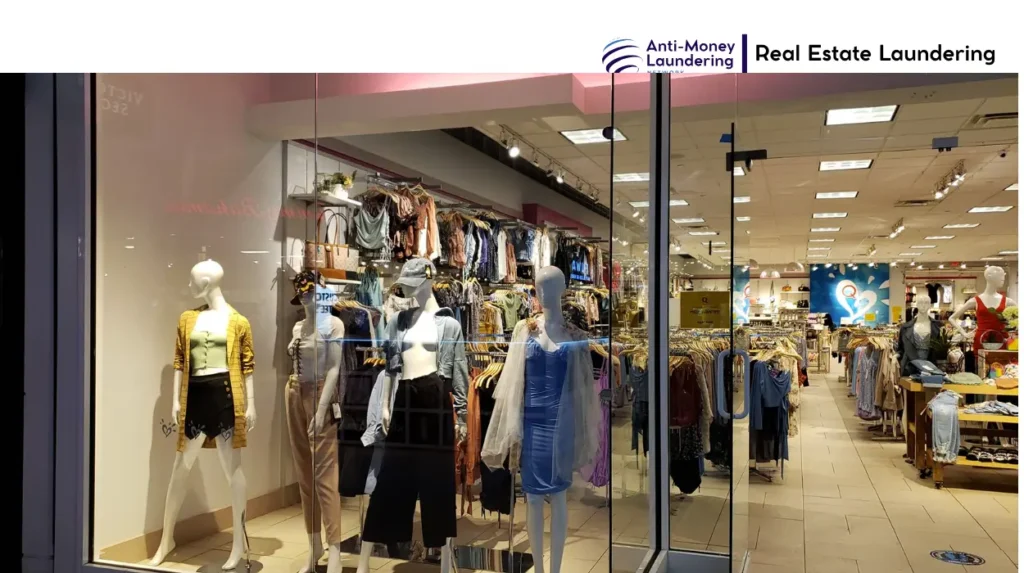
QT Fashion Inc. is a Los Angeles–based apparel wholesaler that became a central example of how ordinary-looking fashion businesses and commercial properties can be exploited in sophisticated trade-based money laundering schemes. Although it operated under brands such as QT Fashion Inc., QT Maternity and Andres Fashion, public records and court documents show that its premises and corporate structure were used to move criminal proceeds, particularly ransom funds and drug money linked to the Sinaloa Cartel, through the Los Angeles Fashion District.
This history makes QT Fashion Inc. a useful evergreen case study in AML compliance, especially for real estate professionals, high‑risk sector analysts and those concerned with beneficial ownership transparency and source‑of‑funds risk.
Project introduction and background
QT Fashion Inc. operated as a wholesaler of maternity clothing and other apparel in the Downtown Los Angeles Fashion District, importing goods from Asia and exporting them onward to Mexico. The business, sometimes referred to publicly as QT Maternity or Andres Fashion, functioned as a typical “qt fashion inc. business” in a dense cluster of small wholesalers and warehouses, making its commercial premises and trade flows appear routine at first glance.
While the precise qt fashion inc. year of establishment is not clearly disclosed in open sources, the company was active at least by 2012, when it appears in federal investigations, and by that time had an established presence and client base in the cross‑border apparel market between the United States, China and Mexico.
The qt fashion inc. address was within the 100‑block Los Angeles Fashion District, a high‑turnover area where thousands of businesses share similar warehouse‑style units, making location‑based red flags harder to spot. As a result, the qt fashion inc. location and its commercial premises fit the profile of a high‑risk sector node: cash‑intensive, reliant on international trade logistics and only lightly scrutinized from a real‑estate AML perspective, despite being in a major U.S. city.
From an AML risk assessment standpoint, this kind of setting is precisely where robust client verification, understanding of source of funds and scrutiny of related real estate transactions are critical but often overlooked.
Founders, ownership and vision
Publicly available information identifies Andrew Jong Hack Park (also reported as Jong Hack Park or Andrew Park) as the qt fashion inc. owner, with Sang Jun Park as a key manager, together forming the core management of the qt fashion inc. company. Their primary business model involved importing wholesale maternity wear and other garments from China into the United States and then supplying Mexican importers, which positioned qt fashions as a mid‑tier player rather than a luxury brand but still exposed it to cross‑border financial and trade risk.
Federal case materials suggest no widely publicized philanthropic or development “vision” beyond standard commercial growth; instead, the company’s role in laundering schemes overshadowed any legitimate brand positioning such as “qt fashion inc brand” or longer‑term ambitions for qt fashion inc. careers and expansion.
There is no detailed public record of qt fashion inc. financial statements or audited disclosures, which is typical for small private wholesalers in the United States but poses challenges for AML compliance and credit risk analysis. The absence of transparent reporting also complicates estimates of qt fashion inc. worth and historical profitability, leaving external observers and real estate professionals to infer financial health from enforcement actions, seizures and trade flows rather than conventional corporate filings.
In many offshore or higher‑risk jurisdictions such opacity would trigger enhanced due diligence, yet in the United States it has long been treated as standard practice for closely held companies, contributing to the overall vulnerability of the sector.
Management, governance and links
The management and project head functions for QT Fashion Inc. appear to have been concentrated in a small team rather than a large corporate board, with Andrew Park as de facto chief decision‑maker and Sang Jun Park as a central operational figure. Federal indictments and media reporting show these individuals were directly involved in handling bulk cash deliveries, coordinating with intermediaries and instructing staff on how to process funds, which means governance failures were not abstract but embedded in day‑to‑day management behavior.
Unlike larger groups that might have independent directors or compliance committees, the qt fashion inc. head office effectively combined ownership, operations and strategic control in a small circle, heightening the risk that personal incentives drove AML‑relevant decisions.
Linked individuals extended beyond the United States, most notably to the principals of the Mexican importer Maria Ferre, based in Culiacán, Sinaloa. Those principals—identified in court documents but not widely known to the general public—coordinated with qt fashion inc. in usa to settle trade obligations and convert U.S. dollar cash into Mexican pesos for the cartel, highlighting how beneficial ownership transparency must be considered at group level, not only within one country.
For any real estate professional or bank conducting qt fashion inc. client verification or onboarding the qt fashion inc. office as a tenant or borrower, mapping these cross‑border personal links would have been essential to a meaningful qt fashion inc. risk assessment.
Controversies, scandals and black money allegations
QT Fashion Inc. entered public view in September 2014 when nearly 1,000 law‑enforcement officers raided dozens of businesses in the Los Angeles Fashion District, seizing at least 65 million dollars linked to drug trafficking and other crimes. In one of the most striking episodes, federal authorities alleged that the Sinaloa Cartel used qt fashion inc. as a hub to accept and launder a 140,000‑dollar ransom payment for a kidnapped U.S. distributor whose 100‑kilogram cocaine shipment had been seized by U.S. agents.
The hostage’s family in California was directed to deliver the cash to QT Fashion, which then routed the money through at least 17 other businesses before it was reflected in pesos in Mexico, exemplifying how an apparently ordinary qt fashion inc. office can serve as a critical node in a kidnapping and extortion chain.
Beyond ransom money, investigators alleged that QT Fashion Inc. routinely processed bulk cash from narcotics trafficking through a Black Market Peso Exchange (BMPE) arrangement with intermediaries and Maria Ferre. Bundles of U.S. currency—even those visibly stained or packaged in suspicious ways—were accepted at the qt fashion inc. location and recorded as payments for apparel orders, obscuring the true criminal source of funds.
These controversies mean that any qt fashion inc. real estate transaction or qt fashion inc. property acquisition during the relevant period must be treated as potentially linked to commingled illicit proceeds, at least for the purposes of AML compliance and retrospective risk analysis.
Money laundering activities and techniques
The QT Fashion case illustrates several key techniques that are relevant not only to trade finance but also to real estate AML risk. The core method was trade-based money laundering: qt fashion inc. united states operations took bulk U.S. dollar cash from cartel intermediaries and used it to pay suppliers or settle invoices, while the Mexican importer then repaid peso amounts domestically, ensuring the cartel received clean local currency.
This BMPE approach layered the funds through the recorded accounts of qt fashion inc. company transactions, effectively turning a clothing wholesaler into a financial intermediary without the governance or controls of a bank.
Investigators also documented related practices such as mislabeling origin (e.g., changing “Made in China” labels to “Made in USA”) to avoid Mexican tariffs, which shows how over‑ or under‑invoicing and documentation fraud can be part of a broader laundering architecture. Even though there is no public evidence of a specific “QT FASHION INC. suspicious real estate deal” like a luxury condo flip, the commercial premises and leasing arrangements formed part of the infrastructure that enabled the scheme, and any qt fashion inc.
real estate transaction during this period would warrant scrutiny for layering (money laundering stage). For example, if qt fashion inc. limited or qt fashion inc llc entities had acquired or refinanced property with undocumented cash contributions, that would have been a classic case where real estate professionals should question the source of funds and assess potential layering risks.
International links and cross‑border beneficiaries
QT Fashion Inc.’s business model inherently relied on international links between the United States, China and Mexico. The company imported garments from Chinese manufacturers into the United States and then shipped them on to Mexico, often to the Culiacán‑based importer Maria Ferre. This meant that suppliers in Asia, logistics providers and Mexican retailers all indirectly benefited from the continued functioning of qt fashion inc. in usa, even if they were unaware of the underlying money laundering risks.
At the same time, the Sinaloa Cartel was a primary illicit beneficiary, receiving pesos in Mexico via BMPE brokers while avoiding the need to move bulk cash physically across the U.S.–Mexico border.
This structure underscores how countries with strong trade ties to the United States can still be drawn into high‑risk networks when U.S. real estate and trade oversight is weak. Mexico benefited in terms of ongoing apparel supply chains and local business profits, but also suffered from the reinforcement of criminal financial power.
From an AML perspective, this case is a reminder that a seemingly domestic qt fashion inc. address in Los Angeles actually sits at the center of a multi‑country value chain, requiring cooperation among regulators and real estate professionals across jurisdictions to achieve beneficial ownership transparency and effective monitoring of high‑risk sector actors.
Regulatory actions and legal proceedings
Following investigations, U.S. authorities unsealed indictments charging QT Fashion Inc. and associated individuals with money laundering, smuggling goods and related offences. The owner, Andrew (Jong Hack) Park, the manager, Sang Jun Park, and intermediary Jose Isabel Gomez Arreola were among those arrested, while some Maria Ferre principals remained fugitives in Mexico.
Federal agencies including the DEA, FBI, IRS‑Criminal Investigation and Homeland Security Investigations coordinated enforcement, reflecting recognition that the Los Angeles Fashion District had become an epicenter of cartel‑linked money flows.
In response to the raids, new reporting requirements were introduced for businesses in the district, obliging them to record foreign cash transactions over 3,000 dollars—lower than the usual 10,000‑dollar threshold—to improve early detection. However, these measures focused on transactional monitoring rather than directly addressing real estate or company‑formation opacity, meaning that future qt fashion inc. market analogues could still exploit similar structural weaknesses.
There is no public indication that a specific QT FASHION INC. property acquisition was seized or that qt fashion inc. directory entries in corporate registries were permanently barred, underlining a gap between headline‑grabbing raids and long‑term structural remedies.
Public impact and market reaction
The raids on the Fashion District and the revelations about QT Fashion Inc. had a significant reputational impact on the local market, even though authorities emphasized that only a small fraction of the roughly 4,000 area businesses were implicated. For legitimate wholesalers, there was concern that being listed near a known qt fashion inc. office or associated addresses in commercial property directories could stigmatize their operations or complicate access to banking services.
At the same time, the case raised uncomfortable questions among investors and landlords about how many tenants in the district were effectively using commercial premises as informal financial intermediaries.
In terms of property prices, available reporting does not show a sustained collapse in values, but rather a period of heightened scrutiny and adjustments in compliance expectations. For AML practitioners, the public impact was more qualitative: QT Fashion Inc. became a reference case for training on high‑risk sector exposure, demonstrating how a tenant’s business model can transform an ordinary warehouse into a node in international crime, even when there is no obvious QT FASHION INC.
suspicious real estate deal on the title register. This has implications for how qt fashion inc. jobs and qt fashion inc. careers‑type roles are assessed in background checks, particularly for positions in finance, logistics and real estate management.
QT Fashion Inc. as originally constituted no longer operates in the same way, following federal enforcement actions and criminal proceedings against its leadership. The specific premises once associated with qt fashion inc. address may now host other tenants or business names, but for AML purposes the historical risk profile of the property, and any QT FASHION INC.
real estate transaction linked to it, should remain on record in internal databases and enhanced‑due‑diligence files. Analysts examining qt fashion inc. worth today should treat the company more as a case study in enforcement history than as a going‑concern valuation exercise.