

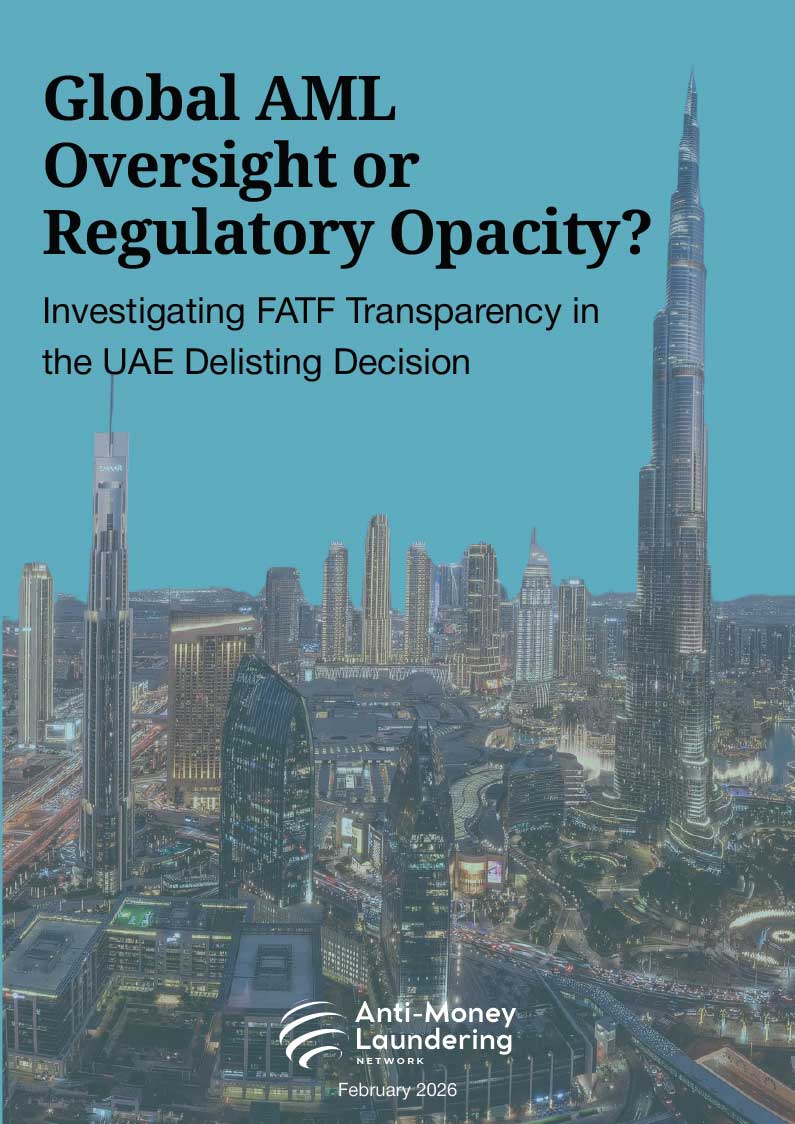
The report “Global AML Oversight or Regulatory Opacity? Investigating FATF Transparency in the UAE Delisting Decision” Investigating FATF Transparency in the UAE Delisting Decision,” published by the Anti Money Laundering Network (AML Network). It argues that the UAE did not “graduate” from high‑risk status; it succeeded in having its risk rebranded – and FATF became a willing accomplice in that rebranding.
A Whitewash in Paris
When FATF removed the UAE from its grey list in February 2024, it knowingly certified as “acceptable” a jurisdiction that remained central to Russian and Iranian sanctions evasion, conflict‑linked gold flows, and structurally opaque corporate vehicles. Rather than acting as a brake on illicit finance, the delisting decision functioned as a lubricant, easing the passage of suspect capital from Dubai and Abu Dhabi into the US, UK and EU financial systems.
The AML Network report makes a stark claim: FATF did not simply misjudge the UAE; it lowered the bar for a powerful, politically connected financial hub while maintaining a harsher standard for weaker jurisdictions. In doing so, it undermined its own methodology, ignored credible external red flags, and rewarded the UAE for legislative cosmetics rather than genuine enforcement.
UAE: High‑Risk Hub in Reformist Clothing
The UAE has spent the past decade building itself as a global money hub: a dense cluster of free zones, secrecy‑friendly corporate registries, gold markets and permissive real‑estate and crypto ecosystems. The report shows that even as FATF prepared to delist the country, that infrastructure continued to channel billions in illicit and sanctions‑busting flows.
- US sanctions repeatedly targeted UAE‑based entities for moving Iranian oil and helping Russia bypass export controls, with dozens of Emirati‑linked companies designated after 2024.
- UN reporting detailed Al‑Shabaab‑linked transfers routed through UAE‑licensed hawaladars and conflict‑zone gold funnelled into Dubai’s trade hubs.
- The UAE itself admitted in its 2025 National Risk Assessment that trade‑based money laundering, virtual assets and high‑risk sectors remained acute vulnerabilities.
Yet none of this blocked the political theatre of “whitelisting.” FATF’s decision gave the UAE exactly what it wanted: a global compliance badge to wave at banks, rating agencies and investors, while the underlying structures of opacity stayed largely intact. This is not reform – it is reputational arbitrage.
FATF’s Two‑Limb Test – And How It Was Broken
FATF’s own rules are clear: to leave the grey list, a country must (1) fix its technical deficiencies (laws, regulations, institutions) and (2) demonstrate that those changes work in practice – that prosecutions, confiscations, STRs and supervisory actions are actually reducing risk. Both limbs are mandatory; technical compliance alone is explicitly “insufficient” to justify delisting.
The AML Network report demonstrates how FATF chose to pretend otherwise in the UAE case:
- On technical compliance, the UAE ticked boxes quickly: Cabinet Decision No. 58 on beneficial ownership, a new AML/CFT Executive Office, FIU resourcing, and DNFBP frameworks.
- On effectiveness, the record was damning: no meaningful terrorist‑financing prosecutions for the Somalia corridor, negligible STRs from gold and other high‑risk DNFBPs, and BO data that remained self‑declared and unverified across 40+ registries.[
By FATF’s own effectiveness scale, the UAE’s performance on key Immediate Outcomes (3, 4, 9, 10, 11) remained “moderate” at best – below the threshold FATF itself says should sustain delisting. FATF knew this and delisted anyway. That is not a technical oversight; it is a conscious decision to relax the standard for a strategically important state.
A System Built for Opacity, Not Transparency
The report dissects the UAE’s structural design: a web of more than 40 free zones – DMCC, JAFZA, RAKEZ, DIFC, ADGM and others – that fragment responsibility and deliberately dilute accountability.
- Each free zone is a fiefdom, with its own registry, rules and compliance culture, all competing to attract incorporations and licence fees.
- Beneficial ownership filings are fragmented, largely self‑declared and not subject to robust central verification. No authority has an easy, real‑time picture of who ultimately owns and controls UAE legal persons and arrangements.
- Nominee directors, layered structures and the 25% disclosure threshold form a ready‑made toolbox for hiding control behind ostensibly compliant paperwork.
The result is what AML Network calls a “Transparency Vacuum” – not incidental, but structural. When FATF chose to treat this system as “largely compliant,” it effectively legitimised a model which offers cosmetic registers to regulators and full‑spectrum opacity to those with money and lawyers.
Real‑world enforcement examples reinforce the critique:
- An ADGM firm operated with serious AML failings for six years before a late‑stage settlement, exposing that supervisors either didn’t see or didn’t act on basic red flags.
- Dozens of DMCC‑connected gold refiners were sanctioned only in 2024 for 256 violations, long after the sector had been flagged internationally as a risk vector.
FATF’s delisting took place against this backdrop. It did not close the transparency vacuum; it certified it.
What FATF Chose Not to See
The most damning charge in the AML Network report is that FATF knowingly filtered out credible external evidence that contradicted the UAE’s self‑portrait.
Under its methodology, FATF’s assessors are obliged to incorporate serious indicators from UN bodies, G7 enforcement agencies and peer institutions. In the UAE case, the pile‑up of red flags was extraordinary
- UN Monitoring Group reports tying UAE‑licensed hawala operators to Al‑Shabaab’s financial architecture.
- The European Commission formally retained the UAE on its list of high‑risk third countries for AML/CFT at the very moment FATF was preparing to delist it.
- OFAC and, later, FinCEN documenting UAE‑based front companies at the heart of Iranian shadow‑banking and Russian sanctions evasion, with billions pushed through US correspondents.
- Independent metrics like the Basel AML Index showing no material risk improvement over the monitoring period.
FATF’s public delisting narrative mentions none of this. It selectively recites the UAE’s legislative and institutional achievements and points to raw numbers of STRs and fines, as if quantity equals effectiveness. It is hard to avoid the conclusion that the organisation treated external evidence as an embarrassment to be excluded, not a warning to be heeded.
This is not a small procedural flaw. When a global standard‑setter suppresses inconvenient data, it ceases to be a referee and starts behaving like a political stakeholder.
One Process, Two Standards
The AML Network report sharply contrasts the UAE’s rapid absolution with the long and painful pathways forced on countries like Panama and Turkey.
- Panama spent 54 months on the grey list, meeting 15 verified action items, building a prosecution track record and enduring intensive scrutiny before delisting – only then followed by EU de‑designation.
- Turkey remained under enhanced monitoring for around 33 months, required to undergo on‑site visits and show tangible progress on terrorism‑related enforcement despite geopolitical sensitivities.
The UAE, a wealthy petro‑hub aggressively marketing itself to global finance, was freed in just 23 months, without matching evidence of terrorist‑financing prosecutions or BO reliability, and in open contradiction to the EU’s high‑risk designation.
The message is clear and corrosive: if you are a smaller or poorer state, the standard bites; if you are a major financial entrepôt with powerful friends, the standard bends. That is how regimes lose legitimacy.
Governance and Lobbying: A Captured Watchdog?
The report is unusually direct in naming the FATF officials at the centre of the UAE decision – Elisa de Anda Madrazo, T. Raja Kumar, Violaine Clerc and Jeremy Weil – and in spelling out their obligations. It frames their roles not as neutral technicians but as fiduciaries for the integrity of the global AML system, with a duty to integrate negative indicators and to resist geopolitical and reputational pressure.
Against that duty, the record looks bleak. The omission of UN, EU and sanctions data from the UAE delisting justification is not plausibly accidental; the scale and visibility of those signals made them impossible to miss. It is more plausible that they were consciously deprioritised because acknowledging them would have made delisting politically impossible.
The report also pulls a curtain back on the UAE’s lobbying machine: multi‑million‑dollar contracts with global PR and advisory firms tasked with selling a narrative of “next‑generation regulation” and “embracing transparency” to Western policy circles. Paris, FATF’s host city, is described as a lobbying black hole – a place where foreign influence around international standard‑setting can flourish without the glare of FARA‑style disclosure.
FATF is not just operating in that environment; it is demonstrably vulnerable to it. When narrative management triumphs over risk evidence, the standard‑setter is no longer setting standards. It is providing cover.
A Corrupted Signal to Global Finance
FATF’s grey list and delisting decisions are supposed to be blunt, conservative instruments: slow to escalate, even slower to forgive, and stubbornly tied to actual risk reduction. The UAE case inverts that logic.
Once the UAE was “white‑listed,” global banks, funds and counterparties had a ready excuse to dial down scrutiny. Enhanced due diligence triggered purely by FATF status fell away; compliance teams faced internal pressure to “re‑normalise” the UAE. For Russian and Iranian networks, for conflict gold middlemen and kleptocrats, this was a gift: an officially sanctioned risk discount on a jurisdiction still riddled with vulnerabilities.
The AML Network report warns that this is not just about the UAE. It is a template. Other ambitious hubs can now see how to play the game: shower reforms onto paper, weaponise PR and lobbying, produce a burst of late‑stage fines, and push relentlessly for a fast exit from increased monitoring. FATF, by rewarding this behaviour once, has invited it elsewhere.
Some actors have already started to hedge against FATF’s drift. The Basel AML Index has deliberately stopped treating delisting as an automatic risk improvement. National authorities lean more heavily on sanctions designations and their own intelligence than on FATF’s public labels. When the standard‑setter’s signals have to be discounted, the standard‑setter has failed.
What Must Happen Next
AML Network’s report does not ask FATF politely to “do better.” It demands a reckoning:
- An independent governance audit of the February 2024 UAE decision, including who knew what, when, and why obvious external red flags were excluded from the official narrative.
- A targeted fifth‑round review of the UAE focused on Immediate Outcomes 3, 4, 9, 10 and 11, explicitly incorporating sanctions, UN and EU evidence.
- Full transparency around ICRG deliberations and evidentiary bases for delisting, subject only to tightly defined confidentiality needs.
- And if the real picture matches what this report documents: restoration of the UAE to enhanced monitoring until effectiveness, not just law‑making, is credibly demonstrated.
At the heart of “Global AML Oversight or Regulatory Opacity?” is a simple, uncompromising point: a standard applied selectively is no standard at all. In the UAE case, FATF has not just looked the other way; it has actively downgraded risk in defiance of the evidence. If that is allowed to stand, the world’s flagship AML body will have moved from guarding the gates of the financial system to decorating them.