

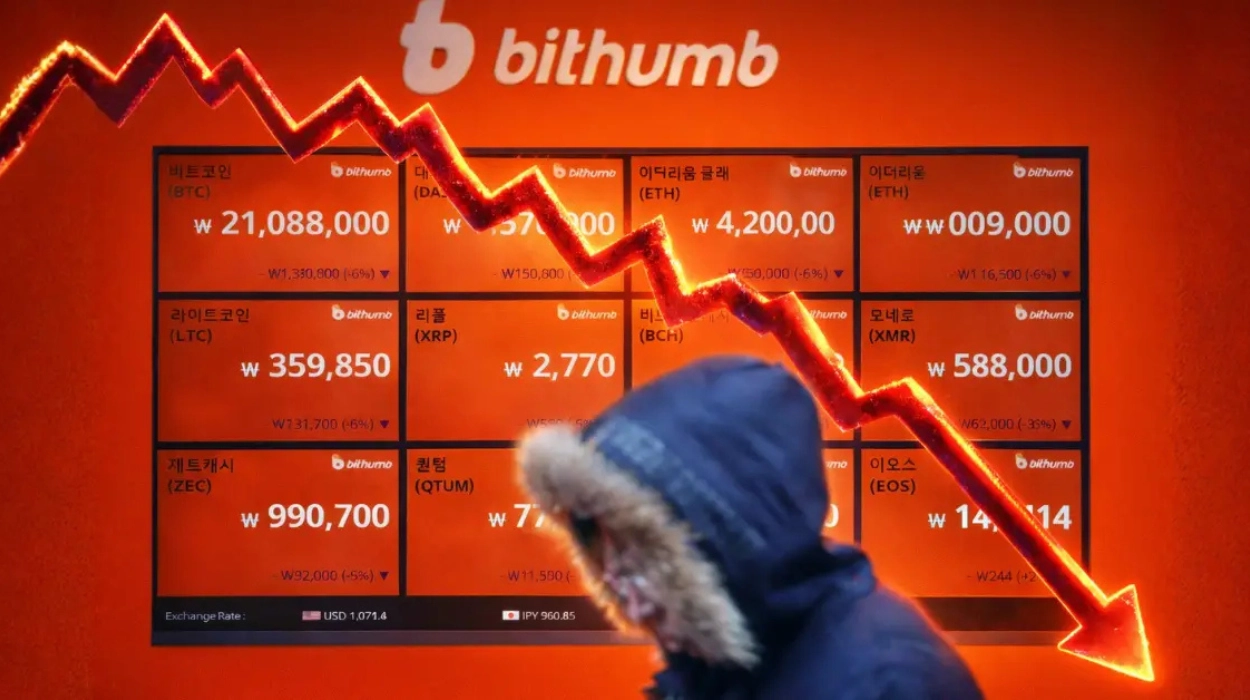
South Korea’s Financial Intelligence Unit (FIU), operating under the Financial Services Commission (FSC), identified multiple AML and Know Your Customer (KYC) deficiencies during its investigation of Bithumb. Key violations included transactions with overseas virtual asset service providers (VASPs) not registered in South Korea, breaching the Specific Financial Information Act. Authorities also flagged inadequate customer due diligence, such as insufficient identity verification and poor monitoring of suspicious transactions, creating vulnerabilities for money laundering.
Bithumb failed to enforce real-name account requirements linked to domestic banks, a mandatory standard for Korean exchanges to curb illicit flows. Regulators noted patterns of unreported high-value transfers and lax screening of potentially risky overseas operators. These lapses echo broader industry issues, as South Korea mandates VASPs to report transactions above certain thresholds and maintain robust AML frameworks aligned with global standards like those from the Financial Action Task Force (FATF).
Details of Proposed Sanctions
The FIU’s advance notice outlines a six-month partial suspension, restricting new user onboarding and virtual asset transfer services while allowing existing customers to continue trading. This targeted approach aims to minimize market disruption but signals severe repercussions for non-compliance. Bithumb’s CEO, identified as Lee Jae-won in some reports, faces a formal reprimand, with additional measures like dismissal of the compliance reporting officer.
Financial penalties are expected to reach tens of billions of Korean won, potentially 20-50 billion won (roughly $14.6-36.5 million USD), though exact figures await final disclosure. A sanctions review committee will convene later this month to deliberate adjustments, as Bithumb has indicated the preliminary measures could be refined. This follows a pattern of escalating enforcement, including a prior three-month suspension and 35 billion won fine against rival Upbit operator Dunamu in 2025 for similar AML failures.
Bithumb’s Response and Context
Bithumb acknowledged receipt of the FIU notice and pledged cooperation with the review process, emphasizing that operations for current users remain unaffected. The exchange recently faced a separate operational glitch, erroneously crediting 695 users with about 620,000 BTC before recovering 99.7% of funds and implementing safeguards—though this incident is unrelated to the AML probe. As South Korea’s second-largest exchange by volume, Bithumb handles significant market share, making the sanctions a focal point for the $100 billion-plus domestic crypto sector.
Industry observers note the timing amplifies pressure, with other exchanges like Coinone and GOPAX also under FIU scrutiny for compliance gaps. Bithumb’s woes highlight ongoing challenges in Korea’s “kimchi premium” market, where strict rules have driven consolidation among compliant platforms.
Broader Implications for Crypto Regulation
This action reinforces South Korea’s zero-tolerance stance on AML risks in virtual assets, especially post-2025 Virtual Asset User Protection Act enhancements. Regulators aim to align domestic VASPs with FATF “Travel Rule” requirements for cross-border transparency, amid global scrutiny of crypto’s role in illicit finance. For Bithumb, the suspension could erode user trust and trading volumes, potentially benefiting compliant rivals like Upbit despite its own past penalties.
Market reactions have been muted so far, with Bitcoin and altcoin prices stable, but prolonged uncertainty might trigger outflows. Analysts predict the FIU’s campaign will spur industry-wide upgrades in AI-driven transaction monitoring and KYC tech. Internationally, the case serves as a cautionary tale for exchanges navigating fragmented global AML regimes.
Historical Context of Enforcement
South Korea has pioneered crypto oversight since the 2018 “4.24 Measures,” mandating real-name trading and bank partnerships. Subsequent probes exposed systemic weaknesses, leading to delistings and fines totaling billions of won. Bithumb itself weathered hacks and leadership scandals but now confronts existential regulatory hurdles. The FIU’s focus on unregistered overseas dealings addresses evasion tactics like using foreign platforms to bypass local controls.
As President Trump’s U.S. administration in 2026 pushes crypto-friendly policies, contrasts with Asia’s rigor highlight divergent paths—Korea’s model prioritizes investor protection over innovation speed. Final sanctions could set precedents for 2027 enforcement waves.
Industry and Expert Reactions
Crypto analysts describe the penalties as “severe but proportionate,” praising the partial suspension for balancing deterrence with stability. Local media like News1 and Chosun Biz frame it as a watershed for accountability. Bithumb stakeholders urge procedural fairness, while compliance experts recommend immediate system overhauls.
This episode amplifies calls for unified ASEAN-Asia AML standards, given cross-border flows. For journalists tracking financial crime, it exemplifies enforcement evolution in high-stakes crypto hubs.