

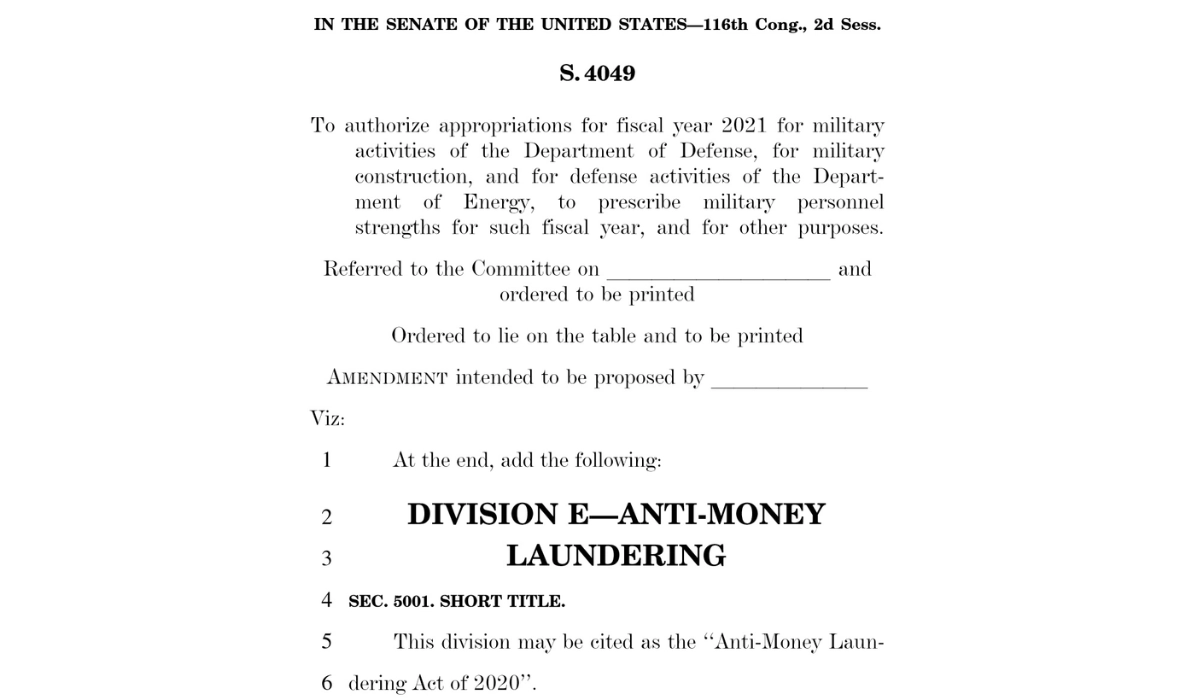
Banking industry leaders and trade groups are urging the U.S. Congress to rapidly pass a “critical” anti-money laundering (AML) reporting bill designed to modernize and streamline outdated Bank Secrecy Act (BSA) requirements. The legislation aims to revise longstanding AML reporting rules to enhance the effectiveness of financial crime detection while reducing burdensome and redundant compliance processes for banks. Leading banking associations, including the American Bankers Association (ABA) and state banking groups, emphasize that the bill will enable banks to better focus resources on high-risk threats like terrorism financing, transnational organized crime, and human trafficking.
Background and Urgency of AML Reform
The proposed AML reporting legislation comes amid ongoing concerns that current BSA regulations and reporting rules—some dating back over four decades—are out of alignment with today’s sophisticated money laundering and financial crime threats. Bankers stress that the existing thresholds and redundant reporting obligations dilute focus and resources needed to combat evolving illicit finance methods.
Barry Loudermilk (R-GA), a bill sponsor, supports raising BSA reporting thresholds as a necessary update to “outdated and redundant” frameworks that hamper risk-based, targeted AML efforts. The banking industry broadly supports this initiative as part of a broader reform agenda led by the Treasury Department, which seeks to simplify AML compliance while strengthening law enforcement’s ability to tackle complex criminal networks.
Core Components of the AML Reporting Bill
The legislation incorporates multiple important reforms aimed at recalibrating AML reporting to reflect current risks and technological capabilities:
- Increase Reporting Thresholds: The bill proposes raising the Currency Transaction Report (CTR) and Suspicious Activity Report (SAR) thresholds. This change is intended to reduce volume of low-risk reports, allowing banks to concentrate on genuinely suspicious transactions.
- Data Sharing and Analysis Enhancements: The bill requires the Financial Crimes Enforcement Network (FinCEN) to analyze SAR data and share threat typologies and emerging patterns with banks and regulators. This innovation would help banks update AML transaction monitoring algorithms with insights derived from government analysis.
- Review and Trim Redundant Rules: The legislation mandates Treasury to review and prune AML regulatory guidance and rules that are obsolete, duplicative, or impede effective crime fighting. This effort aims to modernize and align AML rules with international standards and best practices.
- Enhanced Examiner Training: New requirements call for specialized BSA/AML training for examiners to ensure compliance reviews are informed by expertise and context rather than procedural checklists.
- Foreign Bank Intelligence Access: The bill would empower law enforcement to subpoena records from foreign banks with correspondent accounts in the U.S., closing gaps in cross-border AML investigations.
Support from Banking and Trade Groups
The American Bankers Association and allied state banking groups have sent joint letters urging Congressional inclusion of the AML reform bill in broader legislative packages, noting its “critical provisions” for investigations into organized criminal activity and terrorism financing.
Jim Richards, former head of AML at Wells Fargo, highlighted the bill’s significance, calling it the “biggest revision to the U.S. AML/CFT regime since the USA PATRIOT Act of 2001.” He pointed to the bill’s potential for fostering innovation in AML programs, boosting information sharing, and addressing deep-rooted challenges like ownership transparency and financial de-risking.
Trade groups representing credit unions and consumer banks also emphasize the bill’s importance in helping prevent institutions from abandoning formal banking channels—a loss that would severely weaken intelligence capabilities for investigating illicit finance domestically and internationally.
Broader Context of AML Compliance Challenges
Bankers convey that AML compliance is critical not only for mitigating legal and reputational risks but also for ensuring a level playing field in the financial sector. Comprehensive and focused AML regimes foster fair competition and integrity in banking.
Failure to comply with AML laws such as the BSA, enforced by FinCEN, results in serious penalties including huge fines and sanctions. The BSA remains the cornerstone of AML compliance in the U.S., complemented by laws like the USA PATRIOT Act which enhance investigative powers against money laundering and terrorism financing.
Similarly, recent AML regulatory efforts globally emphasize beneficial ownership transparency, advanced cybersecurity safeguards, and data accuracy in customer due diligence to combat increasingly sophisticated laundering techniques.
Congressional and Regulatory Outlook
The push by bankers is occurring during a period of heightened regulatory enforcement actions and legislative activity around financial crime. Agencies like the Office of the Comptroller of the Currency (OCC) have recently announced enforcement actions related to AML and BSA violations, exemplifying continued regulatory rigor.
The AML reform bill is seen by the banking sector as a pivotal tool for updating America’s AML framework to meet 21st-century threats effectively. Proponents urge Congress to act swiftly to pass the bill to deliver on the demand for simpler, more targeted AML rules that nonetheless equip financial institutions and law enforcement to dismantle illicit financial networks.