

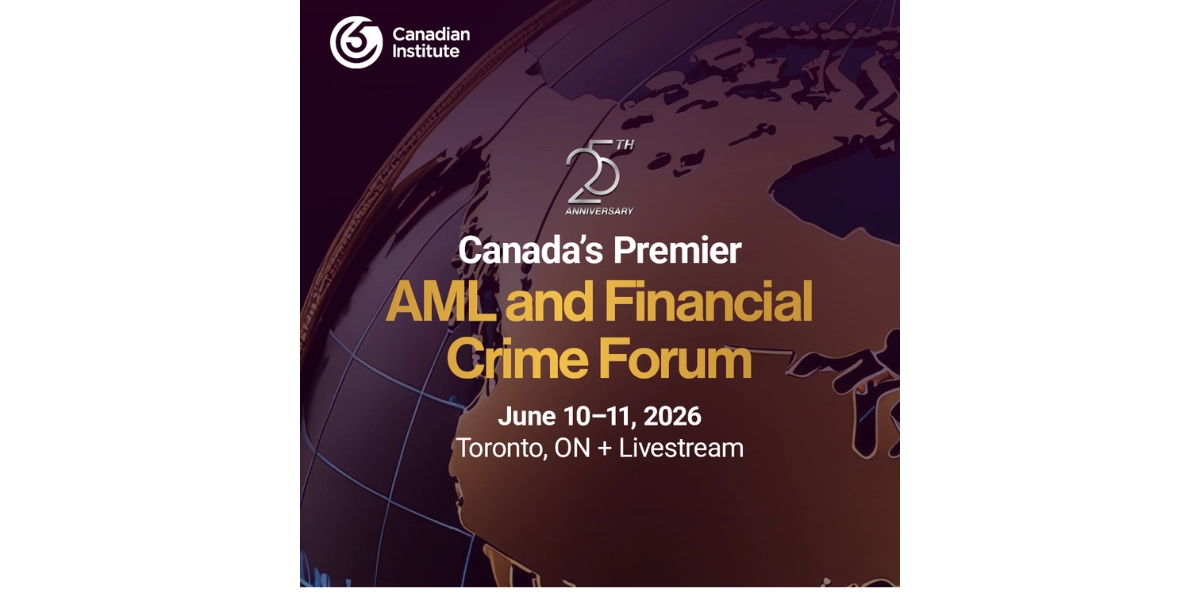
The Canadian Forum on Anti‑Money Laundering and Financial Crime will reconvene in Toronto on June 10–11, 2026, bringing together banking, fintech, legal, regulatory and law‑enforcement leaders to discuss evolving threats, enforcement, and compliance best practices. The two‑day event, organized by the Canadian Institute, will be held at One King West with an option to attend via livestream and aims to address heightened regulatory scrutiny, sector expansion under AML rules, and Canada’s preparations for international evaluation.
Event purpose and context
- The forum’s agenda is framed by a year of heightened enforcement and regulatory reform in Canada, including expanded FINTRAC scrutiny and the federal government’s recent legislative proposals to strengthen financial‑crime powers.
- Organizers say the forum is timely as Canadian reporting entities and regulators prepare for a forthcoming FATF assessment and respond to growing cross‑border and technology‑enabled threats.
Who will attend
- Delegates will include senior bank executives, compliance officers, fintech and crypto compliance specialists, lawyers, private sector risk managers, and public‑sector officials from FINTRAC and other enforcement bodies.
- Industry associations and service providers that support money services businesses (MSBs), mortgage and real‑estate sectors, and payment processors will also be present to discuss sector‑specific compliance challenges.
Key themes and panels
- Regulatory enforcement and penalties: Sessions will examine recent increases in regulatory actions and the implications of proposed changes to FINTRAC’s sanctioning powers, which industry observers say could raise penalty limits and introduce tiered fines based on size and severity.
- Preparing for FATF review: Speakers will discuss how Canada should align governance, risk‑assessment, and reporting frameworks ahead of its international evaluation to avoid reputational and operational consequences.
- Emerging risks: Panels will explore crypto and fintech risks, professional facilitator networks exploiting real‑estate and mortgage channels, and cross‑border money‑laundering typologies observed in recent enforcement cases.
- Practical compliance: Breakouts will cover practical steps for strengthening AML programs, preparing for FINTRAC examinations, transaction monitoring, suspicious‑activity reporting, and remediation following enforcement findings.
Notable developments informing discussions
- FINTRAC enforcement and penalties: Industry commentary and reporting indicate that FINTRAC has signalled plans to increase fines and update enforcement approaches in 2026, prompting firms to reassess controls and resource allocations.
- Bill C‑29 (Financial Crimes Agency Act): The federal government introduced Bill C‑29 to create a Financial Crimes Agency (FCA) tasked with investigating serious, complex financial crimes and assisting in proceeds recovery; delegates are expected to debate operational impact and cooperation with existing agencies if the bill advances.
- Sector expansion under AML obligations: Recent regulatory changes have broadened the sectors subject to AML/CTF obligations—now including mortgage lenders, brokers, leasing and certain payment providers—creating new compliance burdens and enforcement exposure.
Quotes and stakeholder views
- Event promotions and speaker announcements emphasize the forum’s role in delivering practical, operational guidance to reporting entities confronting increased scrutiny and complex typologies.
- Compliance professionals cited in event materials note that the forum provides an opportunity to engage directly with regulators and peers on realistic expectations for risk‑based programs and the operational challenges of compliance modernization.
Format, logistics and access
- The forum will run June 10–11, 2026 at the One King West Hotel in Toronto with livestream options for remote attendees, and offers registration packages targeted at financial‑sector practitioners, legal advisers, and compliance teams.
- Organizers have highlighted networking sessions, case study panels, and practical workshops as core components to support on‑the‑ground improvements to AML programs.
Practical implications for organizations
- Increased enforcement and potential higher fines mean institutions should prioritize governance, enhanced customer due diligence, transaction‑monitoring effectiveness, and timely suspicious‑transaction reporting to reduce regulatory and reputational risk.
- Firms in newly regulated sectors—mortgage, leasing, and certain payment services—will need to accelerate remediation programs, staff training, and third‑party oversight to meet evolving expectations.
Why this forum matters now
- With Canada pursuing legislative and regulatory strengthening of its AML framework and facing international scrutiny, the June forum is positioned as a focal point for policy interpretation, enforcement signals, and practical compliance guidance.
- The event’s cross‑sector attendance creates a platform for public‑private dialogue at a time when cooperation, information‑sharing, and harmonized approaches are being stressed as essential to counter sophisticated financial‑crime networks.
How to follow or register
- Interested attendees can register through the Canadian Institute’s event pages and select in‑person or livestream options; early registration and group rates are typically available through the organizer.
- Media and analysts covering regulatory reform and high‑profile enforcement actions are expected to attend sections of the forum where regulators and industry leaders present enforcement trends and policy updates.
Illustrative example
- A dedicated panel on mortgage and real‑estate exploitation will analyse recent cases where criminal networks used forged paperwork and professional facilitators to launder proceeds through property transactions—highlighting the need for tighter controls across brokers, law firms, and lenders.
For editors and compliance teams seeking guidance, the Canadian Forum offers both a policy lens on national reforms and actionable sessions on compliance operations, making it a timely convening for those tracking Canada’s AML enforcement trajectory.