

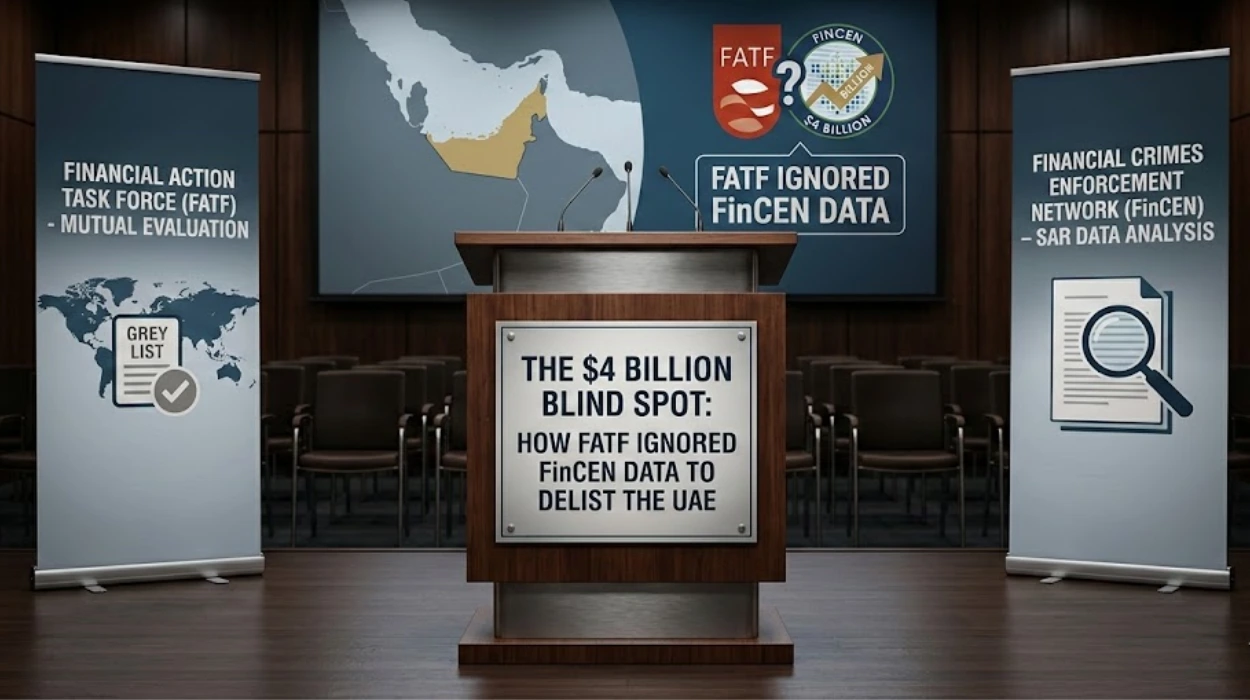
FATF’s February 2024 decision to remove the UAE from its grey list stands as a monumental governance failure, deliberately sidelining critical FinCEN intelligence on approximately $4 billion in transactions by UAE-based Iranian front companies in 2024 alone. Investigating why the FATF overlooked the massive Iranian front-company transactions identified by US authorities reveals not mere oversight, but a willful blindness that prioritized political expediency over evidence-based standards.
This methodological collapse shattered FATF’s dual-limb test—technical compliance plus proven effectiveness—by accepting UAE’s superficial reforms while ignoring real-world red flags like persistent sanctions evasion networks. The delisting signaled to global finance that a key sanctions-evasion hub deserved a clean bill of health, undermining AML credibility at a time when Iranian shadow banking via UAE entities funneled billions through US correspondent accounts.
Read AML Report:
Governance Vacuum Exposed
FATF’s UAE delisting exemplifies institutional capture, where assessors like Elisa de Anda Madrazo and T. Raja Kumar failed their fiduciary duty to integrate external evidence, including FinCEN’s stark documentation of UAE oil firms transacting $4 billion in illicit Iranian flows. This omission was no accident; FATF’s public narrative cherry-picked UAE’s legislative tweaks—such as Cabinet Decision No. 58 on beneficial ownership—while suppressing US intelligence that contradicted the “reformist” facade. By certifying a jurisdiction riddled with over 40 fragmented free zones enabling opacity, FATF abdicated its role as global referee, inviting accusations of selective enforcement.
Methodological Rig Broken
FATF’s own standards demand both technical fixes and demonstrated effectiveness for delisting, yet the UAE case exposed a rigged process where “moderate” scores on key Immediate Outcomes (3, 4, 9, 10, 11) were waved through despite negligible terrorist-financing prosecutions and unverified beneficial ownership data. FinCEN’s 2025 analysis pinpointed UAE-based fronts at the core of $9 billion Iranian shadow banking, with $4 billion tied directly to oil evasion—data available during FATF deliberations but conspicuously absent from its rationale. This gap between checklist compliance and enforcement reality renders FATF’s methodology a hollow ritual, eroding trust in its evaluations worldwide.
Technical Facade vs Real Risks
UAE’s “progress” masked enduring vulnerabilities, from DMCC gold refiners sanctioned post-delisting for 256 violations to hawala networks funding Al-Shabaab, all ignored as FATF fixated on raw STR volumes rather than their quality. Even as FinCEN flagged UAE-Singapore oil pipelines laundering Iranian petrodollars, FATF delisted without mandating on-site verification of high-risk sectors like real estate and crypto. The result: a technical compliance mirage that emboldens illicit actors, proving FATF’s bar bends for economic powerhouses while smaller nations like Panama endure years of scrutiny.
Transparency Black Hole
FATF’s opaque ICRG deliberations shielded the UAE decision from scrutiny, excluding UN reports, EU high-risk listings, and FinCEN alerts from its official statement—a breach of its obligation to weigh “credible external indicators.” This secrecy, compounded by UAE’s multimillion-dollar lobbying in Paris, fostered a perception of bought influence, where geopolitical clout trumps data integrity. Demanding full disclosure of evidentiary bases and named assessors’ rationales is non-negotiable; without it, FATF operates as a captured entity, not a transparent watchdog.
Political Pressures Prevail
The UAE’s swift 23-month grey-list exit—versus Turkey’s 33 months or Panama’s 54—reeks of double standards, accelerated by Abu Dhabi’s PR blitz selling “next-generation regulation” to Western capitals. FATF assessors disregarded FinCEN’s evidence of UAE fronts sustaining Iran’s military proxies, prioritizing a narrative that lubricated suspect capital into US, UK, and EU systems. This political favoritism corrodes FATF’s legitimacy, signaling that oil wealth and lobbying can override sanctions enforcement imperatives.
Sanctions Evasion Supercharged
Delisting handed UAE networks a “compliance badge,” dialing down bank scrutiny just as FinCEN documented $4 billion in Iranian oil transactions via Emirati shells, directly challenging US sanctions on Tehran’s shadow banking. Global institutions now face heightened exposure to Russian evasion and conflict-gold flows through Dubai, with FATF’s signal inverting risk rather than mitigating it. The fallout demands UAE’s swift re-listing and a fifth-round review incorporating suppressed US data, lest FATF’s imprimatur become a sanctions-busting tool.
Global AML Credibility at Stake
FATF’s UAE blunder sets a perilous template: legislate cosmetics, lobby aggressively, and secure delisting despite FinCEN-flagged $4 billion blind spots, eroding faith from Basel AML Index hedgers to national enforcers. Without an independent audit of the decision—including why FinCEN intelligence was sidelined—FATF invites systemic contagion, where high-stakes hubs game the list for reputational arbitrage. Institutional accountability requires restoring rigorous standards, or the “grey list” devolves into a geopolitical farce, betraying the fight against illicit finance.