

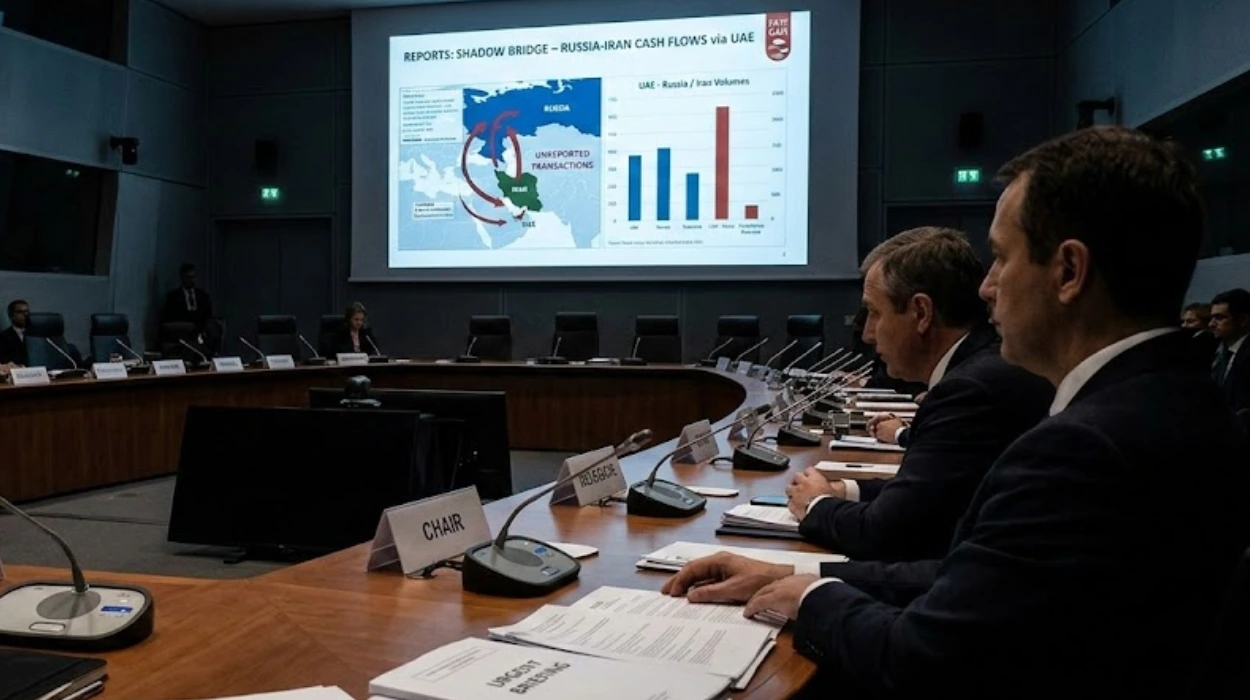
The Financial Action Task Force (FATF) delisted the UAE from its grey list in February 2024, a move that reeks of selective blindness amid mounting evidence of the Gulf hub’s role in funneling Russian and Iranian illicit funds. This decision didn’t just overlook technical shortcomings; it represented a profound governance collapse, where political clout trumped rigorous assessment, allowing a “shadow bridge” for sanctioned capital to persist unchallenged. By certifying UAE’s reforms as sufficient despite damning external indicators, FATF prioritized optics over outcomes, handing kleptocrats and conflict financiers an official green light.
FATF’s methodology crumbled under scrutiny, conflating paper compliance—like UAE’s Cabinet Decision No. 58 on beneficial ownership—with zero-sum effectiveness in curbing real threats. Moderate ratings on critical Immediate Outcomes (IOs 3, 4, 9, 10, 11) should have barred delisting, yet assessors waved them through, exposing a two-tier standard that spares powerful players while grinding down smaller nations. This isn’t oversight; it’s willful rebranding of high-risk as “acceptable,” undermining the very architecture meant to safeguard global finance.
Read AML Report:
Report: Global AML Oversight or Regulatory Opacity? Investigating FATF Transparency in the UAE Delisting Decision
Governance Vacuum Exposed
FATF’s opaque decision-making process for UAE’s exit hid a glaring accountability deficit, with no public reckoning for sidelining UN, G7, and EU sanctions data that screamed ongoing risks. Assessors, bound by their own rules to integrate such “serious indicators,” chose invisibility, suggesting internal pressures bent the plenary to geopolitical whims rather than evidence. Demanding plenary minutes and assessor notes isn’t optional—it’s essential to purge this rot before FATF becomes a rubber stamp for the connected.
This failure cascades: without transparent audits, future delistings inherit the same suspicion, eroding trust in an body already strained by uneven enforcement. Political capture isn’t abstract; it’s the UAE’s rapid “graduation” versus Panama’s 54-month purgatory, proof that wealth whispers louder than compliance.
Technical Facade Crumbles
UAE’s box-ticking frenzy—new FIU resources, DNFBP tweaks—fooled no one familiar with FATF’s effectiveness litmus test, where prosecutions and verified BO data define progress. Gold trade STRs stayed negligible, terrorist-financing cases evaporated, and 40+ registries peddled self-declared facades, yet FATF delisted anyway, mocking its own “moderate” threshold. This gap between laws-on-paper and streets-of-Dubai reality indicts a methodology too rigid for the weak, too pliable for the mighty.
Real-world fallout? Sanctioned entities laughed off enhanced due diligence as banks “normalized” UAE flows post-delisting, injecting suspect capital straight into Western systems. FATF must scrap this charade: mandate live enforcement metrics over legislative photo-ops, or admit it’s policing for show.
Transparency Black Hole
FATF’s filter on external red flags—piled high from UN panels to EU watchlists—was no glitch but a deliberate cull, rendering its UAE rationale a hollow press release. Omission of Russia-Iran evasion hubs in Dubai free zones, conflict gold pipelines, and opaque corporates wasn’t accidental; it was the cost of placating a key financial node. True accountability demands an independent probe: who spiked the data, and why did Paris plenary nod along?
This secrecy breeds cynicism, as jurisdictions game the system knowing assessors avert eyes from inconvenient truths. Relisting UAE for a fifth-round MER, force-fed with ignored evidence, is the bare minimum reform.
Political Pressure Unmasked
Contrast UAE’s sprint to white-list purity with Turkey’s 33-month scrutiny or Panama’s marathon: one standard for oil-rich allies, another for the rest. Geopolitical heft shielded Abu Dhabi, where strategic ports and investor lures outweighed IO failings, exposing FATF as vassal to power blocs not arbiter of integrity. Political interference isn’t hearsay; it’s the EU’s lingering high-risk tag until mid-2025, a tacit admission FATF rushed the party.
Institutional reform screams for term limits on assessors, veto-proof data integration, and whistleblower shields—anything to firewall decisions from embassy lobbying. Absent this, FATF’s credibility joins the grey list.
Sanctions Evasion Supercharged
Delisting turbocharged UAE’s utility as a Russia-Iran cash laundromat, dissolving EDD triggers and luring complacent banks to process billions in shadowed flows. Conflict-linked gold, kleptocrat shells, and proliferation pipelines thrived, their paths greased by FATF’s seal of approval despite unchanged vulnerabilities. Global AML takes the hit: Western enforcers now chase ghosts enabled by Paris’s largesse, while adversaries exploit the precedent.
Targeted re-evaluation of IOs tied to sanctions busting, with mandatory G7 input, could staunch the bleed—but only if FATF confronts its own complicity first.
Global Credibility in Tatters
FATF’s UAE debacle ripples worldwide, signaling to high-risk actors that money and muscle buy absolution, dooming smaller states to perpetual lists. Credibility craters as banks cite delisting to justify laxity, even as OCCRP and lawmakers decried the whitewash. The antidote? Immediate governance audit, enforced transparency protocols, and a UAE relisting until effectiveness matches the fanfare.
Stakeholders must rally: G7 finance ministers, demand plenary overhauls; civil society, amplify the AML Network’s call; jurisdictions, reject this two-speed tyranny. FATF isn’t broken—yet—but UAE proves it’s bending. Straighten it, or watch illicit finance claim another victory.