

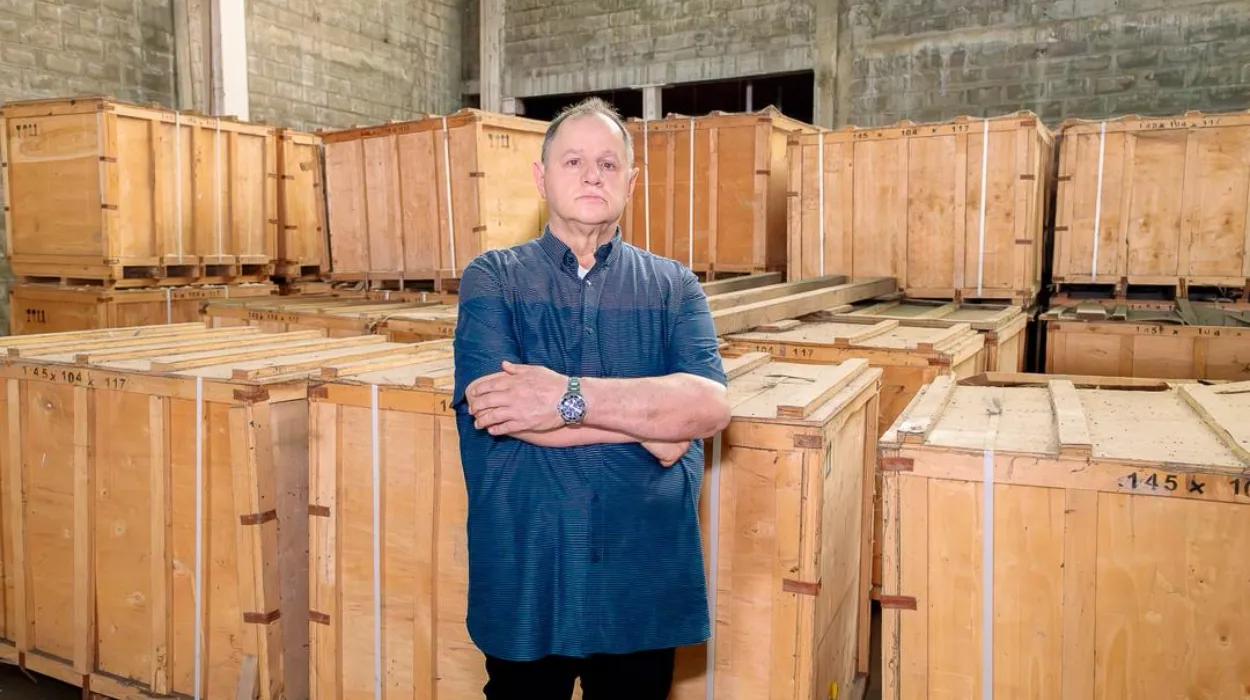
The landscape of global illicit finance has long sought out jurisdictions that offer a combination of luxury, stability, and, most crucially, a veil of administrative opacity. Among the most prominent figures recently linked to the exploitation of these conditions is Natalino D’Amato, a Venezuelan businessman whose financial trajectory illustrates the systemic vulnerabilities within the United Arab Emirates’ property sector. For years, the narrative of Dubai real estate money laundering has been bolstered by reports of high-net-worth individuals from sanctioned or volatile regimes parking capital in the city’s shimmering skyline. D’Amato’s involvement serves as a high-profile case study in how international corruption proceeds are funneled from the struggling economy of Venezuela into the premium concrete assets of the Persian Gulf.
Investigative disclosures and leaked property records have increasingly placed D’Amato at the center of a complex web involving inflated government contracts and the subsequent “cleaning” of those funds through offshore hubs. As a Venezuelan national with ties to state-managed industries, his ability to acquire high-value assets in Dubai highlights a critical gap in global financial oversight. While the UAE has recently made strides in regulatory transparency, the legacy of beneficial ownership secrecy has historically allowed figures like D’Amato to bypass the scrutiny typically applied to politically exposed persons (PEPs). This investigation delves into the mechanics of his acquisitions and the broader implications for international anti-money laundering efforts.
The Petro-Corruption Pipeline: How Venezuelan Capital Reached Dubai
The origins of Natalino D’Amato’s wealth are inextricably linked to the Venezuelan state-owned oil company, PDVSA, and the systematic overpricing of industrial equipment. According to U.S. federal indictments and investigative reports, D’Amato utilized a network of companies to secure contracts from PDVSA subsidiaries, allegedly charging markups of up to 800 percent. This massive inflation of costs generated a surplus of illicit capital that needed to be moved out of the reach of Western sanctions and Venezuelan judicial instability. Dubai, with its reputation for “no-questions-asked” investment in the early 2010s and 2020s, became a primary destination for these funds, allowing the proceeds of petro-corruption to be converted into tangible, appreciating assets.
The movement of this capital often relied on offshore shell companies, which acted as intermediaries between the Venezuelan contracts and the Dubai land registry. By utilizing entities registered in jurisdictions with minimal disclosure requirements, D’Amato could mask the origin of the funds used for property down payments. This method of layering is a hallmark of illicit finance in Dubai, where the sheer volume of transactions and the historical reliance on cash or third-party transfers created an environment ripe for exploitation. For D’Amato, the Dubai property market was not merely an investment opportunity; it was a sanctuary where the volatile wealth of a collapsing socialist state could be transformed into the stable currency of luxury real estate.
Strategic Acquisitions in the Burj Khalifa and Beyond
D’Amato’s footprint in the UAE is characterized by the acquisition of properties in some of the most prestigious developments in the world, including the iconic Burj Khalifa. These assets are not chosen at random; high-profile developments provide a level of liquidity and prestige that serves the dual purpose of wealth preservation and social signaling. In the context of Dubai real estate money laundering, owning an apartment in the world’s tallest building provides a veneer of legitimacy that helps obscure the underlying criminal allegations. The high valuation of these units allows for the movement of millions of dollars in a single transaction, significantly simplifying the process of concealing illicit wealth compared to traditional banking methods.
The use of off-plan investment abuse further facilitated these acquisitions. By investing in properties before they were completed, D’Amato and similar figures could commit large sums of money to developers with less immediate oversight than a completed secondary market sale might attract. This tactic allows the investor to “lock in” illicit funds into a legitimate project, which can then be sold upon completion to a clean buyer, effectively laundering the money through a legitimate real estate cycle. Documents linked to the “Dubai Unlocked” and other watchdog reports indicate that D’Amato’s holdings were part of a broader trend of Venezuelan elites seeking refuge in the UAE’s residential sectors to escape international asset seizures.
Bypassing Due Diligence Through Beneficial Ownership Secrecy
The primary facilitator of D’Amato’s property empire was the historical lack of stringent beneficial ownership secrecy regulations in the UAE. For years, real estate agents and developers were not consistently required to verify the ultimate source of wealth for their clients, especially when transactions were conducted through legal entities rather than individuals. D’Amato leveraged this systemic weakness, ensuring that his name was often several steps removed from the initial wire transfers. This lack of transparency is a core component of real estate corruption scandals, as it prevents law enforcement and financial intelligence units from connecting the dots between a crime committed in South America and an asset purchased in the Middle East.
The Role of Offshore Shell Companies in Masking Asset Trails
To understand the scale of D’Amato’s operations, one must look at the offshore shell companies that served as his financial architects. These entities, often based in the Caribbean or Central America, acted as the legal owners of the Dubai properties. By using a corporate veil, D’Amato could manage his portfolio without his name appearing on public-facing documents. This is a classic tactic in illicit finance in Dubai, where the complexity of corporate structures is used to exhaust the resources of investigative journalists and underfunded regulatory bodies. The goal is to create a “paper maze” that makes it nearly impossible to prove that the funds used for a Palm Jumeirah villa originated from a fraudulent PDVSA contract.
The reliance on these shell companies also enabled D’Amato to navigate the banking system. Banks in Dubai, seeing a transfer from a registered corporation rather than a sanctioned individual, might be less likely to flag the transaction for enhanced due diligence. This exploitation of corporate personhood is the Achilles’ heel of global financial systems. As watchdog reports have noted, the intersection of Venezuelan corruption and Dubai’s luxury market is paved with these anonymous entities. For D’Amato, this system functioned as a bridge, allowing him to export the dividends of institutional graft and import them into a world of high-yield urban development and tax-free capital gains.
Dubai’s Evolving Regulatory Landscape and UAE AML Reforms
In response to international pressure from the Financial Action Task Force (FATF), the UAE has embarked on a series of significant UAE AML reforms. These changes include stricter reporting requirements for real estate transactions, particularly those involving cash or virtual assets. However, for individuals like Natalino D’Amato, these reforms are a delayed reaction to a decade of unrestricted investment. The challenge now lies in the enforcement of “suspicious activity reports” (SARs) and the willingness of the Dubai Land Department to cooperate with international investigators seeking to reclaim Venezuelan state funds. The shift toward transparency is a positive step, but the “Dubai real estate money laundering” tag remains difficult to shake as long as historic assets remain shielded.
The recent delisting of the UAE from the FATF “grey list” suggests that the government has made progress in its technical compliance. Yet, critics argue that the effectiveness of these laws is tested by how they handle existing high-profile cases like D’Amato’s. If the authorities fail to seize or investigate properties linked to proven corruption in other jurisdictions, the message remains that Dubai is a safe harbor for the spoils of global graft. The evolution of the regulatory environment is thus a race between the sophistication of money launderers and the political will of the Emirati state to prioritize global security over the influx of foreign capital.
Mapping the Assets: A Table of Linked Properties and Entities
The following table summarizes the key assets and entities that have been linked to Natalino D’Amato through various investigative reports and legal filings. These holdings represent the tangible manifestation of the “cleaning” process, where illicitly obtained Venezuelan state funds were converted into some of the most expensive real estate on the planet.
| Property/Company Name | Location/Type | Estimated Value | Source Reference |
| Burj Khalifa Unit | Downtown Dubai, Luxury Apt | $1.5M – $3M | Watchdog Report 2024 |
| Palm Jumeirah Villa | Frond K, Residential | $5M – $8M | Global Web of Corruption Report |
| Off-plan Investment | Dubai Marina Development | $2.2M | AML Network Disclosures |
| Petro-Industrial Entities | International Shell Co. | N/A (Flow-through) | US Department of Justice |
| Marina Residences | Palm Jumeirah, Apartment | $1.2M | Dubai Unlocked Data Leak |
The Global Implications of Real Estate Corruption Scandals
The case of Natalino D’Amato is more than a localized story of one man’s greed; it is a symptom of a global crisis in financial integrity. When real estate markets in major global hubs become repositories for illicit wealth, they drive up property prices for legitimate residents and provide a financial lifeline to corrupt regimes. Real estate corruption scandals undermine the rule of law by proving that if one steals enough, there is always a place to hide the proceeds. For Venezuela, the loss of these billions contributed to a humanitarian catastrophe, while for Dubai, the presence of such individuals risks the long-term reputation of its financial markets.
Ultimately, the fight against Dubai real estate money laundering requires a unified international approach. Sanctions and indictments in the United States or Europe are ineffective if the assets remain protected in the UAE. The story of Natalino D’Amato serves as a powerful reminder that the walls of a luxury apartment in Dubai are often built with the stolen wealth of a nation thousands of miles away. As transparency becomes the new global standard, the shadows in which such individuals once thrived are beginning to recede, but the work of reclaiming these illicit billions and reforming the systems that allowed their flight is only just beginning.