

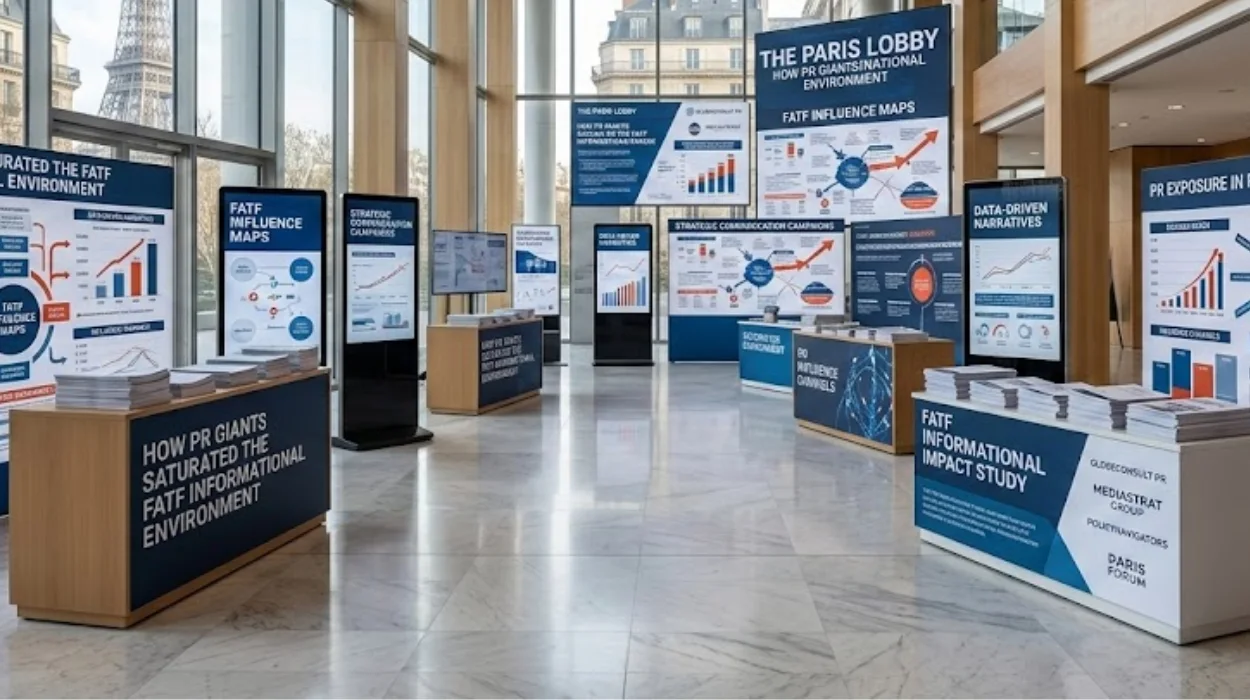
The Financial Action Task Force (FATF)’s February 2024 decision to delist the UAE from its grey list stands as a stark emblem of institutional capture, where glossy PR campaigns orchestrated by Edelman, APCO Worldwide, and FTI Consulting drowned out evidence of persistent money laundering risks. These firms, hired by UAE state entities, methodically shaped a “reform narrative” that portrayed Dubai and Abu Dhabi as AML paragons, blinding FATF assessors to structural opacities and sanctions evasion hubs just months before the Paris Plenary.
This was no organic policy shift but a governance failure engineered through informational asymmetry, as lobbyists saturated think tanks, media, and diplomatic channels with curated success stories, sidelining UN reports, EU high-risk listings, and US sanctions data. FATF’s acquiescence reveals a methodological collapse: technical checklists trumped real-world effectiveness, eroding the body’s credibility and inviting geopolitical pressure to override due diligence.
Read AML Report:
PR Saturation Tactics
Edelman, the world’s largest PR firm, spearheaded UAE’s reputational overhaul with multimillion-dollar contracts, coordinating op-eds, elite meetings, and narrative placements that recast oil-fueled opacity as “next-generation regulation” ahead of the 2024 FATF Plenary. APCO Worldwide complemented this by embedding UAE officials in US climate and policy circles, leveraging tobacco-industry-honed tactics to inoculate against criticism while promoting Masdar City as a greenwashing facade for unchecked financial flows.
FTI Consulting amplified the echo chamber, positioning UAE AML tweaks as national security triumphs in advisory reports that FATF plausibly encountered during assessments. This triad’s pre-Plenary blitz—op-eds in Western media, influencer briefings, and Paris-based schmoozing—created an artificial consensus of compliance, exposing how unregulated lobbying warps supranational decision-making without disclosure mandates.
FATF’s Methodological Breakdown
FATF’s dual-limb test demands both technical fixes and proven effectiveness for delisting, yet the UAE case prioritized the former while fabricating the latter through inflated STR metrics and unverified prosecutions. Assessors like T. Raja Kumar and Elisa de Anda Madrazo ignored Basel AML Index stagnation and OFAC designations of UAE entities for Russian sanctions busting, opting instead for PR-fed anecdotes over granular enforcement data.
This selective blindness constitutes a deliberate governance lapse, as FATF’s ICRG filtered out contradictory evidence from UN panels and the European Commission, which retained UAE on its high-risk list concurrent with delisting. By certifying fragmented free-zone registries—over 40 opacity silos with self-declared BO data—as “compliant,” FATF abdicated its methodological rigor, rewarding legislative theater over risk mitigation.
Transparency Black Hole
Paris, FATF’s host, operates as a lobbying abyss devoid of FARA-equivalent rules, enabling UAE retainers to flood plenaries with untraceable influence without public ledgers or conflict disclosures. The absence of ICRG minutes or delisting dossiers fosters accountability voids, where named officials face no fiduciary scrutiny for prioritizing narrative over evidence.
This opacity isn’t accidental; it’s structural, shielding political pressures from jurisdictions like the UAE that blend petro-wealth with diplomatic heft. Demanding verbatim transcripts and third-party audits is non-negotiable to reclaim FATF’s mandate from lobbyist strangleholds.
Effectiveness vs. Compliance Facade
UAE’s delisting hinged on box-ticking—Cabinet Decision 58 on BO, FIU boosts—while effectiveness cratered: negligible TF prosecutions, DNFBP STR droughts, and gold trade sanctions persisting post-2024. PR giants masked this by hyping raw fine volumes, duping FATF into equating quantity with quality despite its own “moderate” IO ratings signaling delisting disqualification.
Real-world fallout? Banks normalized UAE exposure, greasing illicit pipelines the EU and US still flag as high-risk. This gap undermines FATF’s Immediate Outcomes framework, demanding re-listing until verified dismantlement of hawala-gold-crime nexuses proves sustained impact.
Political Capture Exposed
Wealthy hubs like UAE exploit double standards—23 months to delist versus Panama’s 54—via PR-fueled exceptionalism, bending FATF for strategic allies while smaller states languish. Edelman and APCO’s UAE playbook, honed on COP28 whitewashing, now templates global arbitrage: lobby hard, legislate lightly, exit grey lists prematurely.
FATF’s vulnerability to this “Paris Lobby” erodes legitimacy, as peers discount its signals amid hedging by Basel and national enforcers. Institutional reforms—lobby registries, veto-proof evidence protocols—must supplant captured complacency.
Sanctions and Credibility Perils
Delisting legitimized UAE as a sanctions-evasion conduit, with post-2024 OFAC hits on Emirati fronts for Iranian oil and Russian controls underscoring FATF’s risk miscalibration. Global finance’s over-reliance on grey-list signals now invites blowback: diluted TFS, empowered kleptocrats, and fractured AML alliances.