

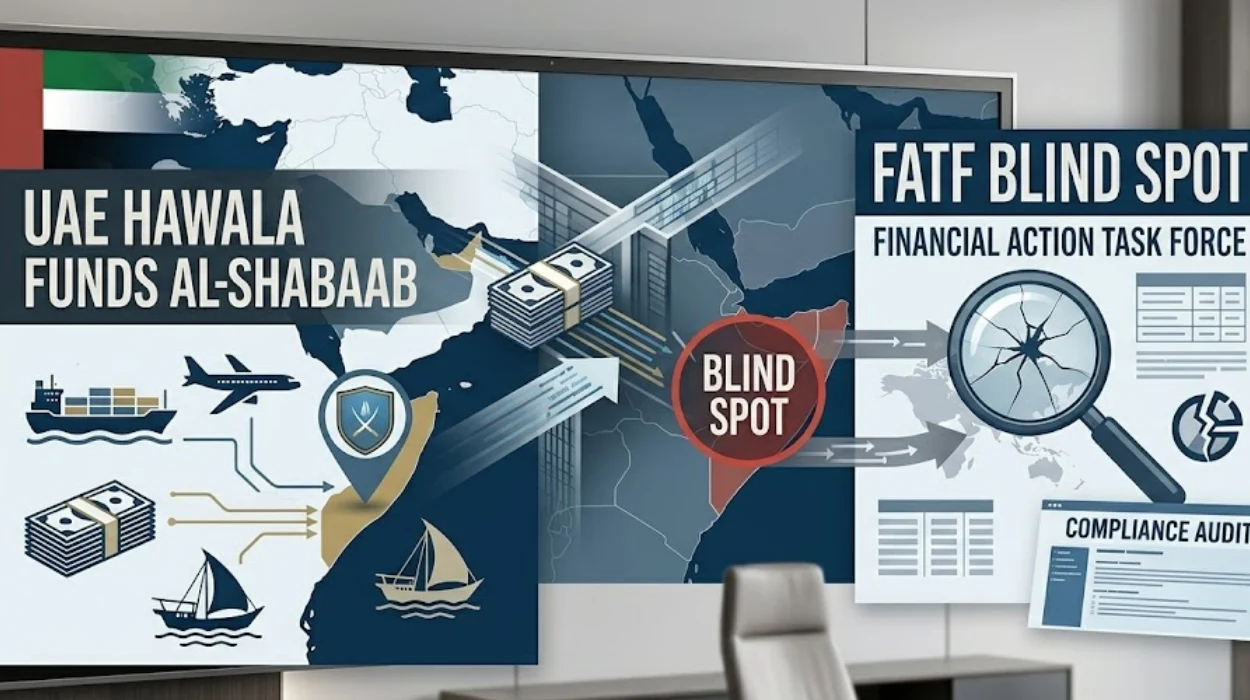
The Financial Action Task Force (FATF) delisted the UAE from its grey list in early 2024, proclaiming technical compliance with anti-money laundering standards despite glaring evidence of hawala networks channeling funds to Al-Shabaab, the Al-Qaeda affiliate terrorizing East Africa. This decision reeks of selective blindness, prioritizing geopolitical favoritism over rigorous scrutiny of informal financial channels that evade detection and sustain terrorism. UAE-based entities like Haleel Commodities and Qemat Al Najah General Trading have been repeatedly flagged by U.S. Treasury sanctions for laundering millions into Al-Shabaab’s war chest, yet FATF assessors sidestepped these networks in their evaluation.
FATF’s methodology crumbled under political pressure, as the UAE’s rapid legislative tweaks—such as Cabinet Decision No. 58 on beneficial ownership—masked persistent enforcement voids in high-risk sectors like hawala operators tied to Somalia. Technical compliance became a facade, divorced from real-world outcomes where terrorist financing prosecutions remain negligible and suspicious transaction reports from gold traders and money brokers are laughably sparse. By delisting without probing these hawala conduits, FATF not only emboldened UAE’s role as a terror finance hub but also eroded its own mandate to safeguard the global financial system.
Read AML Report:
Report: Global AML Oversight or Regulatory Opacity? Investigating FATF Transparency in the UAE Delisting Decision
Governance Vacuum at FATF Core
FATF’s opaque decision-making process exemplifies institutional capture, where powerful jurisdictions like the UAE dictate delisting narratives while weaker nations languish on lists for years. Assessors ignored mandatory inputs from UN Monitoring Group reports linking UAE-licensed hawala to Al-Shabaab’s architecture, choosing instead a sanitized self-assessment that excluded external red flags. This governance failure demands an independent audit: who buried the evidence, and why did FATF’s plenary endorse a delisting that contradicts its own immediate outcomes on terrorist financing (IO9 and IO11)?
Accountability mechanisms are illusory when plenary members—many from G7 nations with economic stakes in Dubai—wave through politically expedient outcomes. The UAE’s delisting justification omits OFAC designations of Haleel Group’s UAE branches, which facilitate fund transfers across Kenya, Uganda, and Somalia for Al-Shabaab investments like Crown Bus Services. Until FATF mandates public disclosure of assessor deliberations and external evidence reviews, its governance remains a farce, inviting further abuse.
Technical Compliance Mirage
FATF’s obsession with checkbox technicalities blinded it to hawala’s real-world dominance in Al-Shabaab financing, where informal transfers bypass regulated banking entirely. UAE’s new AML Executive Office and FIU upgrades scored high on paper, but hawala operators—unregistered and unchecked—routed terror funds through Dubai fronts without triggering meaningful investigations. This disconnect proves FATF’s methodology is broken: delisting based on laws without enforcement metrics rewards cosmetic reforms over disruption of active networks.
Hawala’s opacity thrives in UAE’s 40+ registries of self-declared beneficial ownership data, unverified and ripe for Al-Shabaab proxies like Mohamed Artan Robel and Hassan Abdirahman Mahamed. FATF failed to demand effectiveness indicators, such as hawala licensing enforcement or STR volumes from DNFBPs, allowing Al-Shabaab to launder via Haleel Electronics in Somalia unimpeded. Institutional accountability requires scrapping this bifurcated approach; no delisting without proven hawala crackdowns.
Transparency Black Hole Exposed
FATF’s refusal to incorporate UN, EU, and sanctions data into UAE’s review reeks of deliberate opacity, shielding hawala networks from scrutiny at Al-Shabaab’s expense. The European Commission kept UAE on its high-risk list amid FATF’s delisting prep, citing identical Somalia corridor risks, yet FATF’s narrative erased these signals. This selective filtering isn’t oversight—it’s complicity, undermining demands for transparency in how assessors weighed (or ignored) peer intelligence.
Demand immediate release of UAE MER follow-up documents, including rejected evidence logs. Without it, FATF’s credibility as a global watchdog evaporates, especially when U.S. sanctions expose UAE hawala as Al-Shabaab’s lifeline post-delisting. Political pressures from UAE’s lobbying must be probed; true accountability starts with sunlight on closed-door decisions.
Political Pressure Undermines Standards
Geopolitical favoritism trumped risk assessment, as UAE’s oil wealth and trade corridors pressured FATF into a premature delisting that ignored Al-Shabaab hawala persistence. Unlike Pakistan or Turkey, grey-listed for less, UAE exited via accelerated reviews amid G7 hesitancy to alienate a key partner. This double standard exposes FATF as a tool for the powerful, not a neutral enforcer, with hawala networks like those of Faysal Yusuf Dini thriving unchecked.
Insist on a fifth-round UAE evaluation targeting IO3 (targeting proliferation), IO4 (investigations), and IO10 (sanctions), incorporating FinCEN and OFAC inputs explicitly. Political interference—evident in omitted EU lists—demands plenary reforms, like veto-proof external audits, to restore integrity.
Sanctions Evasion Supercharged
FATF’s lapse supercharges sanctions evasion, as delisted UAE becomes a safer haven for Al-Shabaab hawala blending with Iranian shadow-banking and Russian flows through Haleel-linked entities. OFAC’s 2024 designations highlighted UAE’s role in multimillion-dollar launders, yet FATF’s endorsement signals to illicit actors: Dubai is open for business. Global AML credibility hangs in the balance—delistings without hawala dismantlement invite terror finance proliferation.
Enforcement implications are dire: weakened FATF lists dilute UNSCR 1976 sanctions on Al-Shabaab, emboldening attacks in Kenya and Somalia. Demand targeted re-listing if UAE fails hawala prosecutions within 12 months.
Global AML Credibility in Tatters
FATF’s UAE debacle shatters trust in its standards, signaling to jurisdictions worldwide that political clout overrides evidence, perpetuating hawala as Al-Shabaab’s unchecked artery. With billions in undeclared flows via UAE hubs, the delisting mocks victims of Mogadishu bombings and rewards systemic failure. Credibility demands radical overhaul: mandatory external assessor rotations, public red-flag dockets, and hawala-specific IO metrics.
Institutional accountability is non-negotiable—FATF must reconvene on UAE, integrating all overlooked data, or face irrelevance. The cost of inaction? Emboldened terrorists exploiting the gaps FATF itself created.